We rebuilt the leaderboard after three rounds for every men's major since 2000 from the round-by-round scores in the PGA Tour's past results: the Masters, the PGA Championship, the U.S. Open and The Open, 107 tournaments in all, with no Open in 2020, when the R&A cancelled it. For each one we recorded who led after 54 holes, by how much, and where the eventual champion stood with 18 holes to play.
How often the 54-hole leader wins a major
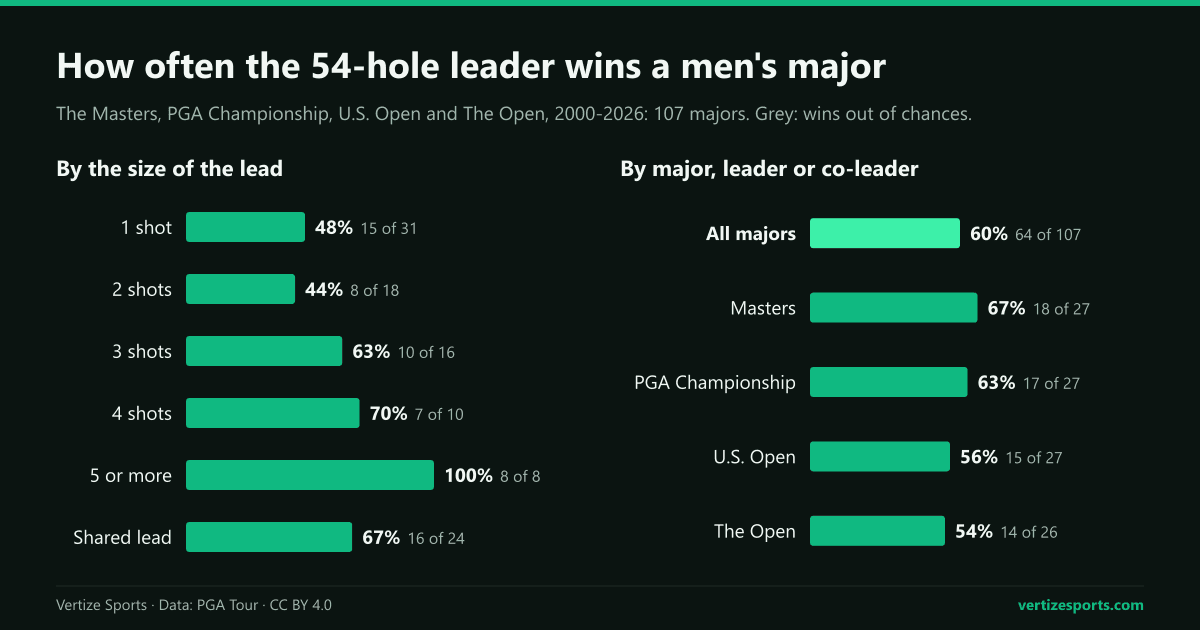
An outright 54-hole leader won 48 of 83 times, 58 percent. When the lead was shared, one of the co-leaders won 16 of 24 times, 67 percent, but those 24 majors had 57 co-leaders between them, and only 16 of them won, 28 percent. Together, the leader or a co-leader won 64 of the 107 majors, and a player from behind won the other 43.
| After 54 holes | Majors | Leader won | Share |
|---|---|---|---|
| Led by 1 shot | 31 | 15 | 48% |
| Led by 2 shots | 18 | 8 | 44% |
| Led by 3 shots | 16 | 10 | 63% |
| Led by 4 shots | 10 | 7 | 70% |
| Led by 5 or more | 8 | 8 | 100% |
| Any outright lead | 83 | 48 | 58% |
| Shared lead | 24 | 16 | 67% |
| All majors | 107 | 64 | 60% |
How big a lead is safe in a major
A one-shot lead is barely an advantage. One-shot leaders won 15 of 31 majors, 48 percent, and two-shot leaders did no better, 8 of 18. The odds change at three: leaders by three or more won 25 of 34, 74 percent, and the eight players who led by five or more all won, from Tiger Woods's 10-shot lead at the 2000 U.S. Open to Wyndham Clark's six at this year's U.S. Open.
No one since 2000 has lost a 54-hole lead of more than four shots, and three players lost one of exactly four: Rory McIlroy at the 2011 Masters, who shot 80 in the final round, Adam Scott at the 2012 Open and Shane Lowry at the 2016 U.S. Open. The last round shows how: the 35 outright leaders who did not win averaged 74.5 on the last day; the 48 who held on averaged 69.8. These are the leads of three shots or more that did not hold:
- Justin Leonard, 2002 PGA Championship: led by 3, shot 77, Rich Beem won
- Retief Goosen, 2005 U.S. Open: led by 3, shot 81, Michael Campbell won
- Sergio Garcia, 2007 Open: led by 3, shot 73, lost a playoff to Padraig Harrington
- Nick Watney, 2010 PGA Championship: led by 3, shot 81, Martin Kaymer won in a playoff
- Dustin Johnson, 2010 U.S. Open: led by 3, shot 82, Graeme McDowell won
- Rory McIlroy, 2011 Masters: led by 4, shot 80, Charl Schwartzel won
- Adam Scott, 2012 Open: led by 4, shot 75, Ernie Els won
- Shane Lowry, 2016 U.S. Open: led by 4, shot 76, Dustin Johnson won
- Mito Pereira, 2022 PGA Championship: led by 3, shot 75, Justin Thomas won in a playoff
When the 54-hole lead is shared
Twenty-four majors went into the last round with a tie at the top, 18 of them between two players, and in those two-way ties one of the pair won 13 times. The three-way ties went the other way: at the 2015 Open, the 2018 Open and the 2021 U.S. Open none of the three co-leaders won, and the champions, Zach Johnson, Francesco Molinari and Jon Rahm, each came from three shots back. All three four-way ties were won from the front, by David Duval at the 2001 Open, Jordan Spieth at the 2015 U.S. Open and Brooks Koepka at the 2018 U.S. Open.
The biggest final-round comebacks in majors since 2000
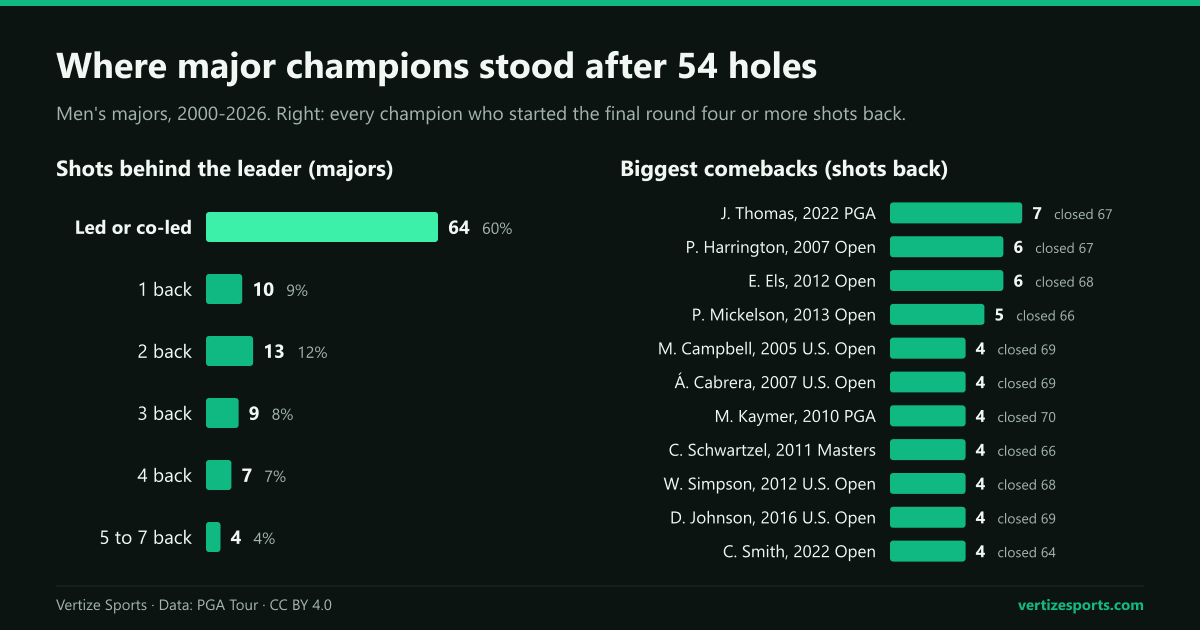
Of the 107 winners, 87 (81 percent) were leading or within two shots after 54 holes; 20 came from three or more back and 11 from four or more. The 43 winners who came from behind averaged 68.1 in the final round.
The four comebacks from five shots or more:
- Justin Thomas, 2022 PGA Championship: seven back in a tie for seventh, closed with a 67 and beat Will Zalatoris in a playoff, while the 54-hole leader, Mito Pereira, shot 75.
- Padraig Harrington, 2007 Open: six back, closed with a 67 and beat Sergio Garcia, who had led by three, in a playoff.
- Ernie Els, 2012 Open: six back, closed with a 68 and won by one as Adam Scott shot 75.
- Phil Mickelson, 2013 Open: five back, closed with a 66 and won by three.
None of them reached the record, which is older. Paul Lawrie started the final round of the 1999 Open 10 strokes behind and won, the greatest comeback in major championship history, a year before the period covered here.
Masters, PGA Championship, U.S. Open and The Open compared
| Major | Leader or co-leader won | Outright leader won | Champions from 3+ back | Biggest comeback |
|---|---|---|---|---|
| Masters | 18 of 27 | 12 of 20 | 3 | 4 shots |
| PGA Championship | 17 of 27 | 13 of 22 | 4 | 7 shots |
| U.S. Open | 15 of 27 | 10 of 19 | 6 | 4 shots |
| The Open | 14 of 26 | 13 of 22 | 7 | 6 shots |
The Masters is the hardest of the four to win from behind. The leader or a co-leader won 18 of 27 (67 percent), and no champion at Augusta since 2000 started the final round more than four shots back; only Charl Schwartzel came from that far, in 2011, when McIlroy shot 80. Six of the seven shared leads at the Masters went to one of the co-leaders.
The Open is where a lead is least safe. Outright leaders there won 13 of 22, in line with the other majors, but only one of four shared leads was converted, and seven Open champions came from three or more back, more than at any other major, including Harrington, Els and Mickelson.
The U.S. Open has the lowest rate for outright leaders, 10 of 19 (53 percent), even though its leaders have had the biggest cushions: 3.2 shots on average, a figure pushed up by Woods's 10-shot lead in 2000 and McIlroy's eight in 2011. The PGA Championship sits in the middle, with the single biggest comeback.
Tiger Woods, Scottie Scheffler and the best closers
Woods led or shared the lead after 54 holes 13 times from 2000 and won 12 of them. The only one he lost was the 2009 PGA Championship, to Y.E. Yang, who started the day two shots behind. His run shows in the totals: from 2000 to 2008 the leader won 26 of 36 majors (72 percent). Take out the 13 majors Woods led and the leaders of the rest won 52 of 94, 55 percent.
From 2009 to 2017 the rate fell to 16 of 36, 44 percent, and it has come back to 22 of 35 (63 percent) since 2018. Scottie Scheffler is four for four with a 54-hole lead in a major, at the 2022 and 2024 Masters and the 2025 PGA Championship and Open. Koepka has converted four of five, losing only the 2023 Masters to Rahm, and McIlroy six of eight. Dustin Johnson is the outlier: in front after 54 holes five times, with one win, at the 2020 Masters.
The 2026 majors: two leads held, two did not
This season split down the middle. At the Masters, McIlroy shared the lead with Cameron Young after 54 holes and won by one with a closing 71, the first back-to-back Masters champion since Woods in 2001 and 2002. At the PGA Championship at Aronimink, Alex Smalley led by two, shot 70 and finished tied for second, as Aaron Rai came from two back with a 65 to win by three.
At the U.S. Open at Shinnecock Hills, Clark took a six-shot lead into Sunday, shot 73 and held on by one over Sam Burns. In July at The Open at Royal Birkdale, Burns led by two, shot 72 and finished third, and Ryan Fox came from two back with a 68 to win by one over Young. Burns has now led two majors after 54 holes, the 2025 U.S. Open and the 2026 Open, and won neither.
With the four majors done, the rest of the season is on our golf schedule, and the tournament being played this week is on the golf leaderboard, round by round and against par. Our guide to the golf pages explains what each one shows, and the golf section links them all.
54-hole leaders in majors: frequently asked questions
How often does the 54-hole leader win a major? About six times in ten. From 2000 to 2026 the leader or a co-leader after three rounds won 64 of 107 men's majors, 60 percent; outright leaders won 48 of 83, 58 percent.
What is the biggest 54-hole lead blown in a major since 2000? Four shots, three times: Rory McIlroy at the 2011 Masters, Adam Scott at the 2012 Open and Shane Lowry at the 2016 U.S. Open. All eight players who led by five or more won.
What is the biggest final-round comeback to win a major? Since 2000, seven shots, by Justin Thomas at the 2022 PGA Championship. The record is 10, by Paul Lawrie at the 1999 Open.
How often does the Masters leader win? Twelve of the 20 outright 54-hole leaders at Augusta from 2000 to 2026 won, 60 percent. Counting co-leaders, the leader won 18 of 27 Masters, the highest rate of the four majors.
Did the 54-hole leaders win the 2026 majors? Two of them did: Rory McIlroy, a co-leader, at the Masters and Wyndham Clark at the U.S. Open. Aaron Rai at the PGA Championship and Ryan Fox at The Open both came from two shots back.
How this was built: round-by-round scores of all 107 men's majors from 2000 to 2026 from the PGA Tour's past results for each tournament; the June 2021 U.S. Open, missing there, comes from its PGA Tour leaderboard. The 54-hole standings add up each player's first three rounds, without disqualified players. A major counts as won by the leader when the champion, playoffs included, led or shared the lead after 54 holes. Every tournament was checked against the third- and final-round tables of its Wikipedia page: the leaders, the margins and the champion's deficit and final round agree in all 107.