To count them we rebuilt every men's major from the PGA Tour's round-by-round results: the Masters, the U.S. Open and The Open from 1934, the year of the first Masters, and the PGA Championship from 1958, its first year at stroke play after decades of match play. A playoff here is any tie for first after 72 holes. Our list matches the official records of the Masters and the PGA Championship, and Wikipedia's for the other two.
How often do majors go to a playoff
Since 1934 the U.S. Open has needed one most often, 20 times in 89 editions (22 percent), and The Open least, 14 times in 86 (16 percent); the Masters and the PGA Championship are at 20 percent. Since 2000 the order has flipped: the Masters has had seven playoffs, the PGA Championship and The Open five each and the U.S. Open two, 19 in 107 majors.
| Major | Majors | Playoffs | Share | Since 2000 | Last playoff |
|---|---|---|---|---|---|
| Masters | 90 | 18 | 20% | 7 of 27 | 2025 |
| PGA Championship | 69 | 14 | 20% | 5 of 27 | 2022 |
| U.S. Open | 89 | 20 | 22% | 2 of 27 | 2008 |
| The Open | 86 | 14 | 16% | 5 of 26 | 2015 |
| All four majors | 334 | 66 | 20% | 19 of 107 | 2025 |
By decade, the 2000s had the most, 11 of 40 majors (28 percent), and the 1940s, with only 17 majors at stroke play, the highest share, 5 of 17. The 2010s fell to 6 of 40, and the 2020s so far have the lowest rate of any decade since 1934: two playoffs, at the 2022 PGA Championship and the 2025 Masters, in 27 majors (7 percent).
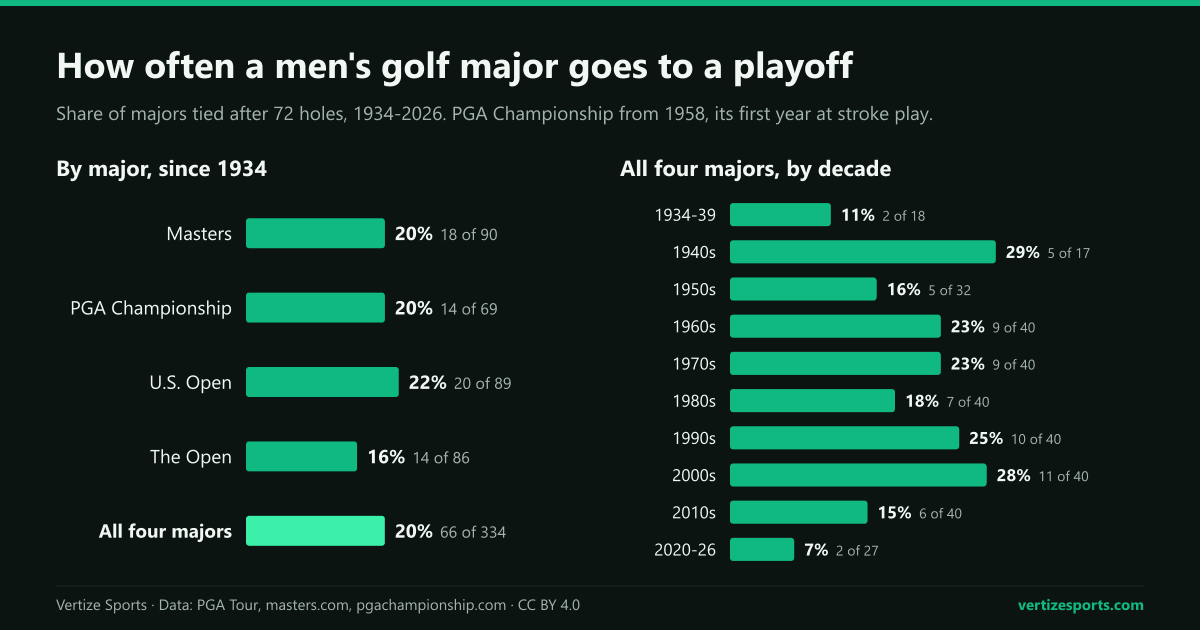
Since 1934, no major has gone longer without a playoff than the U.S. Open is going now: 18 editions in a row through 2026. The longest runs at the other three were 13 Opens from 1976 to 1988, 12 Masters from 1991 to 2002 and 10 PGA Championships from 2012 to 2021, and The Open has now gone 10 without one, since 2015.
Masters playoff history: 18 playoffs, sudden death since 1976
The Masters has gone to extra holes 18 times. Gene Sarazen beat Craig Wood over 36 holes in 1935, five more ties were settled over 18 holes from 1942 to 1970, and the last 12 went to sudden death, a format the Masters announced in 1976 and first needed in 1979, when Fuzzy Zoeller beat Ed Sneed and Tom Watson. None of the 12 has gone past a second extra hole.
Sudden death began on the 10th hole through 2003; since 2005 it has started on the 18th and moved to the 10th for a second hole. Nick Faldo is the only player to win two Masters playoffs, in 1989 and 1990, and Justin Rose has lost two, to Sergio Garcia in 2017 and to Rory McIlroy on the first extra hole in 2025.
U.S. Open playoff format: two holes since 2018
Through 2017 a tie at the U.S. Open meant an 18-hole playoff the next day. In February 2018 the USGA replaced it with a two-hole aggregate, followed by sudden death if still tied, and that format has never been needed. All 20 U.S. Open playoffs since 1934 lasted at least 18 holes: Byron Nelson in 1939 and Lloyd Mangrum in 1946 needed a second round of 18, and the 1990, 1994 and 2008 playoffs went to sudden death after 18.
The drought is new. From 1934 to 1999 the U.S. Open went to a playoff 18 times in 62 editions, 29 percent, a higher rate than any other major in those years; since 2000 it has happened twice in 27, Retief Goosen over Mark Brooks in 2001 and Woods over Mediate in 2008.
British Open playoff format: three holes since 2019
The Open has had 14 playoffs since 1934. Three were played over 36 holes (1949, 1958 and 1963) and two over 18 (1970 and 1975) before the switch to a four-hole aggregate in 1989, when Mark Calcavecchia beat Greg Norman and Wayne Grady at Royal Troon. That format settled nine Opens through 2015, and only one needed sudden death: in 2002, Ernie Els beat Thomas Levet on the first sudden-death hole.
Since 2019 The Open has used a three-hole aggregate followed by sudden death; at Royal Birkdale this July the three holes were to be the 14th, 15th and 18th. It has never been needed: the last Open playoff was Zach Johnson's win over Louis Oosthuizen and Marc Leishman at St. Andrews in 2015.
PGA Championship playoff format: three holes since 2000
The PGA Championship has used three formats: an 18-hole playoff from 1958 to 1976, sudden death from 1977 to 1999 and, since 2000, a three-hole aggregate followed, if needed, by sudden death. Its 14 playoffs split two, seven and five among them, and none of the five three-hole playoffs needed a fourth hole, from Woods over Bob May in 2000 to Justin Thomas over Will Zalatoris in 2022.
| Major | Playoff format | Years | Playoffs since 1934 |
|---|---|---|---|
| Masters | 36 holes | 1935 | 1 |
| Masters | 18 holes | 1942-1970 | 5 |
| Masters | Sudden death | Since 1976 | 12 |
| PGA Championship | 18 holes | 1958-1976 | 2 |
| PGA Championship | Sudden death | 1977-1999 | 7 |
| PGA Championship | Three-hole aggregate | Since 2000 | 5 |
| U.S. Open | 18 holes, next day | Through 2017 | 20 |
| U.S. Open | Two-hole aggregate | Since 2018 | 0 |
| The Open | 36 or 18 holes | Before 1989 | 5 |
| The Open | Four-hole aggregate | 1989-2018 | 9 |
| The Open | Three-hole aggregate | Since 2019 | 0 |
Who wins major playoffs: the 54-hole leader or a chaser
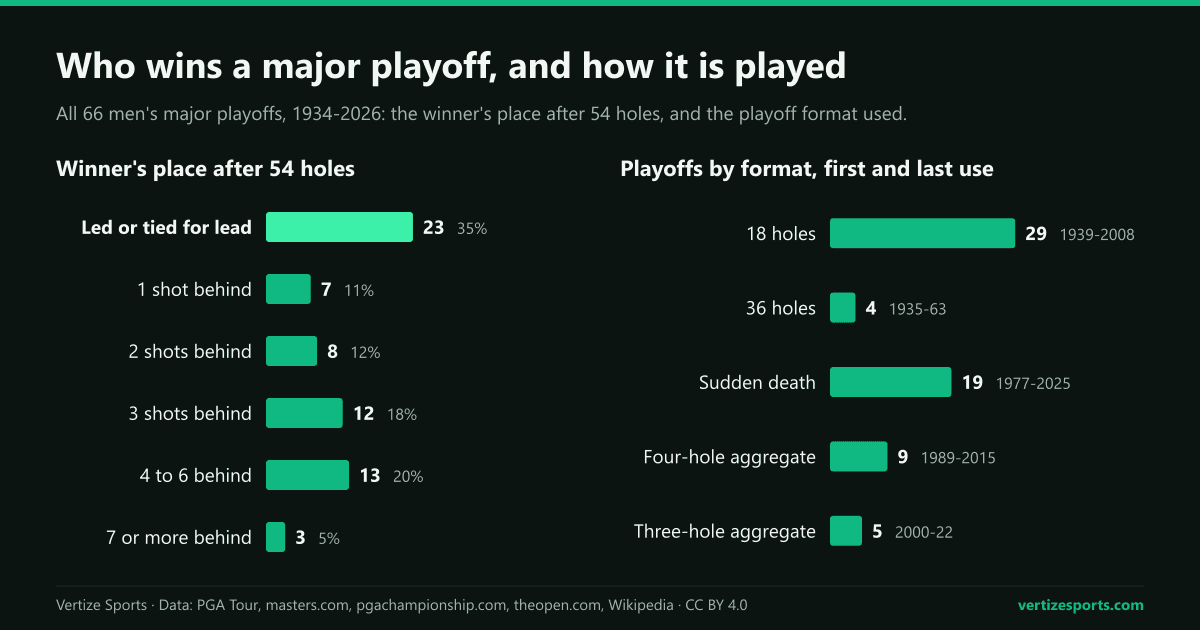
Usually a chaser. In 23 of the 66 playoffs, 35 percent, the winner had led or shared the lead after 54 holes; the other 43 started the last round behind, by a median of three shots. A 54-hole leader reached the playoff 46 times and won exactly half of them. Leaders have done better lately, winning 10 of the 19 playoffs since 2000, against 13 of 47 before.
The biggest comeback by a playoff winner was Paul Lawrie's at the 1999 Open. Tied for 14th and 10 shots behind Jean van de Velde after 54 holes, Lawrie closed with a 67 and won the playoff against van de Velde, who had led by five, and Justin Leonard. John Mahaffey at the 1978 PGA Championship and Thomas in 2022 both came from seven back.
The longest major playoffs
Six playoffs went 36 holes: the 1935 Masters and the Opens of 1949, 1958 and 1963, all played over 36, and the 1939 and 1946 U.S. Opens, where an 18-hole playoff ended in a tie and another 18 followed. The longest since then was the 1994 U.S. Open: Colin Montgomerie was eliminated after 18 holes, and Ernie Els beat Loren Roberts on the second hole of sudden death, the 20th of the playoff.
The short formats rarely run long. The longest was the 2002 Open, at five holes, and eight playoffs ended on the first extra hole, five of them at the Masters, most recently McIlroy's in 2025.
Major championship playoff records: most wins and losses
Jack Nicklaus and Tiger Woods have won the most major playoffs, three each, in three different majors. Woods never lost one; Nicklaus lost the 1971 U.S. Open playoff to Lee Trevino. Greg Norman lost the most, four, one in each major, the only player since 1934 to lose a playoff at all four. Arnold Palmer, Ben Hogan and Tom Watson each won one and lost three, and all three of Palmer's defeats came at the U.S. Open.
| Player | Won-lost | Won | Lost |
|---|---|---|---|
| Tiger Woods | 3-0 | 2000 PGA, 2005 Masters, 2008 U.S. Open | None |
| Jack Nicklaus | 3-1 | 1962 U.S. Open, 1966 Masters, 1970 Open | 1971 U.S. Open |
| Byron Nelson | 2-1 | 1939 U.S. Open, 1942 Masters | 1946 U.S. Open |
| Ernie Els | 2-1 | 1994 U.S. Open, 2002 Open | 2004 Open |
| Nick Faldo | 2-1 | 1989 Masters, 1990 Masters | 1988 U.S. Open |
| Ben Hogan | 1-3 | 1950 U.S. Open | 1942 Masters, 1954 Masters, 1955 U.S. Open |
| Arnold Palmer | 1-3 | 1962 Masters | 1962 U.S. Open, 1963 U.S. Open, 1966 U.S. Open |
| Tom Watson | 1-3 | 1975 Open | 1978 PGA, 1979 Masters, 2009 Open |
| Greg Norman | 0-4 | None | 1984 U.S. Open, 1987 Masters, 1989 Open, 1993 PGA |
The 2026 majors and the 2027 Masters
None of the 2026 majors went to a playoff, and only one of the last 16 has, the 2025 Masters. Three of this year's four were decided by a single shot:
- Masters: Rory McIlroy, by one over Scottie Scheffler
- PGA Championship: Aaron Rai, by three over Jon Rahm and Alex Smalley
- U.S. Open: Wyndham Clark, by one over Sam Burns
- The Open: Ryan Fox, by one over Cameron Young
The next chance is the 2027 Masters, in the week of April 5 to 11 at Augusta National, before the PGA Championship at PGA Frisco in May, the U.S. Open at Pebble Beach in June and The Open at St. Andrews in July, according to the PGA Tour. Our golf schedule lists every tour event, the golf leaderboard follows the one in play and the golf section links every page; two earlier studies cover how often the 54-hole leader wins a major and what score it takes to win one.
Golf major playoffs: frequently asked questions
How often does a golf major go to a playoff? About one time in five: 66 of the 334 men's majors played at stroke play since 1934, 20 percent, and 19 of the 107 since 2000.
What is the playoff format at each major? The Masters uses sudden death. The PGA Championship plays a three-hole aggregate, the U.S. Open two holes and The Open three, each followed by sudden death if players are still tied.
When was the last U.S. Open playoff? In 2008, when Tiger Woods beat Rocco Mediate on the first sudden-death hole after they had tied over 18 holes.
Who has won the most major playoffs? Jack Nicklaus and Tiger Woods, three each, the most since 1934. Woods is unbeaten in major playoffs, and Greg Norman went 0-4.
How this was built: the round-by-round results of all 334 men's majors played at stroke play from 1934 to 2026 (the PGA Championship from 1958), from the PGA Tour's past results. A playoff is a tie for first after 72 holes; 54-hole standings add each player's first three rounds (for the 1949 Open, whose rounds the PGA Tour lacks, Wikipedia's third-round table). The 66 playoffs match masters.com, pgachampionship.com and Wikipedia. Formats: masters.com, pgachampionship.com, theopen.com, the PGA Tour and NBC Sports; holes played in U.S. Open and Open playoffs: Wikipedia. 2026 results checked against the PGA Tour on September 30, 2026.