Seeding is the draw's built-in forecast. Today's Grand Slam rulebook seeds players from the rankings of about a week before the event and puts the No. 1 seed on the first line of the draw and the No. 2 seed on the last, so the two can meet only in the final. We checked that forecast against every singles draw at the four majors since 2000, rebuilt from the official records of the ATP Tour and the WTA: who won, with what seed, and how far the No. 1 seed went. With no Wimbledon in 2020, that makes 107 tournaments per tour.
How often the No. 1 seed wins a Grand Slam
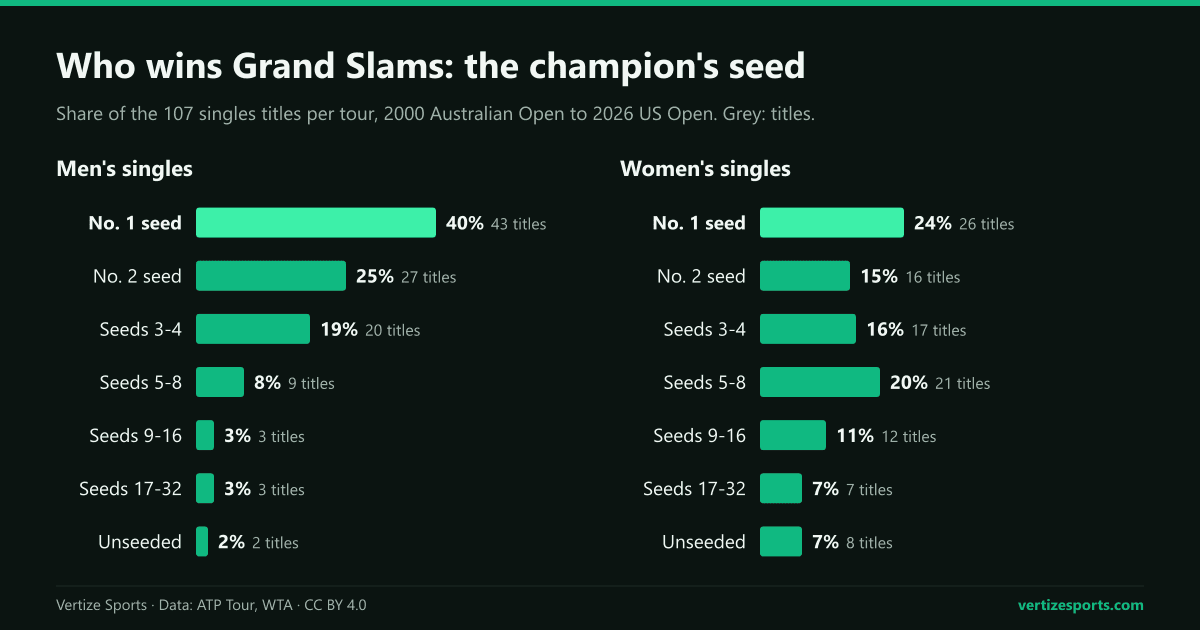
The top seed is still the most likely champion in either draw. The men's No. 1 seed won 43 titles, 40 percent, and the No. 2 seed 27; in the women's draw the No. 1 seed won 26, 24 percent, and the No. 2 seed 16. Below the top two, the draws split: seeds five to eight won 21 women's titles, more than the No. 2 seed, but only 9 men's.
| Champion's seed | Men | Women | All |
|---|---|---|---|
| No. 1 | 43 (40%) | 26 (24%) | 69 (32%) |
| No. 2 | 27 (25%) | 16 (15%) | 43 (20%) |
| No. 3-4 | 20 (19%) | 17 (16%) | 37 (17%) |
| No. 5-8 | 9 (8%) | 21 (20%) | 30 (14%) |
| No. 9-16 | 3 (3%) | 12 (11%) | 15 (7%) |
| No. 17-32 | 3 (3%) | 7 (7%) | 10 (5%) |
| Unseeded | 2 (2%) | 8 (7%) | 10 (5%) |
| Total | 107 | 107 | 214 |
Put another way, 84 percent of men's majors went to one of the top four seeds, against 55 percent of women's. Only 8 men's titles went to a player seeded ninth or lower or not seeded at all; in the women's draw that happened 27 times, a quarter of all titles.
How far the No. 1 seed usually goes
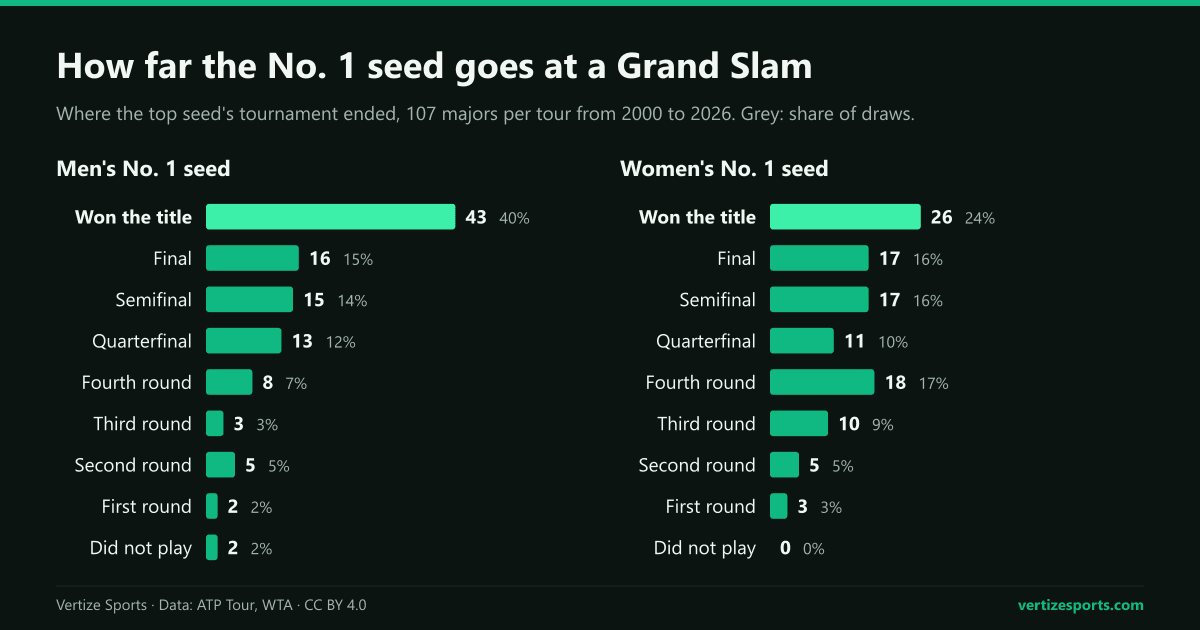
More than half the time the men's No. 1 seed reaches the final, 59 times in 107. The women's No. 1 seed reached 43 finals, and her median finish is the semifinals. The gap is widest in the early rounds: the women's top seed lost before the quarterfinals 36 times, a third of all draws, and the men's 18 times. Five times the No. 1 seed lost in the first round:
- Martina Hingis at Wimbledon in 2001, to Virginia Ruano Pascual.
- Lleyton Hewitt at the 2002 Australian Open, to Alberto Martin.
- Hewitt again at Wimbledon in 2003, to the qualifier Ivo Karlovic.
- Angelique Kerber at the 2017 French Open, to Ekaterina Makarova.
- Simona Halep at the 2018 US Open, to Kaia Kanepi.
Twice the men's No. 1 seed never played a match. Rafael Nadal pulled out of Wimbledon in 2009 with tendinitis in his knees after the draw was made, and Novak Djokovic missed the 2022 Australian Open after Australia canceled his visa three days before play began. Both count here as majors the top seed did not win.
Which Grand Slam is hardest for the top seed
| Major | No. 1 seed won, men | No. 1 seed won, women | Champion outside top 4, men | Champion outside top 4, women |
|---|---|---|---|---|
| Australian Open | 13 of 27 | 7 of 27 | 5 of 27 | 9 of 27 |
| French Open | 6 of 27 | 7 of 27 | 5 of 27 | 13 of 27 |
| Wimbledon | 14 of 26 | 6 of 26 | 2 of 26 | 17 of 26 |
| US Open | 10 of 27 | 6 of 27 | 5 of 27 | 9 of 27 |
For men, Wimbledon has been the safest major for the favorite: the No. 1 seed won it 14 times in 26 and reached 17 finals. The French Open has been the hardest, 6 titles in 27, even though one man won it 14 times. Nadal won only three of his French Open titles as the No. 1 seed, in 2011, 2014 and 2018; seven came as the No. 2 seed, with Roger Federer or Djokovic seeded first.
For women, the No. 1 seed wins about as often at each major, six or seven titles apiece; what changes is who wins instead. At Wimbledon only 9 of 26 champions came from the top four seeds, and the other 17 include Venus Williams, seeded 23rd in 2007, and Barbora Krejcikova, seeded 31st in 2024. The women's No. 1 seed reached the Wimbledon final 9 times and lost before the quarterfinals 12 times.
Unseeded Grand Slam champions since 2000
Ten players have won a major without a seed, two men and eight women. Their ranking at the time comes from the ATP and WTA records.
- Goran Ivanisevic, Wimbledon 2001: a wildcard ranked 125th.
- Gaston Gaudio, French Open 2004: ranked 44th.
- Serena Williams, Australian Open 2007: ranked 81st.
- Kim Clijsters, US Open 2009: a wildcard with no ranking.
- Jelena Ostapenko, French Open 2017: ranked 47th.
- Sloane Stephens, US Open 2017: ranked 83rd.
- Iga Swiatek, French Open 2020: ranked 54th.
- Barbora Krejcikova, French Open 2021: ranked 33rd.
- Emma Raducanu, US Open 2021: a qualifier ranked 150th.
- Marketa Vondrousova, Wimbledon 2023: ranked 42nd.
No unseeded man has won a major since Gaudio in 2004, and none seeded lower than eighth since Djokovic, seeded 12th, won Wimbledon in 2018: the last 32 men's majors all went to a top-eight seed. The women's draw has moved the other way. Four of the eight unseeded women's champions won in 2020 or later, and three more were seeded 17th or lower.
Why the men's draw is more predictable
Part of the answer is who held the top seed. Djokovic, Federer and Nadal were the men's No. 1 seed in 73 of the 107 draws and won 32 titles from there; every other man seeded first won 11 of 34. Djokovic alone was the No. 1 seed 33 times and won 15. Serena Williams filled the same role for women, with 12 titles in 23 majors as the top seed, while the other women seeded first won 14 of 84, 17 percent.
Others held the top seed often and rarely won from it. Martina Hingis was the No. 1 seed at eight majors in 2000 and 2001 and lost two finals; Caroline Wozniacki was the top seed six times and never got past the semifinals. Aryna Sabalenka has been the No. 1 seed at the last eight majors, reached five finals and won one, the 2025 US Open.
The format differs too. Under the rulebook, men's singles at the majors are best of five sets and women's best of three, so an upset in the men's draw takes three winning sets instead of two.
The 2026 season: the No. 1 seed at each major
The men's No. 1 seed won three of the four majors in 2026, as in 2006, 2007, 2015 and 2021; no season since 2000 has had all four. Carlos Alcaraz won the Australian Open as the top seed, beating Djokovic in the final, and Jannik Sinner did the same at Wimbledon, beating Alexander Zverev. With Sinner not in the US Open draw, Zverev was the No. 1 seed there and won it, beating the eighth seed, Ben Shelton, in the final.
The exception was Paris. Sinner, seeded first, lost in the second round of the French Open to the unseeded Juan Manuel Cerundolo, and Zverev won the title as the No. 2 seed, beating Flavio Cobolli in the final. It was his first major; the US Open was his second.
The women's top seed won none. Sabalenka was the No. 1 seed at all four majors and lost two finals to Elena Rybakina, who won the Australian Open as the fifth seed and the US Open as the second. Sabalenka also lost to Diana Shnaider in the French Open quarterfinals and to Naomi Osaka in the fourth round at Wimbledon. Mirra Andreeva, seeded eighth, won the French Open, and Linda Noskova, seeded ninth, won Wimbledon.
It was the 11th season since 2000 in which the women's No. 1 seed won no major; for men that has happened three times, in 2003, 2008 and 2020. The next test is the 2027 Australian Open. Until then, the draws of the tournaments in play, with each player's seed beside the name, are on the Vertize tennis scores page, the rest of the tour is in the tennis section, and our guide to scores and draws explains how they are laid out.
Top seeds at the Grand Slams: frequently asked questions
How often does the No. 1 seed win a Grand Slam? About one time in three: 69 of 214 singles titles from 2000 to 2026, 32 percent. The men's No. 1 seed won 43 of 107 majors (40 percent) and the women's 26 of 107 (24 percent).
Has an unseeded player won a Grand Slam? Yes, ten times since 2000: Goran Ivanisevic and Gaston Gaudio among the men, and eight women, most recently Marketa Vondrousova at Wimbledon in 2023.
What is the lowest seed to win a Grand Slam since 2000? Barbora Krejcikova, seeded 31st, at Wimbledon in 2024. The lowest-seeded men's champion was Albert Costa, seeded 20th at the 2002 French Open.
Which Grand Slam does the top seed win most often? For men, Wimbledon: the No. 1 seed won 14 of 26 since 2000. For women the Australian Open and the French Open are level, seven of 27 each.
How often do the top two seeds meet in a Grand Slam final? In 31 of the 107 men's finals since 2000 and 12 of the 107 women's finals.
How this was built: every singles draw at the four majors from the 2000 Australian Open to the 2026 US Open, 107 per tour. The men's draws come match by match from the ATP Tour results archive. For women, the champion and her seed come from the WTA's official tournament records, and the No. 1 seed's result from her WTA match record at that event. Every champion, champion's seed and No. 1 seed result, and every men's runner-up, was checked against the Wikipedia draw pages, and all 214 draws matched. The seed is the one printed in the official draw; wildcards and qualifiers without one count as unseeded. The majors seeded 16 players through the 2001 French Open and 32 since. When the No. 1 seed was in the draw but did not play, the event counts as one the top seed did not win. Data collected September 28, 2026.