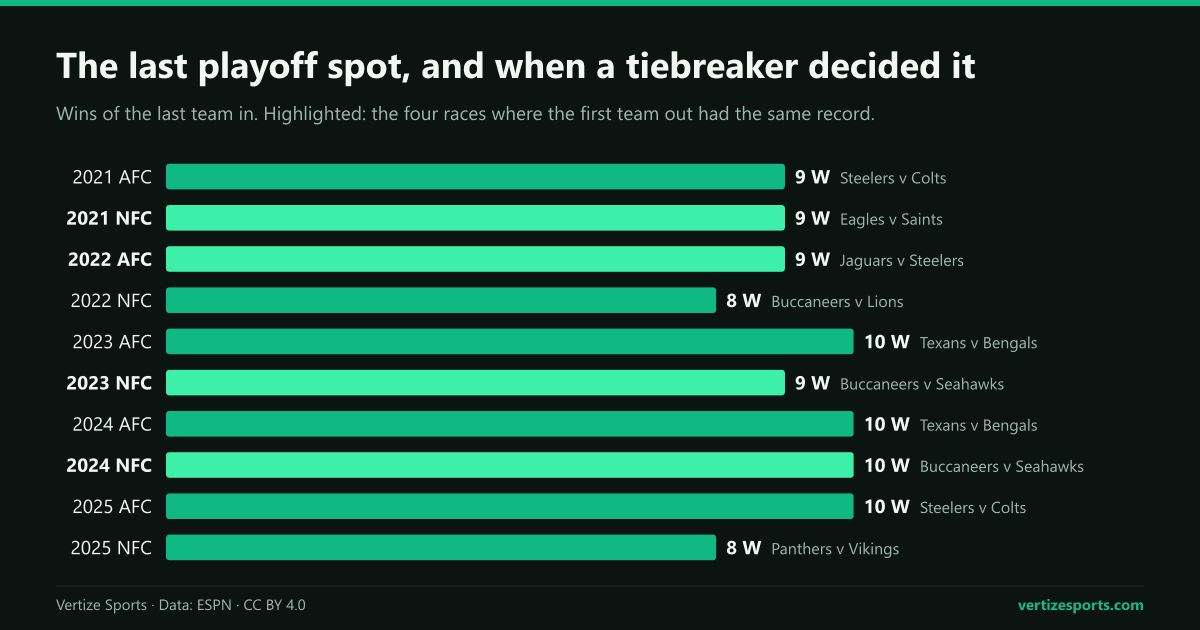
Every league needs a way to separate teams that finish level. Most of them barely use it. The NFL uses it constantly, because seventeen games is not many and thirty-two teams pile up on the same records, and because a division title is worth a home game regardless of what the rest of the conference did.
How often it actually matters
We looked at the last five seasons of the seven-team format, ten conference races in all, and compared the last team in with the best team left out. In four of the ten the two had finished with exactly the same record. That is 40 percent of recent playoff races decided not by the standings but by the order below them.
| Season | Record | In | Out |
|---|---|---|---|
| 2021 NFC | 9-8 | Philadelphia Eagles | New Orleans Saints |
| 2022 AFC | 9-8 | Jacksonville Jaguars | Pittsburgh Steelers |
| 2023 NFC | 9-8 | Tampa Bay Buccaneers | Seattle Seahawks |
| 2024 NFC | 10-7 | Tampa Bay Buccaneers | Seattle Seahawks |
Tampa Bay appear twice, and the reason is the same both times: a division title. The Buccaneers won the NFC South and took the seat that comes with it; the Seahawks, level on record but without a division of their own to win, went home. The 2024 case is the sharpest of all, because Seattle finished 10-7 and became the first team with double-digit wins to miss since the schedule went to seventeen games.
The order, for two teams in the same division
| # | Two teams in the same division |
|---|---|
| 1 | Head-to-head record |
| 2 | Record in division games |
| 3 | Record in common games |
| 4 | Record in conference games |
| 5 | Strength of victory |
| 6 | Strength of schedule |
It starts with the most direct question available: did you beat them? If they split, the list widens one ring at a time, from the division to the games both teams happened to share, then to the conference. Only when all of that comes out level does it reach strength of victory, which is the combined record of the teams you beat, and strength of schedule, which is the combined record of everyone you played.
And for two teams from different divisions
| # | Two teams from different divisions |
|---|---|
| 1 | Head-to-head, if they played |
| 2 | Record in conference games |
| 3 | Record in common games, minimum four |
| 4 | Strength of victory |
| 5 | Strength of schedule |
This is the list that settles most wild card races, and it is where strength of victory earns its reputation. Two teams that never met and share few opponents can run all the way down to it, at which point a playoff place turns on how good the teams you beat in September turned out to be in December.
There is one more rule that trips people up: if three or more teams are tied, the league eliminates them one at a time rather than comparing all three at every step. As soon as one team is separated, the remaining pair starts the whole list again from the top.
What it means for a playoff race
- A division title is worth more than a better record somewhere else. Four of the seven seats in each conference are reserved for division winners, which is how an 8-9 team hosts a playoff game.
- Head-to-head is the one tiebreaker you control directly, and it is the first one asked. A divisional game in week three can be worth as much as a win in week eighteen.
- Strength of victory rewards beating good teams, so results elsewhere keep moving your position after your own season is over.
- Conference record matters more than it looks: it is the second question in a wild card tie, before common games.
Play the run-in yourself
The NFL simulator starts from the real standings with the played games locked, and you fill in the rest. It sorts on record, so it will not run the full tiebreaker list for you; what it does show is whether your team is even in the conversation, which is the part that the list cannot fix.
- Fill in the remaining games and watch the conference reorder as you type.
- The week-by-week schedule has every game, and the divisional ones are the tiebreakers being played out in advance.
- For what the line usually costs, we counted the last team in for every recent season: a median of 9-8, and eleven wins that has never missed.
The tiebreaker order is the NFL's published procedure; the counts come from the final standings of 2021 to 2025, the five seasons of the seventeen-game schedule with seven playoff teams per conference. A tie here means the last team in and the first team out finished with identical win, loss and tie totals.