We took every NRL game from 2003 to the 2026 grand final, 4,792 of them, from the public data behind NRL.com's draw, matched every golden point game to its score, and read how each one was decided from the winning margin and NRL.com's match timelines.
How golden point works in the NRL
The NRL approved golden point in March 2003, for the 2003 season. The rules since:
- Regular season. Level after 80 minutes, the teams play five minutes, change ends without a break and play five more. The first try, penalty goal or field goal ends the game; a golden point try is not converted. If nobody scores, it is a draw and each team gets one competition point.
- Finals, 2003 to 2015. Golden point straight away, with no 10-minute limit: a final cannot end level.
- Finals since 2016. After the 2015 grand final was settled in golden point, the NRL added extra time: two five-minute halves in which every score counts, then golden point until someone scores.
- Two-point field goal, since 2021. A field goal from 40 metres out is worth two points, in golden point as well.
The regular-season format has not changed since 2003. The NRL looked at other ideas in 2019, including a set of six for the other team to answer a golden point score, but did not adopt them: in 2026 every golden point game still ended at the first score, and draws are still possible.
How many NRL games go to golden point
175 of the 4,576 regular-season games since 2003 went to golden point, 3.8 percent, and so did seven finals: an average of 7.6 golden point games a season from 2003 to 2025. That is a lower rate than overtime in the NFL, where 6.0 percent of regular-season games went to overtime from 2002 to 2025.
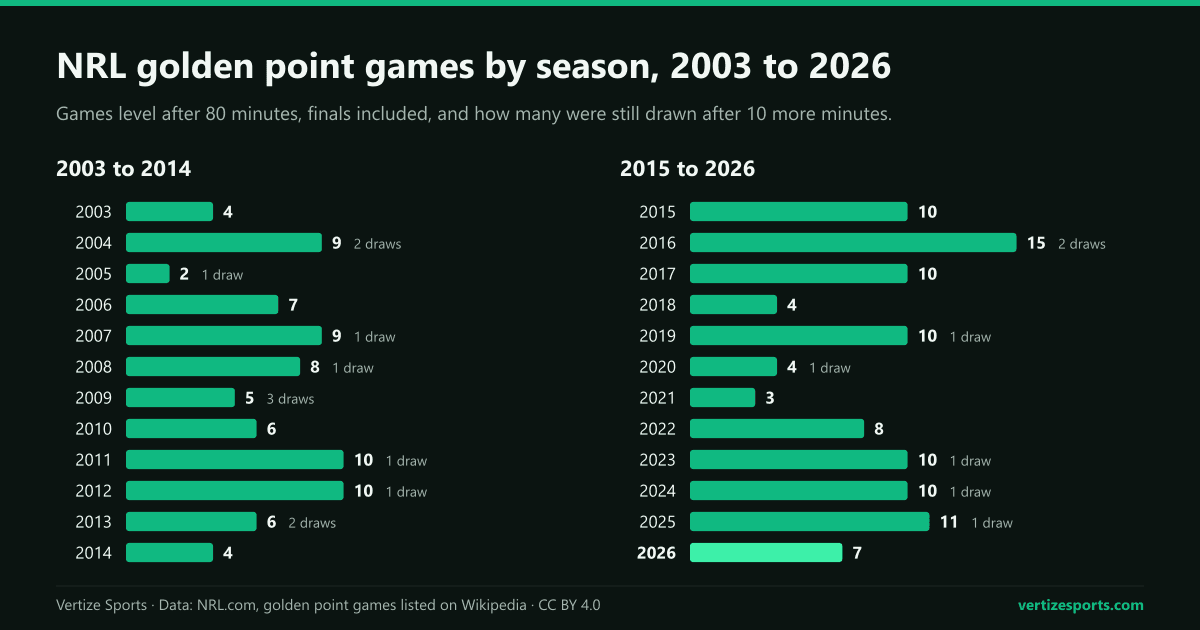
The busiest season was 2016, with 15 golden point games; the quietest was 2005, with two. Nine seasons reached 10 or more, and three of them were the last three before 2026: 10 in 2023, 10 in 2024 and 11 in 2025, when the league had 17 teams and 204 regular-season games.
| Season | Golden point games | Draws | Field goals | Tries | Penalty goals |
|---|---|---|---|---|---|
| 2003 | 4 | 0 | 1 | 2 | 1 |
| 2004 | 9 | 2 | 3 | 3 | 1 |
| 2005 | 2 | 1 | 0 | 1 | 0 |
| 2006 | 7 | 0 | 5 | 1 | 1 |
| 2007 | 9 | 1 | 4 | 2 | 2 |
| 2008 | 8 | 1 | 4 | 2 | 1 |
| 2009 | 5 | 3 | 2 | 0 | 0 |
| 2010 | 6 | 0 | 3 | 3 | 0 |
| 2011 | 10 | 1 | 8 | 0 | 1 |
| 2012 | 10 | 1 | 9 | 0 | 0 |
| 2013 | 6 | 2 | 2 | 1 | 1 |
| 2014 | 4 | 0 | 4 | 0 | 0 |
| 2015 | 10 | 0 | 6 | 3 | 1 |
| 2016 | 15 | 2 | 7 | 6 | 0 |
| 2017 | 10 | 0 | 7 | 2 | 1 |
| 2018 | 4 | 0 | 3 | 0 | 1 |
| 2019 | 10 | 1 | 9 | 0 | 0 |
| 2020 | 4 | 1 | 2 | 0 | 1 |
| 2021 | 3 | 0 | 2 | 1 | 0 |
| 2022 | 8 | 0 | 6 | 2 | 0 |
| 2023 | 10 | 1 | 6 | 2 | 1 |
| 2024 | 10 | 1 | 9 | 0 | 0 |
| 2025 | 11 | 1 | 3 | 4 | 3 |
| 2026 | 7 | 0 | 6 | 0 | 1 |
How NRL golden point games are won: field goals, tries and penalty goals
Field goals decide most of them. Of the 163 golden point games with a winner, 111 were won by a field goal, 68 percent, including 3 two-point field goals; 35 were won by a try, 21 percent, and 17 by a penalty goal, 10 percent.
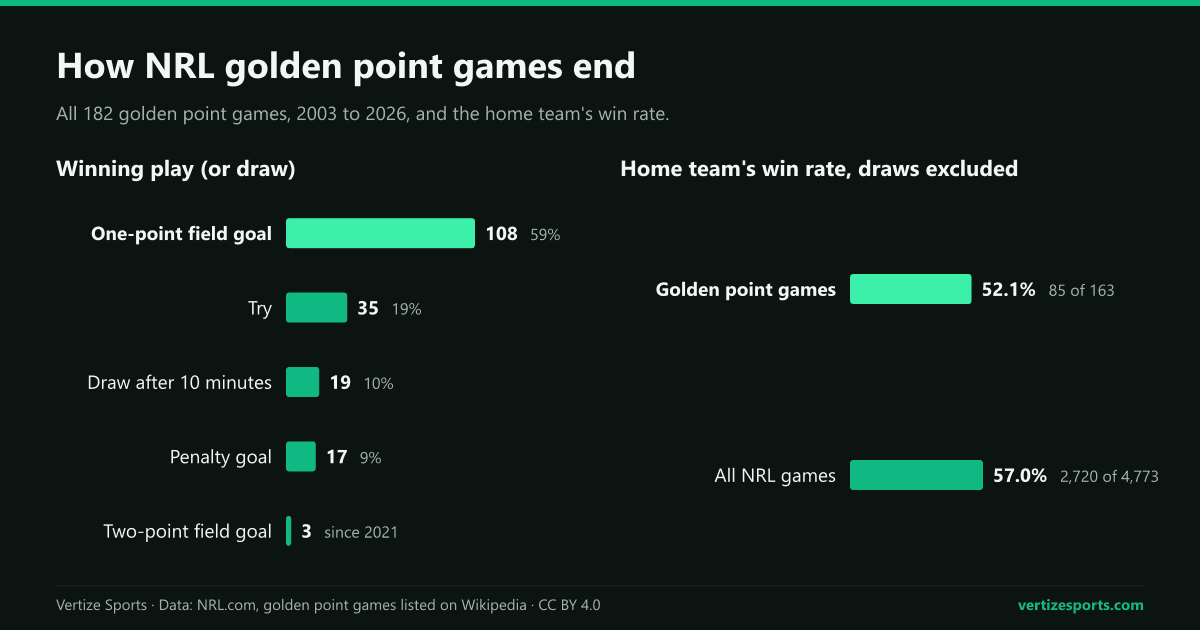
Draws have become rarer. From 2003 to 2014, 12 of the 80 golden point games ended level, 15 percent; from 2015 to 2026, seven of 102 did, 7 percent. The most in one season was three, in 2009, and the last was the North Queensland Cowboys' 30-30 draw with the Penrith Panthers in round 10 of 2025. Every drawn NRL game since 2003 went through golden point first.
The three two-point field goals that won golden point games were kicked for the Cowboys in a 2022 qualifying final against the Cronulla-Sutherland Sharks, for Penrith against the Dolphins in round 20 of 2024, and for the Dolphins against the New Zealand Warriors three rounds later.
Home and away in golden point
Golden point shrinks the home advantage. Home teams won 52.1 percent of the decided golden point games, 85 to 78, against 57.0 percent of all NRL games with a winner since 2003. Both figures use the designated home team, so neutral games such as grand finals and the Las Vegas openers count too.
By club, the Canberra Raiders have won the most golden point games, 16, with one draw and 11 losses. The Canterbury-Bankstown Bulldogs have the best record, 14 wins, a draw and three losses, and the Newcastle Knights the worst, four wins, four draws and 12 losses. The Warriors have drawn five, more than anyone.
Golden point and extra time in the NRL finals
Ten finals have been level after 80 minutes since 2003. Seven were decided in golden point, and three were settled inside the fixed extra time used since 2016, so they never reached golden point.
| Season | Final | Result | How it was decided |
|---|---|---|---|
| 2010 | Qualifying final | Sydney Roosters 19, Wests Tigers 15 | Try in golden point |
| 2011 | Semi-final | Brisbane Broncos 13, St. George Illawarra Dragons 12 | Field goal in golden point |
| 2014 | Semi-final | Canterbury-Bankstown Bulldogs 18, Manly Warringah Sea Eagles 17 | Field goal in golden point |
| 2015 | Elimination final | Canterbury-Bankstown Bulldogs 11, St. George Illawarra Dragons 10 | Field goal in golden point |
| 2015 | Grand final | North Queensland Cowboys 17, Brisbane Broncos 16 | Field goal in golden point |
| 2016 | Semi-final | North Queensland Cowboys 26, Brisbane Broncos 20 | Try in extra time |
| 2017 | Elimination final | North Queensland Cowboys 15, Cronulla-Sutherland Sharks 14 | Field goal in extra time |
| 2022 | Qualifying final | North Queensland Cowboys 32, Cronulla-Sutherland Sharks 30 | Two-point field goal in golden point |
| 2023 | Elimination final | Newcastle Knights 30, Canberra Raiders 28 | Penalty goal in extra time |
| 2025 | Qualifying final | Brisbane Broncos 29, Canberra Raiders 28 | Field goal in golden point |
The 2015 grand final is the only one since 2003 to go past 80 minutes. The Cowboys levelled at 16-16 with a try on the last play of normal time, and Johnathan Thurston's field goal 2 minutes 17 seconds into golden point won the club's first premiership, according to NRL.com's timeline and the list of golden point games. The rule change followed the next year.
Extra time has changed how finals end: the Cowboys' 2016 try came 4 minutes 16 seconds into extra time and the game still ran to 90 minutes. The two finals that reached golden point after extra time, in 2022 and 2025, were decided at 92:23 and 93:28 of game time.
Golden point in the 2026 NRL season
Seven games went to golden point in 2026, all in the regular season, 3.4 percent of the 204 games, and for the first time since 2022 none ended in a draw. The first was the season opener in Las Vegas, where the Bulldogs beat the St. George Illawarra Dragons 15-14 in round 1, and the last was the Cowboys' 19-18 win over the Manly Warringah Sea Eagles at 4 Pines Park on 12 July, in round 19. Manly played three of the seven and lost all three.
Round 10 produced the only golden point game since 2003 with a three-point margin. The Parramatta Eels' Mitchell Moses kicked a field goal 56 seconds into golden point, the Cowboys were penalised for pressure on the kicker, and the penalty goal that followed was added to the score: Parramatta won 33-30 in Townsville. None of the nine finals went past 80 minutes, and the Sydney Roosters beat the Knights 19-18 in the grand final in normal time.
You can follow every result and the ladder on the NRL draw and the NRL ladder pages, and tip the rest of a season with the NRL ladder predictor.
NRL golden point: frequently asked questions
How long is golden point in the NRL? Up to 10 minutes in the regular season, as two halves of five minutes with a change of ends and no break. In the finals, 10 minutes of extra time are played first, then golden point with no time limit.
Can an NRL game end in a draw? Yes, in the regular season, if nobody scores in the 10 minutes of golden point. It has happened 19 times since 2003, most recently in 2025. Finals cannot end in a draw.
How often do NRL games go to golden point? 175 of 4,576 regular-season games from 2003 to 2026, 3.8 percent, plus seven finals. 2016 had the most, 15.
Has an NRL grand final gone to golden point? Once, in 2015, when Johnathan Thurston's field goal gave the North Queensland Cowboys a 17-16 win over the Brisbane Broncos.
How this was built: every NRL game from 2003 to the 2026 grand final, 4,792 games, from the public data behind NRL.com's draw pages, downloaded on 4 October 2026. NRL.com's game clock marks extra time only in 2003 and from 2013, so the golden point games were taken from Wikipedia's list, updated to 12 July 2026, and each one was matched to the NRL.com game with the same score; from 2013 the clock confirms the list both ways, and no game after 12 July went past 80 minutes. The winning play comes from the margin (a try is not converted in golden point) and, for every two- or three-point margin since 2013, from NRL.com's match timelines. Wikipedia's own tally has one more field goal and one fewer penalty goal than the scores allow; we follow the scores.