We sorted every NFL game since 2002, the first season of the 32-team league, by the overtime rule in force when it was played. The rules have changed five times since 2010, and one of those changes did not do what the league expected.
NFL overtime rules for the 2026 season
This season's rules are the ones adopted in 2025: the changes in the 2026 rulebook deal with kickoffs, onside kicks and disqualifications and leave Rule 16, on overtime, as it was.
- Coin toss. When regulation ends tied, the referee tosses a coin and the visiting captain calls it. The winner gets the same choice as before the opening kickoff.
- Both teams get the ball. Each team must have the chance to possess the ball once, unless the kicking team scores a safety on the first possession, which wins it. Then, if one team is ahead, it wins; if not, the next score of any kind wins.
- Regular season: one 10-minute period. There is no second period, even if the second team has not had the ball yet. If the score is level when time runs out, the game is a tie. Each team has two timeouts.
- Playoffs: 15-minute periods until someone wins. The second team's possession cannot be cut short by the end of a period, each team has three timeouts per half, and a game still tied after four overtime periods gets a new coin toss.
- No coaches' challenges. Every replay review in overtime is started by the replay official or the league's officiating department.
The league adopted modified sudden death for the playoffs in 2010 and for the regular season in 2012, cut regular-season overtime to 10 minutes in 2017 for player safety, guaranteed both teams a possession in the playoffs in 2022 and did the same for the regular season in 2025, keeping 10 minutes rather than the 15 the Philadelphia Eagles had proposed.
| Season | Change | Applies to |
|---|---|---|
| 2010 | A field goal on the first possession no longer ends the game; a touchdown still does | Playoffs |
| 2012 | The same modified sudden death | Regular season |
| 2017 | Overtime cut from 15 to 10 minutes | Preseason and regular season |
| 2022 | Both teams get the ball, even after a touchdown on the first possession | Playoffs |
| 2025 | Both teams get the ball; the 10-minute period stays | Regular season |
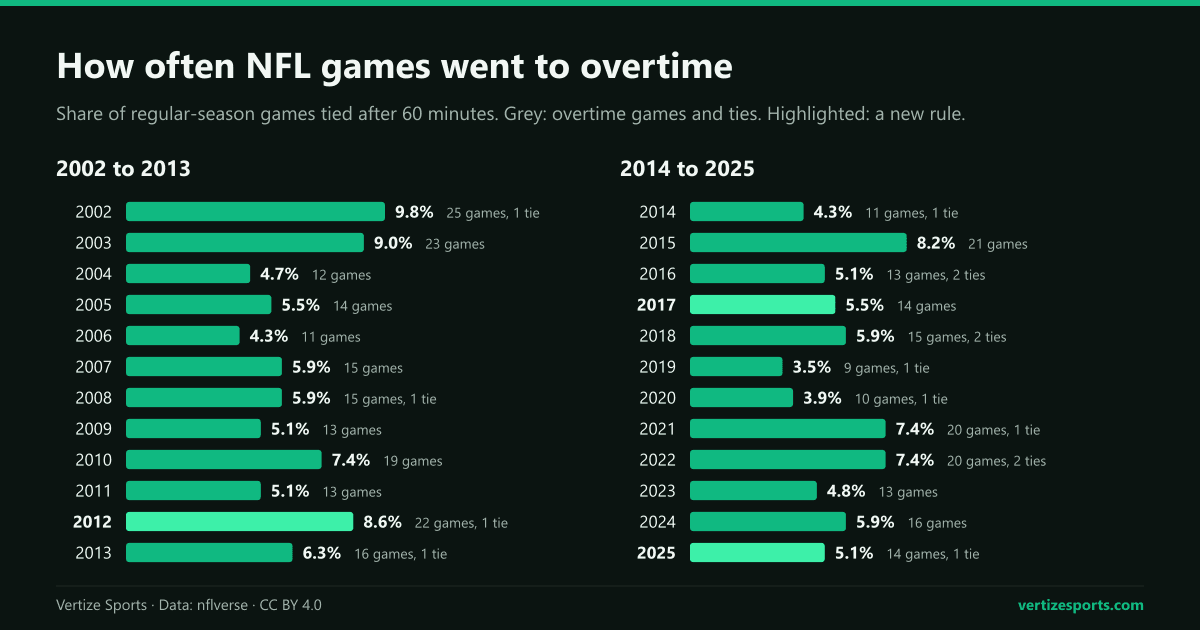
How often NFL games go to overtime
About one game in 17. From 2002 to 2025, 374 of the 6,223 regular-season games were still tied after four quarters, 6.0 percent, an average of 15.6 a season. The busiest year was the first one: 25 games went to overtime in 2002, 9.8 percent of the schedule. The quietest was 2019, with 9.
| Overtime rule | Seasons | Games | Went to overtime | Ties | Overtime games tied |
|---|---|---|---|---|---|
| Sudden death, 15 minutes | 2002-2011 | 2,560 | 160 (6.3%) | 2 | 1.3% |
| Modified sudden death, 15 minutes | 2012-2016 | 1,280 | 83 (6.5%) | 5 | 6.0% |
| Modified sudden death, 10 minutes | 2017-2024 | 2,111 | 117 (5.5%) | 7 | 6.0% |
| Both teams possess, 10 minutes | 2025 | 272 | 14 (5.1%) | 1 | 7.1% |
| Both teams possess, 10 minutes | 2026 so far | 47 | 3 (6.4%) | 0 | 0% |
| All rules | 2002-2025 | 6,223 | 374 (6.0%) | 15 | 4.0% |
Under every rule, between 5 and 7 percent of games have reached overtime. That is to be expected: whether a game is tied after 60 minutes is settled in regulation. What the rules change is how overtime ends.
How often do NFL games end in a tie?
Fifteen times in 24 seasons: 0.24 percent of regular-season games, or one in every 415. Half of those seasons had no tie at all, nine had one and three had two: 2016, 2018 and 2022. The most recent was a 40-40 tie between the Green Bay Packers and the Dallas Cowboys on September 28, 2025, the first under the rule that gives both teams the ball.
Ties became more common in 2012, not in 2017. Under pure sudden death, when a field goal on the first possession ended the game, only 2 of the 160 overtime games finished level, 1.3 percent. Once that field goal stopped ending it, ties rose to 6.0 percent of overtime games, 5 of 83, and stayed there after the period was cut to 10 minutes: 7 of 117, again 6.0 percent.
The league expected the shorter period to do more. When owners approved it in 2017, NFL Research counted 83 overtime games and five ties in the previous five seasons, the same figures as our data, and estimated that a 10-minute limit would have produced 16 ties, about three a season. The eight seasons that followed under that limit and the old possession rule had 7 ties, fewer than one a season.
| Season | Week | Game | Score |
|---|---|---|---|
| 2002 | 10 | Atlanta at Pittsburgh | 34-34 |
| 2008 | 11 | Philadelphia at Cincinnati | 13-13 |
| 2012 | 10 | St. Louis at San Francisco | 24-24 |
| 2013 | 12 | Minnesota at Green Bay | 26-26 |
| 2014 | 6 | Carolina at Cincinnati | 37-37 |
| 2016 | 7 | Seattle at Arizona | 6-6 |
| 2016 | 8 | Washington vs. Cincinnati, in London | 27-27 |
| 2018 | 1 | Pittsburgh at Cleveland | 21-21 |
| 2018 | 2 | Minnesota at Green Bay | 29-29 |
| 2019 | 1 | Detroit at Arizona | 27-27 |
| 2020 | 3 | Cincinnati at Philadelphia | 23-23 |
| 2021 | 10 | Detroit at Pittsburgh | 16-16 |
| 2022 | 1 | Indianapolis at Houston | 20-20 |
| 2022 | 13 | Washington at N.Y. Giants | 20-20 |
| 2025 | 4 | Green Bay at Dallas | 40-40 |
Both teams get the ball: what the new overtime rule changed
The case for the change was the coin toss: teams receiving the overtime kickoff won 56.8 percent of overtime games from 2017 to 2024, up from 55.4 percent from 2001 to 2011. In the playoffs, coin-toss winners had gone 10-2 in overtime since 2010, and the rule there changed after the Kansas City Chiefs beat the Buffalo Bills 42-36 in the January 2022 divisional round with a touchdown on the first possession of overtime. Buffalo never had the ball.
The final scores show the new rule at work. From 2002 to 2024, every regular-season overtime game with a winner was decided by two, three or six points, because a touchdown ended the game on the spot, with no extra point. In 2025, 4 of the 13 overtime games with a winner were decided by one or seven points, margins the old rules could not produce. Three were one-point games in which both teams scored a touchdown, such as the Seattle Seahawks' 38-37 win over the Los Angeles Rams, settled by a two-point conversion. In the fourth, the Detroit Lions beat the New York Giants 34-27 with a touchdown and an extra point in overtime; under the old rule, the touchdown alone would have ended it.
Home field is worth about as much in overtime as in the rest of the game. In the 355 overtime games with a winner played at one team's stadium from 2002 to 2025, the home team won 55 percent, against 56 percent of all home games with a winner. Our measurement of home advantage in six leagues compares that edge with other sports.
NFL playoff overtime rules and results
Playoff games go to overtime more often, and they can only end with a winner. From 2002 to 2025, 26 of the 276 postseason games needed overtime, 9.4 percent, against 6.0 percent in the regular season.
| Overtime rule | Seasons | Playoff games | Went to overtime | Share |
|---|---|---|---|---|
| Sudden death | 2002-2009 | 88 | 11 | 12.5% |
| Modified sudden death | 2010-2021 | 136 | 12 | 8.8% |
| Both teams possess | 2022-2025 | 52 | 3 | 5.8% |
| All rules | 2002-2025 | 276 | 26 | 9.4% |
Two Super Bowls went to overtime in that span: the New England Patriots' 34-28 win over the Atlanta Falcons after the 2016 season, and the Chiefs' 25-22 win over the San Francisco 49ers after the 2023 season, the first playoff overtime under the rule that gives both teams the ball. The only others under that rule came in the divisional round in January 2026, when the Denver Broncos beat the Bills 33-30 and the Rams won 20-17 at the Chicago Bears, both with a field goal in overtime.
Overtime in the 2026 NFL season so far
Through Sunday of Week 3, 3 of the 47 games have gone to overtime, 6.4 percent, and none has ended in a tie. Detroit beat the New Orleans Saints 31-30 in Week 1 after both teams scored a touchdown in overtime. In Week 2, Green Bay won 20-17 at the New York Jets and Kansas City beat the Indianapolis Colts 33-30. The Eagles' Monday night game at Chicago closes Week 3.
At the rates since 2002, a 272-game season produces about 16 overtime games and, going by the share of overtime games tied since 2012, about one tie. A tie counts as half a win and half a loss for both teams in the standings; when teams finish level, the NFL's tiebreakers decide the order.
In the Vertize NFL simulator you can type any score into the games that are left, a tie included, and the standings count it the same way. The NFL schedule lists all 272 games of the season, week by week.
NFL overtime and ties: frequently asked questions
How long is overtime in the NFL? One 10-minute period in the regular season. In the playoffs, overtime is played in 15-minute periods, as many as it takes to produce a winner.
Do both teams get the ball in NFL overtime? Yes: in the playoffs since 2022 and in the regular season since 2025, unless the kicking team scores a safety first. In the regular season, time can run out before the second team has the ball.
How often do NFL games end in a tie? Fifteen times in the 24 regular seasons from 2002 to 2025, one game in every 415. Every one of them went to overtime first.
When was the last NFL tie? On September 28, 2025, when the Green Bay Packers and the Dallas Cowboys tied 40-40. It is the only tie since both teams were guaranteed a possession in the regular season.
Can an NFL playoff game end in a tie? No. Playoff overtime continues until one team wins. From 2002 to 2025, 26 playoff games went to overtime, and every one produced a winner.
How this was built: every regular-season and postseason game from 2002 to 2025, and the 2026 games played through September 27, from the nflverse games file, which records final scores and which games went to overtime. Seasons are grouped by the overtime rule in force; home and road records leave out the 5 regular-season overtime games at neutral sites. Single-game overtime line scores come from NFL.com, and the rules from the 2026 rulebook and NFL.com's reports on each change. Our counts match the league's where they overlap: 83 overtime games and five ties in 2012-16, and 12 playoff overtime games in 2010-21.