We matched every UFC fight recorded by UFC Stats, the fight-by-fight database at ufcstats.com, 8,909 bouts from UFC 2 in March 1994 through September 26, 2026, with the birthdate it lists for each fighter. Left out are draws (65), no contests (90), the 228 decisive fights with a birthdate missing, 158 of them from before 2005, and four in which both fighters have the same listed birthdate. That leaves 8,522 fights, nearly nine in ten of them since 2010.
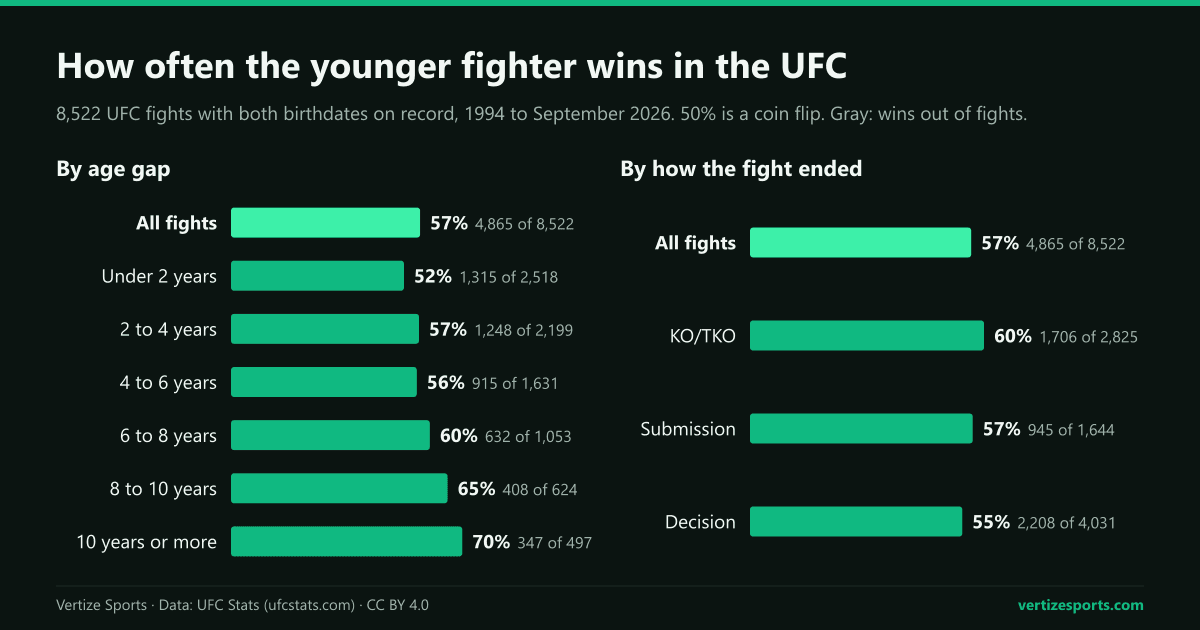
Younger fighter win percentage in the UFC, by age gap
Across those 8,522 fights the younger fighter won 4,865, or 57.1 percent, with a margin of error of about a point either way. That is about three times the edge of a longer reach, which has won 52 percent of UFC fights, and close to what a better record is worth: the fighter with the higher UFC win percentage going in won 57 percent of the 5,632 fights where the two differed.
The size of the gap matters. Three fights in ten were between fighters born less than two years apart, and there the younger won 52 percent; under a year apart, it was a coin flip. From there the rate climbs to 60 percent at six to eight years and 70 percent in the 497 fights with a gap of 10 years or more.
| Age gap | Fights | Younger won | Win rate |
|---|---|---|---|
| Under 2 years | 2,518 | 1,315 | 52% |
| 2 to 4 years | 2,199 | 1,248 | 57% |
| 4 to 6 years | 1,631 | 915 | 56% |
| 6 to 8 years | 1,053 | 632 | 60% |
| 8 to 10 years | 624 | 408 | 65% |
| 10 years or more | 497 | 347 | 70% |
| Any gap | 8,522 | 4,865 | 57% |
UFC win rate by age
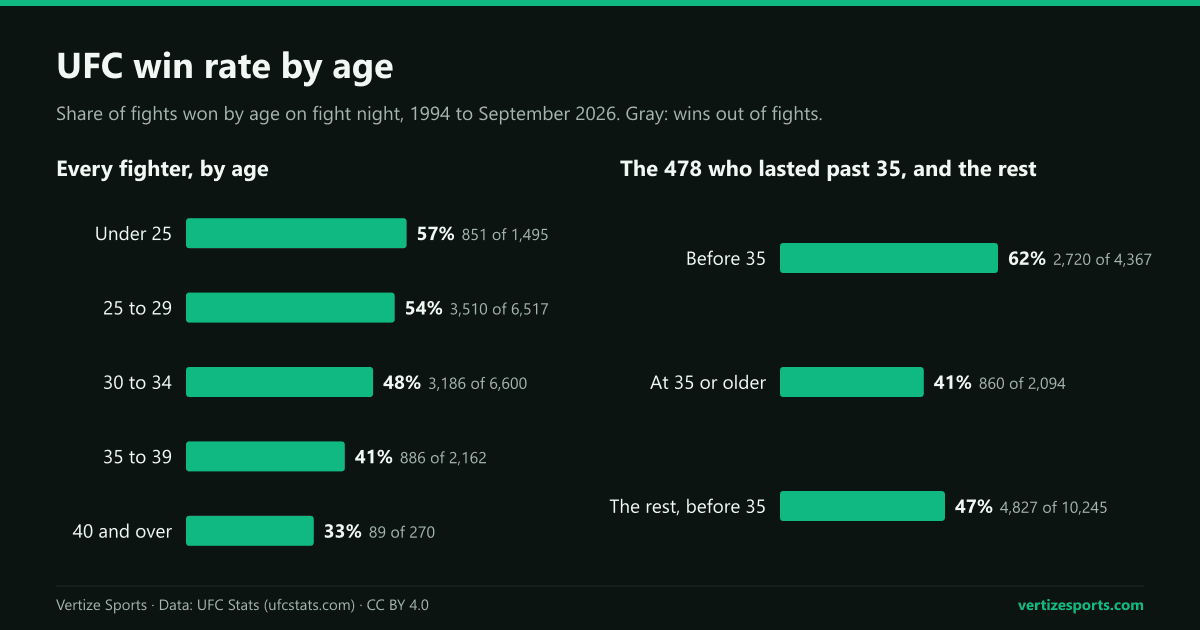
Counting every fighter in every one of those fights, win rates fall with each age band, from 57 percent under 25 to 33 percent at 40 or older. The break-even point is 30: fighters that age won 51 percent, those aged 31 won 49 percent, and every older age with at least 50 fights has won less than half.
| Age on fight night | Fights | Won | Win rate |
|---|---|---|---|
| Under 25 | 1,495 | 851 | 57% |
| 25 to 29 | 6,517 | 3,510 | 54% |
| 30 to 34 | 6,600 | 3,186 | 48% |
| 35 to 39 | 2,162 | 886 | 41% |
| 40 and over | 270 | 89 | 33% |
When a fighter 35 or older met one under 30, the older fighter won 34 percent of 871 fights. Age matters among young fighters too: when both were under 30, the younger still won 54 percent of 2,118 fights, and when both were 30 or older, 56 percent.
Age in knockouts, submissions and decisions
Age shows most in knockouts. The younger fighter won 60 percent of fights that ended by knockout or technical knockout, 57 percent of submissions and 55 percent of decisions, with split decisions a coin flip at 51 percent. Knockouts also account for more of fighters' losses as they age: 27 percent of losses under 25, 38 percent at 35 to 39 and 43 percent at 40 or older.
Age and weight class: the same edge in every division
In each of the 11 divisions the UFC ranks, the younger fighter has won between 55 and 60 percent, from 55 at middleweight to 60 at lightweight; at heavyweight and flyweight, the two ends of the men's scale, it is 58 percent. Men and women come out the same, at 57 percent, and a spread between divisions this wide would turn up by chance about two times in five.
What the age numbers can and cannot show
These are raw win rates, and age travels with other things. The biggest is survivorship: fighters still in the UFC at 35 are mostly the ones good enough to have lasted. The 478 who fought in the UFC both before and after turning 35 had won 62 percent of their fights before 35, against 47 percent for everyone else; at 35 or older they won 41 percent, and 353 of them did worse than before.
Other things cut both ways. The older fighter usually had more UFC fights going in (64 percent of fights where the counts differed), the younger one more often the better UFC win percentage (58 percent). Three checks on fighter quality point the same way as the headline:
- Between fighters within one win and one loss of each other in the UFC going in, the younger won 56 percent of 2,841 fights.
- The same 1,553 fighters won 60 percent of their fights when they were the younger one and 46 percent when they were the older.
- When both fighters were making their UFC debut, the younger won 55 percent of 454 fights.
The edge has also grown as the UFC has aged. The average fighter was 28.7 years old from 1994 to 2004 and 31.9 in 2025 and 2026, and fighters 35 or older now make up 23 percent of appearances, against 7 to 9 percent before 2015. The younger fighter won 55 percent of fights before 2015 and 59 percent since 2020. The data cannot separate age from what comes with it, such as accumulated damage and time between fights, and without betting odds we cannot tell whether the younger fighter wins more often than expected.
The oldest UFC champion and the youngest
Randy Couture is the oldest fighter to win a UFC belt: he was 43 when he beat Tim Sylvia for the heavyweight title at UFC 68 in March 2007, defended it at 44 and was 45 when Brock Lesnar took it at UFC 91 in November 2008. Glover Teixeira is the oldest first-time champion, winning the light heavyweight title two days after his 42nd birthday at UFC 267 in 2021. Only four titles have been won at 40 or older, three of them by Couture.
At the other end, Jon Jones is the youngest champion in UFC history, 23 years and 243 days old when he beat Mauricio Rua at UFC 128 in 2011. Joshua Van, the current flyweight champion, is second at 24 years and 57 days, after beating Alexandre Pantoja, 11 years his senior, at UFC 323 in December 2025. Only two others have won the belt in a fight before turning 25: Josh Barnett at heavyweight in 2002 and Carlos Newton at welterweight in 2001.
Most title winners are between 25 and 34: 103 of the 134 undisputed titles decided in the cage since 1997 went to fighters that age, and the median winner was 31. The 98 champions who lost the belt in a fight had a median age of 32, and 57 of them lost to a younger challenger. In title fights the younger fighter won 56 percent of 385, and champions 35 or older kept the belt in 58 percent of their decided title defenses, against 71 percent for younger champions.
Current UFC champions' ages and the next title fights
Six of the ten current champions are 35 or older, and their median age is 35; Alexander Volkanovski, the featherweight champion, turned 38 on September 29, and Joshua Van is the only one under 33. It fits a trend: since 2020 the median new champion has been 33, against 30 from 1997 to 2019, and 14 of the 48 titles won in the cage have gone to fighters 35 or older. Five of the nine current champions who won the belt in a fight beat a younger opponent.
| Division | Champion | Age | Age when crowned | Won the belt against (age) |
|---|---|---|---|---|
| Heavyweight | Ciryl Gane | 36 | 36 (promoted) | Alex Pereira (38), interim title |
| Light heavyweight | Carlos Ulberg | 35 | 35 | Jiří Procházka (33) |
| Middleweight | Sean Strickland | 35 | 35 | Khamzat Chimaev (32) |
| Welterweight | Islam Makhachev | 34 | 34 | Jack Della Maddalena (29) |
| Lightweight | Justin Gaethje | 37 | 37 | Ilia Topuria (29) |
| Featherweight | Alexander Volkanovski | 38 | 36 | Diego Lopes (30) |
| Bantamweight | Petr Yan | 33 | 32 | Merab Dvalishvili (34) |
| Flyweight | Joshua Van | 24 | 24 | Alexandre Pantoja (35) |
| Women's bantamweight | Kayla Harrison | 36 | 34 | Julianna Peña (35) |
| Women's flyweight | Vacant | — | — | — |
| Women's strawweight | Mackenzie Dern | 33 | 32 | Virna Jandiroba (37) |
The next title fights, with ages on fight night and the gap between birthdates:
- October 3, UFC 332 in Salt Lake City: Natalia Silva (29) and Wang Cong (34), 4.7 years apart, fight for the women's flyweight title, which Valentina Shevchenko vacated with an injury.
- October 24, UFC 333 in Abu Dhabi: Volkanovski (38) defends the featherweight title against Movsar Evloev (32), 5.4 years younger, and Petr Yan (33) the bantamweight title against Merab Dvalishvili (35), 2.1 years older.
- November 14, UFC 334 at Madison Square Garden: Ciryl Gane (36), promoted to undisputed champion in September, defends the heavyweight title against Josh Hokit (29), 7.6 years younger, and Kayla Harrison (36) the women's bantamweight title against Amanda Nunes (38), 2.1 years older.
Every card is on the Vertize UFC schedule, and the UFC hub lists the divisions and their weight limits.
Age in the UFC: frequently asked questions
Does age matter in the UFC? Yes. The younger fighter has won 57 percent of 8,522 UFC fights with both birthdates on record, and 70 percent when the gap was 10 years or more; fighters 35 or older have won 40 percent of their fights.
Who is the oldest UFC champion? Randy Couture, who won the heavyweight title at 43 at UFC 68 in 2007 and held it until he was 45. Glover Teixeira is the oldest first-time champion, at 42 in 2021.
Who is the youngest UFC champion? Jon Jones, who won the light heavyweight title at 23 at UFC 128 in 2011. Joshua Van is second, at 24 in December 2025.
How old are UFC champions? Since 1997 the median fighter to win an undisputed title in the cage was 31 on the night. The ten current champions have a median age of 35, and six are 35 or older.
How this was built: the 8,909 UFC fights recorded by UFC Stats (ufcstats.com) from UFC 2 in March 1994 (it has no record of UFC 1) to September 26, 2026, from the copy on GitHub refreshed on September 27, with the birthdate UFC Stats lists for each fighter. The younger fighter is the one born later; an age gap is the difference between birthdates, and an age on fight night counts completed years. Records going in count UFC fights only. Title reigns are rebuilt from the title fights and the belts that changed hands outside the cage, in the 11 divisions the UFC ranks. Champions follow the UFC rankings of September 29, with Ciryl Gane counted from his promotion on September 19 and the women's flyweight title vacant since Valentina Shevchenko gave it up on September 5, though the rankings still list her. The UFC's athlete pages give the same ages, except that Volkanovski and Nunes are still listed at 37. Margins of error are 95 percent Wilson intervals.