We matched every UFC fight recorded by UFC Stats, the fight-by-fight database at ufcstats.com, 8,909 bouts through September 26, 2026, with the reach and height it lists for each fighter. Draws (65) and no contests (90) are out; so are the 1,124 decisive fights where a reach is missing, more than half of them from before 2010, and the 1,002 where both fighters are listed at the same reach. That leaves 6,628 fights from 1997 to 2026, almost all of them since 2005.
Reach advantage win percentage in the UFC
Across those 6,628 fights the longer-reach fighter won 3,458, or 52.2 percent. With this many fights the margin of error is about a point either way, 51.0 to 53.4 percent, so the edge is real but small: about two extra wins per 100 fights compared with a coin flip. A better UFC record going in has been worth three times as much; the fighter with the higher UFC win percentage won 57 percent of the 4,671 fights where the two differed.
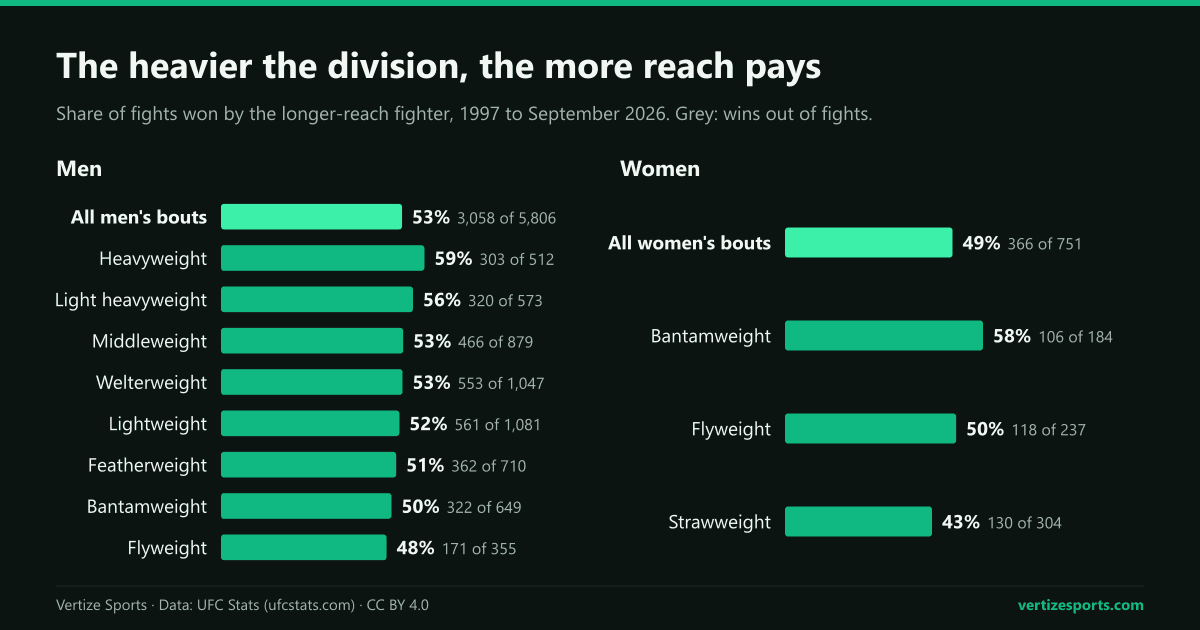
The size of the gap matters. Half of all fights had a gap of one or two inches, and there the longer fighter won 50.1 percent of 3,375. The rate rises to 53 percent at three or four inches, 54 percent at five or six and 60 percent at seven or more, though only 368 fights had a gap that large.
| Reach advantage | Fights | Longer reach won | Win rate |
|---|---|---|---|
| 1 to 2 inches | 3,375 | 1,690 | 50% |
| 3 to 4 inches | 1,990 | 1,064 | 53% |
| 5 to 6 inches | 895 | 485 | 54% |
| 7 inches or more | 368 | 219 | 60% |
| Any gap | 6,628 | 3,458 | 52% |
Where reach matters most: the heavier divisions
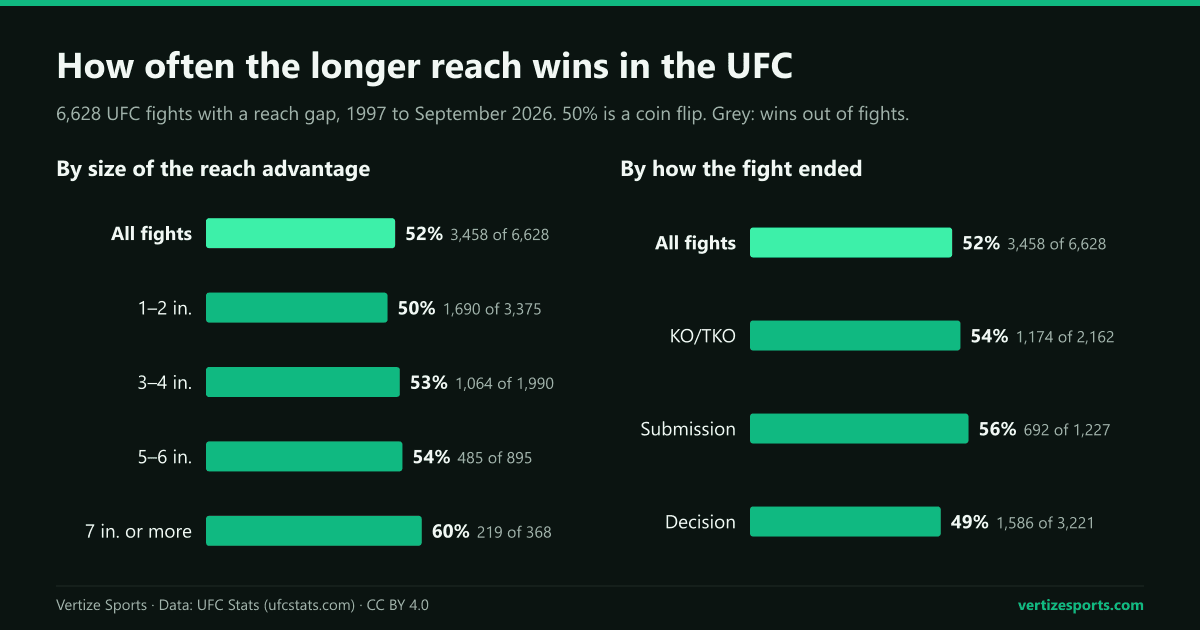
Among the men, the edge falls division by division from heavyweight to flyweight. The longer fighter won 59 percent of 512 heavyweight fights and 56 percent of 573 at light heavyweight, but only 50 percent of 1,714 in the three lightest men's divisions, flyweight, bantamweight and featherweight, and 48 percent at flyweight alone. Middleweight, welterweight and lightweight sit between 52 and 53 percent.
Women's divisions show no edge overall: the longer fighter won 49 percent of 751 fights, and 49 percent of the 127 with a gap of five inches or more. The same slope by weight appears, though, from 58 percent at bantamweight to 50 at flyweight and 43 at strawweight, the one division where the shorter fighter has clearly come out ahead, winning 57 percent of 304 fights; across a dozen divisions, one result that far from even could be chance.
Reach in knockouts, submissions and decisions
Reach shows up in finishes more than on the scorecards. The longer fighter won 54 percent of the fights that ended by knockout or technical knockout and 56 percent of those that ended in a submission, but 49 percent of decisions. On the judges' cards reach made no measurable difference until the gap reached seven inches, where the longer fighter won 58 percent of 159 decisions. Our count of how UFC fights end shows how common each result is.
Height advantage in the UFC
Height tells a similar story. The taller fighter won 52 percent of the 6,309 fights with a height difference, and the rate stays between 51 and 54 percent whatever the size of the gap.
The two measures usually travel together, and the edge appears only when they do. When the longer-reach fighter was also the taller one, he or she won 53 percent of 4,313 fights; when not, 50 percent of 2,313, a pattern that holds at every size of reach gap. A taller fighter with the same reach as the opponent won 50 percent of 785 fights. The edge seems to belong to the bigger fighter overall more than to long arms as such.
What the reach numbers can and cannot show
These are raw win rates, not a controlled experiment. We have no betting odds, which would say how good each fighter was thought to be, so we cannot tell whether the longer fighter wins more often than the market expects. Reach is the single figure UFC Stats lists today, not a measurement taken before each fight, and fighter quality is not controlled beyond these checks:
- Reach is not standing in for a better record: the longer fighter had the better UFC win percentage going in only 52 percent of the time, counting fights where the two differed.
- Between fighters within one win and one loss of each other in the UFC going in, the longer reach won 52 percent of 2,003 fights, the same edge as overall.
- The same 1,148 fighters won 54 percent of their fights with the longer reach and 51 percent with the shorter one.
- The edge has barely moved over time: between 51 and 54 percent in every five-year span from 2005 to 2024, and 54 percent in 2026 so far.
The checks support a small, real edge. They do not settle the bigger gaps: among fighters with similar records, the longer one won 52 percent of 399 fights with a gap of five inches or more, a sample too small to confirm or rule out the larger effect seen overall.
The longest reach in the UFC
UFC Stats lists four fighters at 84 inches, the longest reach of anyone who has fought in the UFC: Jon Jones, Stefan Struve, Sergei Pavlovich and Robelis Despaigne, the last two of whom have fought in 2026. The UFC's athlete pages put Jones and Struve half an inch longer, at 84.5. Jones had the longer reach in all 22 of his decisive fights with a gap and won 21, the loss a 2009 disqualification against Matt Hamill. Among women, Bea Malecki's 74 inches are the longest.
The biggest gap on record in a UFC fight is 13 inches, when Miguel Torres (76) beat Antonio Banuelos (63) on a decision at UFC 126 in 2011. Of the two decided fights with a 12-inch gap, one went to the longer fighter, Jones over Daniel Cormier in 2015, and one did not: Mark Hunt stopped the 84-inch Struve in 2013.
Current UFC champions' reach and the next title fights
The current champions show how small the edge is. Seven of the ten champions won their belt against an opponent with a longer reach, and five are shorter than the median fighter in their division; 61 of the 66 other welterweights who fought in the past year have a longer reach than Islam Makhachev. Only three had the longer reach when they won the belt: Justin Gaethje and Sean Strickland by an inch each, and Ciryl Gane by two over Alex Pereira, in the interim title fight that preceded his promotion.
| Division | Champion | Reach | Division median | Won the belt against |
|---|---|---|---|---|
| Heavyweight | Ciryl Gane | 81 in | 78 in | Alex Pereira (79 in) |
| Light heavyweight | Carlos Ulberg | 77 in | 76 in | Jiří Procházka (80 in) |
| Middleweight | Sean Strickland | 76 in | 75 in | Khamzat Chimaev (75 in) |
| Welterweight | Islam Makhachev | 70 in | 74 in | Jack Della Maddalena (73 in) |
| Lightweight | Justin Gaethje | 70 in | 71.5 in | Ilia Topuria (69 in) |
| Featherweight | Alexander Volkanovski | 71 in | 70.5 in | Diego Lopes (72 in) |
| Bantamweight | Petr Yan | 67 in | 69 in | Merab Dvalishvili (68 in) |
| Flyweight | Joshua Van | 65 in | 67.5 in | Alexandre Pantoja (67 in) |
| Women's bantamweight | Kayla Harrison | 66 in | 68 in | Julianna Peña (69 in) |
| Women's flyweight | Vacant | — | — | — |
| Women's strawweight | Mackenzie Dern | 63 in | 63 in | Virna Jandiroba (64 in) |
In title fights overall the longer reach has done better, 58 percent of 307, though Jones won 16 of them; without him the rate is 55 percent. The next title fights are mostly close on the tape, with reach as listed by UFC Stats:
- October 3, UFC 332 in Salt Lake City: Natalia Silva (65 inches) and Wang Cong (66) fight for the women's flyweight title, which Valentina Shevchenko vacated with an injury.
- October 24, UFC 333 in Abu Dhabi: Alexander Volkanovski (71) defends the featherweight title against Movsar Evloev (72), and Petr Yan (67) the bantamweight title against Merab Dvalishvili (68).
- November 14, UFC 334 at Madison Square Garden: Gane (81), promoted to undisputed champion in September, defends the heavyweight title against Josh Hokit (73), and Kayla Harrison (66) the women's bantamweight title against Amanda Nunes (69).
Four of the five gaps are one to three inches, where the longer fighter has won 50 to 53 percent. Gane's eight inches are the exception: at heavyweight, the longer fighter has won 61 percent of fights with a gap of five inches or more. Every card is on the Vertize UFC schedule, the UFC hub lists the divisions and their weight limits, and our study of first title defenses shows how often new champions keep the belt.
Reach in the UFC: frequently asked questions
Does reach matter in the UFC? A little. The longer-reach fighter has won 52 percent of 6,628 UFC fights with a reach gap, and 60 percent with a gap of seven inches or more; gaps of one or two inches have been a coin flip.
What is the longest reach in UFC history? 84 inches on UFC Stats, shared by Jon Jones, Stefan Struve, Sergei Pavlovich and Robelis Despaigne. The UFC's own athlete pages list Jones and Struve at 84.5.
Does height matter in the UFC? About as much as reach, and mostly together with it: the taller fighter has won 52 percent of fights with a height difference, but neither height nor reach has shown an edge on its own.
Which current UFC champion has the longest reach? Ciryl Gane, the heavyweight champion, at 81 inches. The shortest belongs to Mackenzie Dern, the strawweight champion, at 63.
How this was built: the 8,909 UFC fights recorded by UFC Stats (ufcstats.com) from UFC 2 in March 1994 to the Fight Night of September 26, 2026, from the copy on GitHub refreshed on September 27, with the height and reach UFC Stats lists for each fighter, in whole inches; the first fight with both reaches on record is from 1997. Draws, no contests and fights with equal or missing reach are left out, among them 18 fights since November 2025 involving newer fighters with no reach on the UFC Stats fighter list. Fighters who share a name were told apart by weight and age, and renamed fighters joined by hand; records going in count UFC fights only. The UFC's athlete pages list some fighters half an inch longer or shorter, which changes no title-fight gap above by more than half an inch, nor its direction. Champions follow the UFC rankings of September 29 and Gane's promotion, except that the women's flyweight title counts as vacant: Valentina Shevchenko gave it up on September 5, though the rankings still list her. Margins of error are 95 percent Wilson intervals.