The year-end No. 1 is the player on top of the season's last ATP or WTA singles ranking. We listed every one, checked against the official ATP and WTA records, and matched each season with that year's Grand Slam champions and the winners of the season-ending ATP Finals and WTA Finals.
How many Grand Slams the year-end No. 1 wins
Usually one or two. The men's year-end No. 1 won one major in 19 seasons, two in 21 and three in 10; the women's won one in 17, two in 13 and three in 11, and Graf won all four in 1988. On average the men's No. 1 won 1.7 majors a season and the women's 1.6: 43 percent of the men's majors played since 1973 and 39 percent of the women's since 1975.
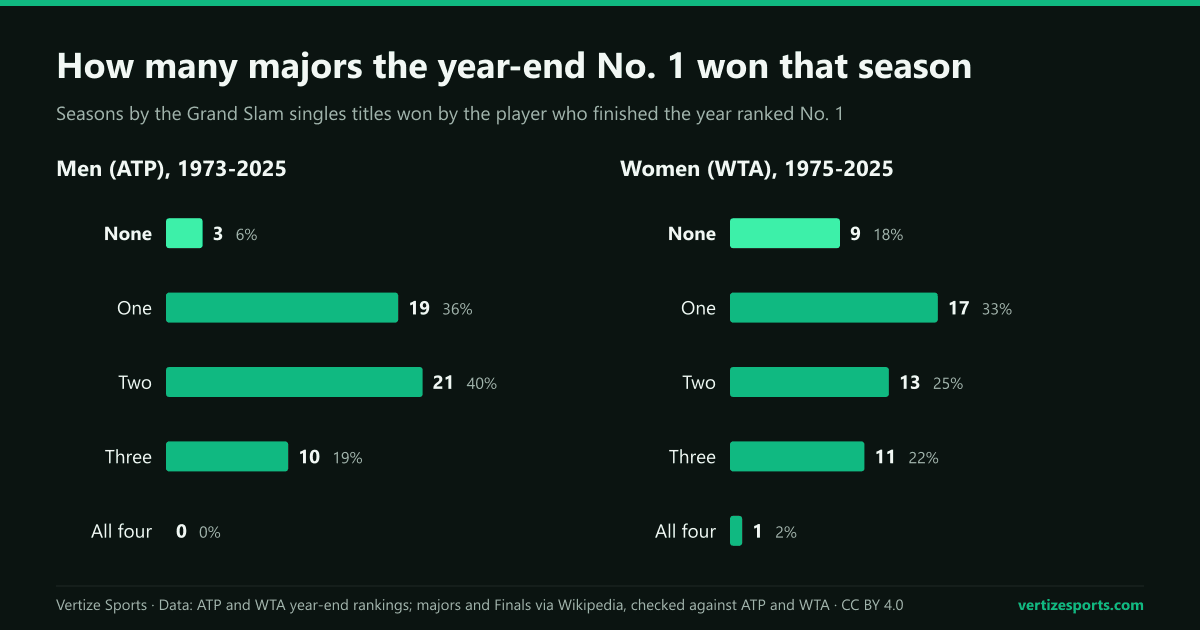
Twelve times, the player who finished No. 1 won no major that season:
- Jimmy Connors in 1975 and 1977, and John McEnroe in 1982.
- Martina Hingis in 2000, and Lindsay Davenport in 2001, 2004 and 2005.
- Jelena Jankovic in 2008, Caroline Wozniacki in 2010 and 2011, and Simona Halep in 2017, none of whom had won a major at the time.
- Ashleigh Barty in 2020, a season with no Wimbledon.
No man has finished No. 1 without a major since McEnroe in 1982, 43 seasons in a row. The women's record went the other way: every women's No. 1 from 1975 to 1999 won at least one major, and 9 of the 26 since 2000 did not. Wozniacki and Halep won a first major later, in 2018; Jankovic never did.
Nor did finishing first always mean winning the most majors. In 8 men's seasons and 13 women's, another player won more of them than the year-end No. 1. In 1977 Guillermo Vilas won two while Connors, with none, finished on top, and in 2001 Jennifer Capriati and Venus Williams won two each while Davenport, with none, finished first. More recently, Djokovic won two in 2016 to Andy Murray's one, and Rafael Nadal two in 2022 to Carlos Alcaraz's one.
Year-end No. 1 tennis history: every ATP and WTA No. 1 by season
Eleven of the 19 men and 13 of the 16 women finished on top more than once.
| Season | Men (ATP) | Majors won | Women (WTA) | Majors won |
|---|---|---|---|---|
| 1973 | Ilie Nastase | 1 | — | — |
| 1974 | Jimmy Connors | 3 | — | — |
| 1975 | Jimmy Connors | 0 | Chris Evert | 2 |
| 1976 | Jimmy Connors | 1 | Chris Evert | 2 |
| 1977 | Jimmy Connors | 0 | Chris Evert | 1 |
| 1978 | Jimmy Connors | 1 | Martina Navratilova | 1 |
| 1979 | Bjorn Borg | 2 | Martina Navratilova | 1 |
| 1980 | Bjorn Borg | 2 | Chris Evert | 2 |
| 1981 | John McEnroe | 2 | Chris Evert | 1 |
| 1982 | John McEnroe | 0 | Martina Navratilova | 2 |
| 1983 | John McEnroe | 1 | Martina Navratilova | 3 |
| 1984 | John McEnroe | 2 | Martina Navratilova | 3 |
| 1985 | Ivan Lendl | 1 | Martina Navratilova | 2 |
| 1986 | Ivan Lendl | 2 | Martina Navratilova | 2 |
| 1987 | Ivan Lendl | 2 | Steffi Graf | 1 |
| 1988 | Mats Wilander | 3 | Steffi Graf | 4 |
| 1989 | Ivan Lendl | 1 | Steffi Graf | 3 |
| 1990 | Stefan Edberg | 1 | Steffi Graf | 1 |
| 1991 | Stefan Edberg | 1 | Monica Seles | 3 |
| 1992 | Jim Courier | 2 | Monica Seles | 3 |
| 1993 | Pete Sampras | 2 | Steffi Graf | 3 |
| 1994 | Pete Sampras | 2 | Steffi Graf | 1 |
| 1995 | Pete Sampras | 2 | Steffi Graf | 3 |
| 1996 | Pete Sampras | 1 | Steffi Graf | 3 |
| 1997 | Pete Sampras | 2 | Martina Hingis | 3 |
| 1998 | Pete Sampras | 1 | Lindsay Davenport | 1 |
| 1999 | Andre Agassi | 2 | Martina Hingis | 1 |
| 2000 | Gustavo Kuerten | 1 | Martina Hingis | 0 |
| 2001 | Lleyton Hewitt | 1 | Lindsay Davenport | 0 |
| 2002 | Lleyton Hewitt | 1 | Serena Williams | 3 |
| 2003 | Andy Roddick | 1 | Justine Henin | 2 |
| 2004 | Roger Federer | 3 | Lindsay Davenport | 0 |
| 2005 | Roger Federer | 2 | Lindsay Davenport | 0 |
| 2006 | Roger Federer | 3 | Justine Henin | 1 |
| 2007 | Roger Federer | 3 | Justine Henin | 2 |
| 2008 | Rafael Nadal | 2 | Jelena Jankovic | 0 |
| 2009 | Roger Federer | 2 | Serena Williams | 2 |
| 2010 | Rafael Nadal | 3 | Caroline Wozniacki | 0 |
| 2011 | Novak Djokovic | 3 | Caroline Wozniacki | 0 |
| 2012 | Novak Djokovic | 1 | Victoria Azarenka | 1 |
| 2013 | Rafael Nadal | 2 | Serena Williams | 2 |
| 2014 | Novak Djokovic | 1 | Serena Williams | 1 |
| 2015 | Novak Djokovic | 3 | Serena Williams | 3 |
| 2016 | Andy Murray | 1 | Angelique Kerber | 2 |
| 2017 | Rafael Nadal | 2 | Simona Halep | 0 |
| 2018 | Novak Djokovic | 2 | Simona Halep | 1 |
| 2019 | Rafael Nadal | 2 | Ashleigh Barty | 1 |
| 2020 | Novak Djokovic | 1 | Ashleigh Barty | 0 |
| 2021 | Novak Djokovic | 3 | Ashleigh Barty | 1 |
| 2022 | Carlos Alcaraz | 1 | Iga Swiatek | 2 |
| 2023 | Novak Djokovic | 3 | Iga Swiatek | 1 |
| 2024 | Jannik Sinner | 2 | Aryna Sabalenka | 2 |
| 2025 | Carlos Alcaraz | 2 | Aryna Sabalenka | 1 |
Most year-end No. 1 finishes in tennis, and the longest streaks
Djokovic finished eight seasons at No. 1, from 2011 to 2023, the men's record, and Graf eight, from 1987 to 1996, the women's. Martina Navratilova did it seven times and Pete Sampras six; Connors, Roger Federer, Nadal, Chris Evert and Serena Williams finished five seasons each.
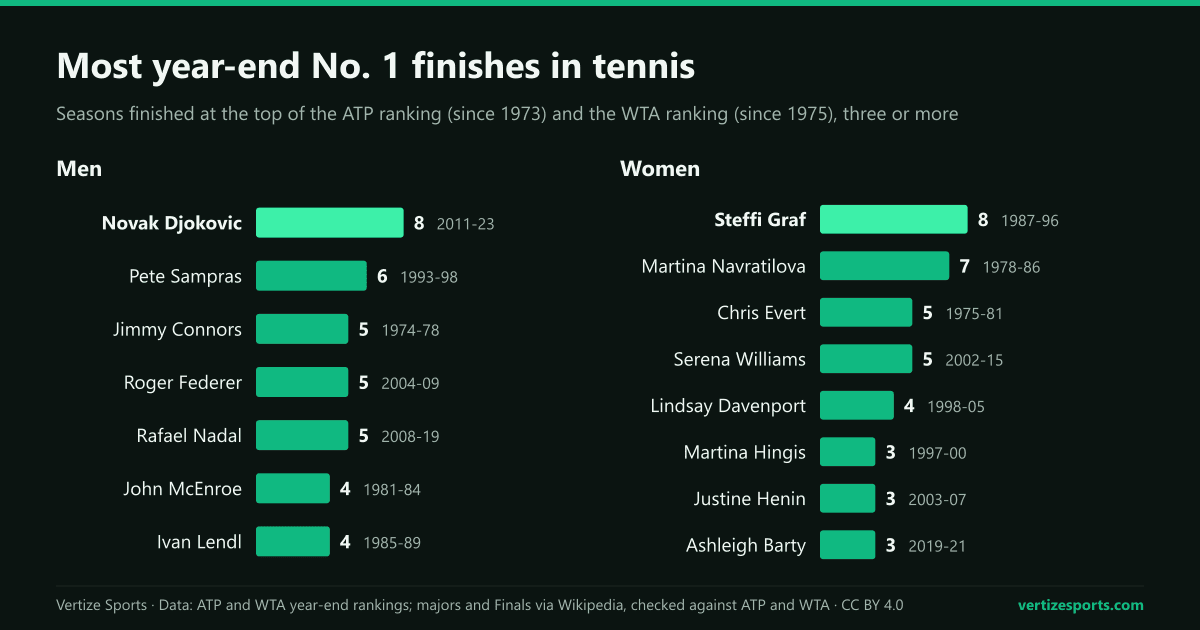
The longest runs of consecutive seasons at No. 1:
- Sampras, six from 1993 to 1998, the longest on either tour.
- Connors, five from 1974 to 1978, and Navratilova, five from 1982 to 1986.
- McEnroe from 1981 to 1984, Federer from 2004 to 2007 and Graf twice, from 1987 to 1990 and from 1993 to 1996: four each.
Djokovic's eight came in five separate runs, none longer than two seasons. From 2004 to 2023, Federer, Nadal and Djokovic finished 18 of the 20 seasons at No. 1; the exceptions were Murray in 2016 and Alcaraz in 2022.
How often the year-end No. 1 changes
The men's year-end No. 1 was a different player from the year before in 29 of 52 seasons, and in nine of the last 10, every season from 2016 to 2025 except 2021. The women's changed in 24 of 50 and in five of the last 10: Barty finished on top three years running from 2019 to 2021, Iga Swiatek in 2022 and 2023 and Aryna Sabalenka in 2024 and 2025.
Year-end No. 1 and the ATP Finals and WTA Finals
Finishing No. 1 and winning the season-ending championship have gone together less than half the time. The men's year-end No. 1 won the ATP Finals in 24 of 53 seasons, 45 percent, but only twice since 2017, Djokovic in 2023 and Jannik Sinner in 2024. Our history of the ATP Finals covers the rest of its record.
From 1975 to March 1986 the women's championship was played between February and April, so we count from November 1986, when it moved to the end of the season. Since then the women's year-end No. 1 has won the WTA Finals in 16 of 39 editions, 41 percent, most recently Swiatek in 2023; the event was not played in 2020.
Youngest and oldest year-end No. 1s
Hingis finished 1997 at No. 1 at the age of 17, the youngest on either tour, and Alcaraz was 19 in 2022, the youngest man; before him it was Lleyton Hewitt, 20 in 2001. The oldest are Djokovic, 36 in 2023, and Serena Williams, 34 in 2015.
Who finished 2025 as world No. 1: Alcaraz and Sabalenka
Alcaraz finished 2025 at No. 1 for the second time. Sinner won the Australian Open and Wimbledon and Alcaraz the French Open and the US Open, and the two met in three of those four finals. Alcaraz clinched the year-end No. 1 at the ATP Finals in Turin by beating Lorenzo Musetti in the group stage, then lost the final to Sinner, 7-6, 7-5.
Sabalenka was No. 1 in every week of 2025 and finished there for the second year in a row. Sabalenka won one major, the US Open, and lost the Australian Open final to Madison Keys and the French Open final to Coco Gauff. Elena Rybakina won the WTA Finals.
Year-end No. 1 in 2026: the season so far
All four majors of 2026 have been played. Alcaraz won the Australian Open, Alexander Zverev the French Open and the US Open, and Sinner Wimbledon; Rybakina won the Australian Open and the US Open, Mirra Andreeva the French Open and Linda Noskova Wimbledon. In the WTA ranking of Oct. 12, Rybakina was No. 1 and Sabalenka No. 2. In the ATP ranking dated Oct. 5, the latest on the ATP site when we checked on Oct. 14, Sinner was No. 1 and Zverev No. 2. On Oct. 12 the ATP announced that Zverev had clinched the 2026 year-end No. 1, the first German man to earn it.
The season closes with the WTA Finals at Indian Wells, California, from Nov. 8 to 15, and the ATP Finals in Turin from Nov. 15 to 22. Results from the tournaments in play are on our tennis scores page, and the rest of the tour is in the tennis section. On the majors themselves, see how old Grand Slam champions are and how often the top seed wins one.
Year-end No. 1 in tennis: frequently asked questions
Who has the most year-end No. 1 finishes in tennis? Novak Djokovic among men and Steffi Graf among women, eight each. Martina Navratilova has seven and Pete Sampras six.
Has anyone finished No. 1 without winning a Grand Slam that year? Yes, 12 times: Jimmy Connors in 1975 and 1977, John McEnroe in 1982 and nine women since 2000, most recently Ashleigh Barty in 2020.
Who was the youngest year-end No. 1? Martina Hingis, 17 in 1997. The youngest man is Carlos Alcaraz, 19 in 2022.
Who finished 2025 as world No. 1? Carlos Alcaraz in the ATP rankings and Aryna Sabalenka in the WTA rankings, Sabalenka for the second year in a row.
How this was built: every year-end No. 1 in singles from the first ATP year-end ranking, 1973, and the first WTA one, 1975, through 2025: 53 men's seasons and 51 women's. The lists come from Wikipedia's lists of ATP and WTA No. 1 players; every season matches the official lists of the ATP, with its news releases for 2022 to 2025, and the WTA. The WTA credits 1995 to Steffi Graf; Monica Seles shared the No. 1 ranking with Graf from August 1995 to November 1996. Majors come from Wikipedia's Grand Slam champions lists, checked against the WTA's official records (200 women's finals) and the ATP's official draws (every men's major since 2000); a season's majors are those whose final was played that year. Season-ending champions come from Wikipedia's ATP Finals and WTA Finals pages, checked against the official list of ATP Finals champions and the WTA's records; each ATP edition counts for the season it closed. Ages are at the end of each season, from ATP and WTA dates of birth (Wikipedia's for the men of 1973 to 1992). Data collected October 14, 2026; see also our methodology.