We counted the winners of every World Championship Grand Prix from the 1950 British Grand Prix to this year's Azerbaijan Grand Prix, 1,153 races in 77 seasons, from the season results pages on formula1.com. The Indianapolis 500 was also a round of the championship from 1950 to 1960, but it is not a Grand Prix and is left out; none of the drivers who won it in those years ever won a World Championship Grand Prix, so counting it would add one winner to each of those 11 seasons. Three races of the 1950s were won by two drivers sharing a car, and both are credited with the win. Teams are counted by constructor, whatever the engine: Brabham-Ford and Brabham-BMW, both winners in 1982, are one team.
How many different race winners in an F1 season
Usually five. Of the 76 complete seasons from 1950 to 2025, 27 had exactly five different winners, more than any other number, and five is also the median. Seven seasons had eight or more, and two had only two. The calendar has grown far more than the list of winners: from 7.4 Grands Prix a season in the 1950s to 24 in each of the last two seasons, while the winners went from 3.6 a season in the 1950s to 5.0 from 2020 to 2025.
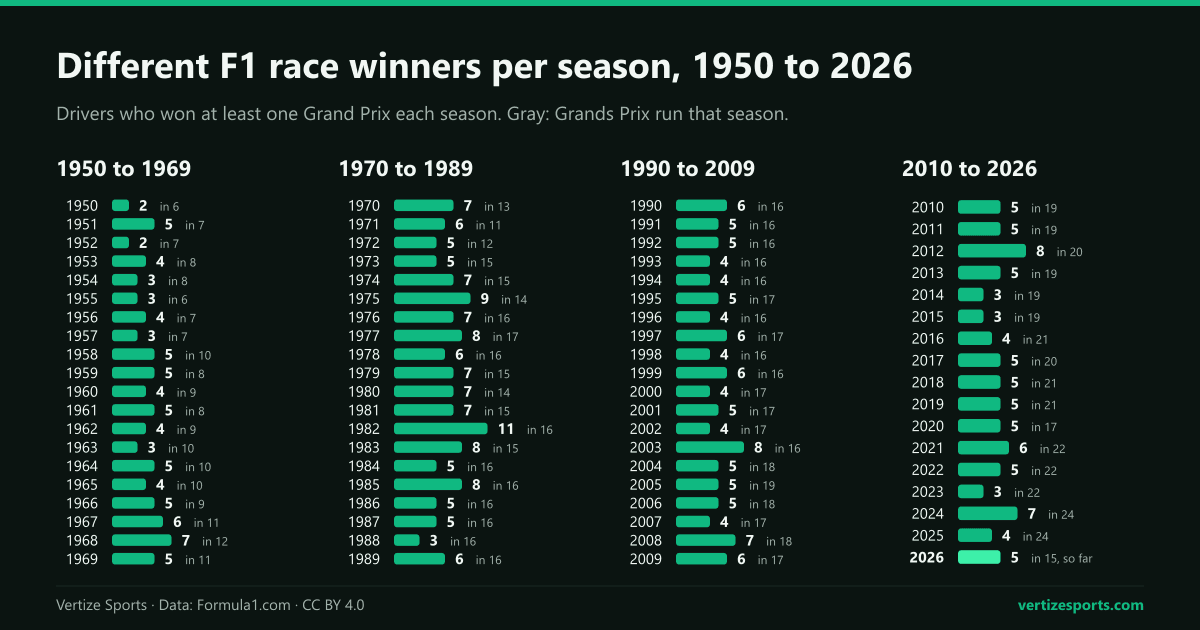
The most open decades were the 1970s and the 1980s, with 6.7 and 6.5 different winners a season and more than four winning teams. Since 1990, no decade has averaged more than 5.3 winners a season.
| Decade | Grands Prix a season | Winners a season | Teams a season | Top winner's share | Champion won most |
|---|---|---|---|---|---|
| 1950s | 7.4 | 3.6 | 2.1 | 54% | 9 of 10 |
| 1960s | 9.9 | 4.8 | 3.7 | 44% | 8 of 10 |
| 1970s | 14.4 | 6.7 | 4.7 | 34% | 8 of 10 |
| 1980s | 15.6 | 6.5 | 4.6 | 33% | 4 of 10 |
| 1990s | 16.2 | 4.9 | 3.3 | 46% | 10 of 10 |
| 2000s | 17.4 | 5.3 | 3.4 | 46% | 9 of 10 |
| 2010s | 19.8 | 4.8 | 3.1 | 48% | 9 of 10 |
| 2020-25 | 21.8 | 5.0 | 3.3 | 55% | 5 of 6 |
F1 seasons with the most different winners
The record belongs to 1982: 11 winners from seven teams in 16 races. Five drivers won twice and nobody won more. From the Monaco Grand Prix in May, won by Riccardo Patrese, to the Swiss Grand Prix at the end of August, won by Rosberg for Williams, nine consecutive races went to nine different drivers. Five of the 11 won a Grand Prix for the first time, the most first-time winners of any season.
Next comes 1975, with nine winners in 14 races, and five seasons had eight: 1977, 1983, 1985, 2003 and 2012. The 2012 season opened with seven different winners in its first seven races, from Jenson Button in Australia to Lewis Hamilton in Canada, the longest such run at the start of any season. Since 2012, no season has had more than the seven of 2024.
| Season | Grands Prix | Winners | Teams | Most wins | Champion, wins |
|---|---|---|---|---|---|
| 1975 | 14 | 9 | 6 | Niki Lauda, 5 | Niki Lauda, 5 |
| 1977 | 17 | 8 | 6 | Mario Andretti, 4 | Niki Lauda, 3 |
| 1982 | 16 | 11 | 7 | Five drivers, 2 | Keke Rosberg, 1 |
| 1983 | 15 | 8 | 6 | Alain Prost, 4 | Nelson Piquet, 3 |
| 1985 | 16 | 8 | 5 | Alain Prost, 5 | Alain Prost, 5 |
| 2003 | 16 | 8 | 5 | Michael Schumacher, 6 | Michael Schumacher, 6 |
| 2012 | 20 | 8 | 6 | Sebastian Vettel, 5 | Sebastian Vettel, 5 |
The most dominant F1 seasons
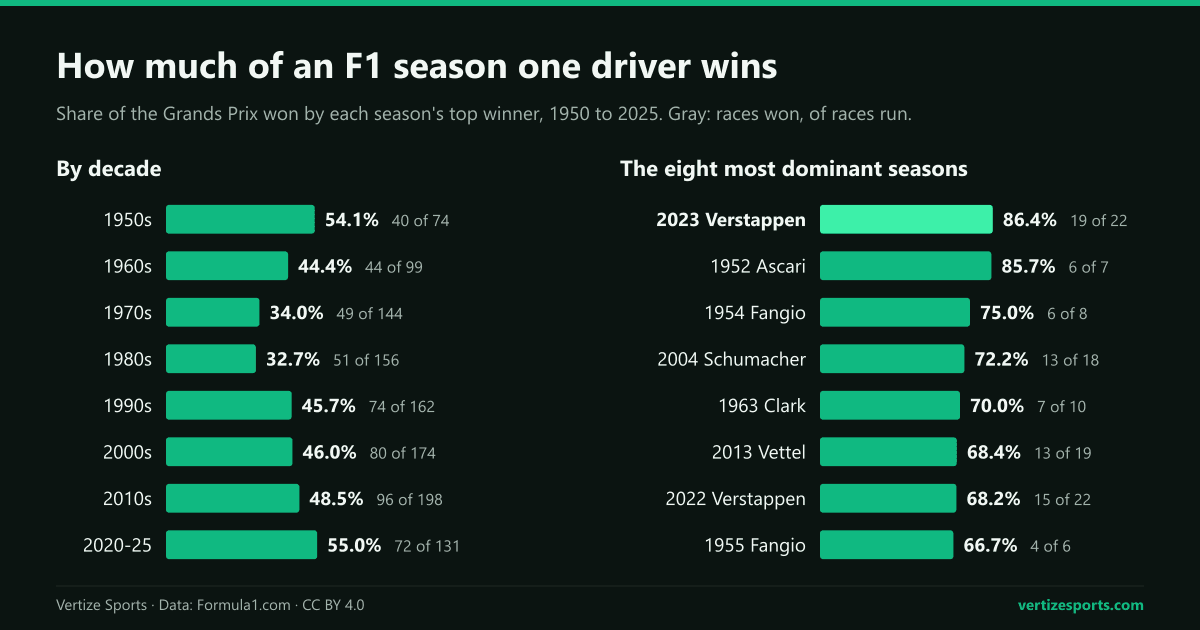
Measured by the share of the Grands Prix won by one driver, the most dominant season is 2023, when Verstappen won 19 of the 22 for Red Bull, 86.4 percent, as formula1.com's 2023 results show. Alberto Ascari's 1952 for Ferrari is a fraction behind, six of seven, 85.7 percent, followed by Juan Manuel Fangio's six of eight in 1954 and Michael Schumacher's 13 of 18 for Ferrari in 2004. At the bottom is 1982 again: nobody won more than two of the 16 races, 12.5 percent.
| Season | Driver | Team | Won | Share |
|---|---|---|---|---|
| 2023 | Max Verstappen | Red Bull | 19 of 22 | 86.4% |
| 1952 | Alberto Ascari | Ferrari | 6 of 7 | 85.7% |
| 1954 | Juan Manuel Fangio | Maserati, Mercedes | 6 of 8 | 75.0% |
| 2004 | Michael Schumacher | Ferrari | 13 of 18 | 72.2% |
| 1963 | Jim Clark | Lotus | 7 of 10 | 70.0% |
| 2013 | Sebastian Vettel | Red Bull | 13 of 19 | 68.4% |
| 2022 | Max Verstappen | Red Bull | 15 of 22 | 68.2% |
| 1955 | Juan Manuel Fangio | Mercedes | 4 of 6 | 66.7% |
| 2002 | Michael Schumacher | Ferrari | 11 of 17 | 64.7% |
| 2020 | Lewis Hamilton | Mercedes | 11 of 17 | 64.7% |
By decade, the top winner took about a third of the races in the 1970s and 1980s and the most from 2020 to 2025, 55 percent, just above the 1950s' 54. A team's share runs higher, since it enters more than one car. Alfa Romeo won all six Grands Prix of 1950 and Ferrari all seven of 1952, the only seasons with a single winning team. Since then, the highest share is Red Bull's 21 of 22 in 2023, 95.5 percent, ahead of McLaren's 15 of 16 in 1988 and Mercedes' 19 of 21 in 2016.
How often the F1 champion wins the most races
Usually, but not always. In 62 of the 76 seasons from 1950 to 2025, the champion won more Grands Prix than anyone else or tied for the most. In the other 14, another driver won more, six times in the 1980s alone.
| Season | Champion | Wins | Most wins |
|---|---|---|---|
| 1958 | Mike Hawthorn | 1 | Stirling Moss, 4 |
| 1964 | John Surtees | 2 | Jim Clark, 3 |
| 1967 | Denny Hulme | 2 | Jim Clark, 4 |
| 1977 | Niki Lauda | 3 | Mario Andretti, 4 |
| 1979 | Jody Scheckter | 3 | Alan Jones, 4 |
| 1982 | Keke Rosberg | 1 | Five drivers, 2 |
| 1983 | Nelson Piquet | 3 | Alain Prost, 4 |
| 1984 | Niki Lauda | 5 | Alain Prost, 7 |
| 1986 | Alain Prost | 4 | Nigel Mansell, 5 |
| 1987 | Nelson Piquet | 3 | Nigel Mansell, 6 |
| 1989 | Alain Prost | 4 | Ayrton Senna, 6 |
| 2008 | Lewis Hamilton | 5 | Felipe Massa, 6 |
| 2016 | Nico Rosberg | 9 | Lewis Hamilton, 10 |
| 2025 | Lando Norris | 7 | Max Verstappen, 8 |
Two of the 35 world champions took the title with a single win: Mike Hawthorn in 1958, when Stirling Moss won four races, and Rosberg in 1982. The most recent champion to win fewer races than a rival is Lando Norris, with seven wins in 2025 to Verstappen's eight; Norris took the title by two points, as our count of recent F1 title margins shows. Verstappen's 19 in 2023 are the most wins by a champion, and by any driver, in one season. For how often the leader at each stage of a season goes on to the title, see our study of F1 championship comebacks.
F1 race winners in 2026
Five drivers from three teams have won the 15 Grands Prix of 2026, through the Azerbaijan Grand Prix on September 26, according to formula1.com's results. That is already more winners than in all 24 races of 2025, which had four:
- Kimi Antonelli, Mercedes: 8 (China, Japan, Miami, Canada, Monaco, Belgium, Italy and Spain). China was the first Grand Prix win of Antonelli's career.
- George Russell, Mercedes: 3 (Australia, Austria and Azerbaijan).
- Lando Norris, McLaren: 2 (Hungary and the Netherlands).
- Lewis Hamilton, Ferrari: 1 (Barcelona-Catalunya), Hamilton's first Grand Prix win for Ferrari.
- Charles Leclerc, Ferrari: 1 (Great Britain).
Antonelli has won 53 percent of the races so far and Mercedes 11 of 15, 73 percent. Verstappen, who won the most races in 2025, has not won this year, and neither has Oscar Piastri, who won seven for McLaren last season; Red Bull, a winner in every season from 2016 to 2025, has yet to win a race.
Eight Grands Prix are left on the 2026 calendar, starting with the Bahrain Grand Prix, moved this year to Sepang in Malaysia, on October 4. The last two, in Qatar and Abu Dhabi, are in doubt: teams expect a final decision by mid-October. Antonelli leads the drivers' standings by 66 points over Russell; for where the title can be settled, see when Antonelli can clinch it.
Different F1 race winners: frequently asked questions
Which F1 season had the most different winners? 1982, when 11 drivers won the 16 Grands Prix. The next highest is nine, in 1975, and no season since 1982 has had more than eight, the total of 1983, 1985, 2003 and 2012.
How many different race winners does a typical F1 season have? Five, the most common number and the median of the 76 seasons from 1950 to 2025. Only 1950 and 1952 had as few as two.
What is the most dominant season in F1 history? By share of races won, 2023: Max Verstappen won 19 of the 22 Grands Prix, 86.4 percent, just ahead of Alberto Ascari's six of seven in 1952.
Has a driver won the F1 title with only one race win? Yes, twice: Mike Hawthorn in 1958 and Keke Rosberg in 1982.
How many different drivers have won F1 races in 2026? Five through the Azerbaijan Grand Prix: Kimi Antonelli, George Russell, Lando Norris, Lewis Hamilton and Charles Leclerc, with eight races left.
How this was built: the winner and team of every Formula 1 World Championship Grand Prix from the 1950 British Grand Prix to the 2026 Azerbaijan Grand Prix, 1,153 races, from the season results pages on formula1.com. The 11 Indianapolis 500s of 1950 to 1960 are not counted. In the three shared drives, the 1951 French, 1956 Argentine and 1957 British Grands Prix, the race counts once and both drivers are credited with the win. Teams are constructors, whatever the engine. The top winner's share is the most wins by one driver divided by the season's Grands Prix, and decade figures cover complete seasons. Champions come from formula1.com's final standings from 1991 and, before that, from the list of world champions on Wikipedia, checked against formula1.com's Hall of Fame; every champion's win count here matches that list. Standings and calendar from formula1.com, September 30, 2026.