Antonelli started the Mexico City Grand Prix fourth and finished third, 4.006 seconds behind winner Verstappen, in formula1.com's official result, and that made him champion: he needed only ninth place, formula1.com's race report said. The drivers' standings had Antonelli 119 points clear of Verstappen with four Grands Prix, 25 points a win and no sprints, left. Antonelli's ninth win of the season had come a week earlier, in Austin, from his seventh pole.
The F1 standings after the Mexico City Grand Prix
| Driver | Team | Points | Wins | Behind |
|---|---|---|---|---|
| Kimi Antonelli | Mercedes | 380 | 9 | - |
| Max Verstappen | Red Bull | 261 | 3 | 119 |
| Lewis Hamilton | Ferrari | 259 | 1 | 121 |
| George Russell | Mercedes | 250 | 3 | 130 |
| Charles Leclerc | Ferrari | 245 | 1 | 135 |
| Lando Norris | McLaren | 221 | 2 | 159 |
| Oscar Piastri | McLaren | 144 | 0 | 236 |
The championship was a Mercedes story from the opening weekends of the new regulations, and inside Mercedes it was Antonelli's. He won nine of the 19 races, 47 percent; the other ten went to five drivers: three each for George Russell and Verstappen, two for Lando Norris and one each for Lewis Hamilton and Charles Leclerc. Verstappen won none of the first 15 races and three of the last four.
How many points were left in the 2026 F1 season
A Grand Prix win is worth 25 points, with no bonus for the fastest lap, and a tie on points goes to the driver with more wins, then more second places. The sprints were over, the sixth and last in Singapore on October 10, so the four Grands Prix after Mexico City were worth 100 points, 19 fewer than Antonelli's lead over Verstappen. Hamilton was 121 behind, Russell 130, Leclerc 135 and Norris 159; Oscar Piastri, 236 behind, was long out of reach.
The calendar had changed once already: Bahrain and Saudi Arabia were dropped in March because of the conflict in the Middle East, and Bahrain's race was moved to Sepang in Malaysia, where Verstappen won it from pole on October 4.
How Antonelli clinched the title in Mexico City
The earliest chance was the United States Grand Prix in Austin on October 25, and it took three results at once, as we worked out on October 15: a win for Antonelli, Russell ninth or lower and Hamilton fifth or lower. Antonelli won from pole, but Russell finished eighth and Hamilton fourth, one place short of what he needed in each case, so he arrived in Mexico City with 365 points to Russell's 242: 123 ahead, with five races and 125 points left.
In Mexico City ninth place was enough, and tenth was not. If Russell won the race and Antonelli finished ninth, the gap would be exactly 100 points, the points left, and even four more Russell wins would leave the two level on 367 points, with Antonelli ahead on Grand Prix wins, nine to eight. With a tenth place the gap would be 99. Antonelli did much better than that. Verstappen won from fifth on the grid, after a one-place penalty; Hamilton, on pole, was second; Russell was sixth. It is the sixth title decided in Mexico City, as our history of the Mexico City Grand Prix counts.
What our October 15 simulation said
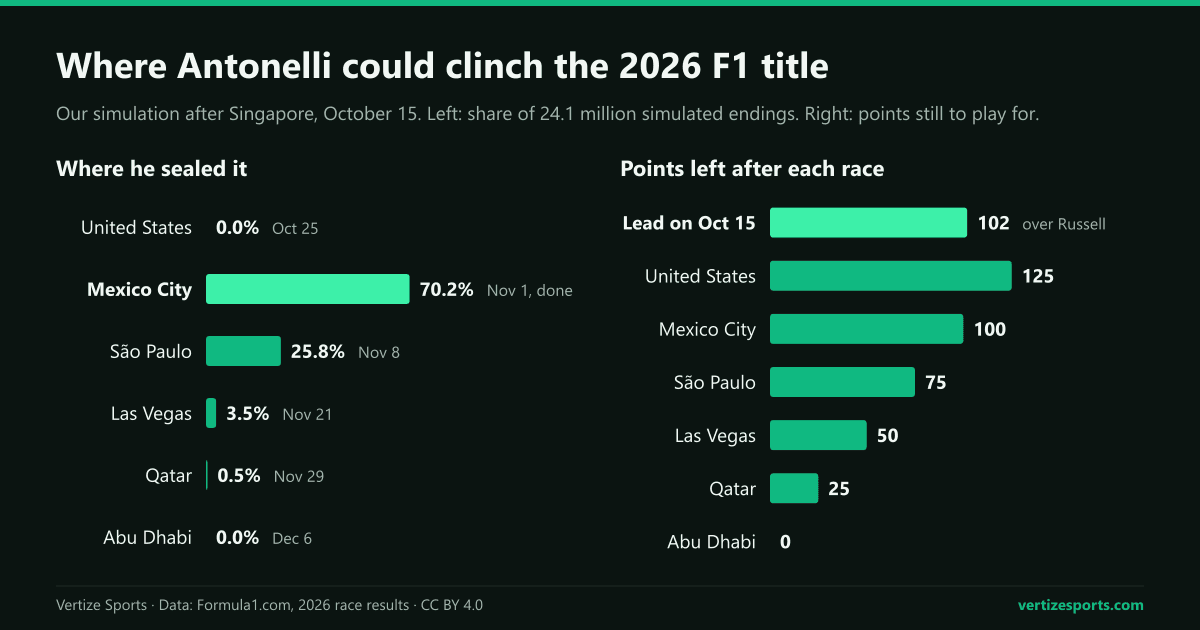
On October 15, after Singapore, we replayed the six races left in every possible way: each one a copy of one of the 17 Grands Prix already run, with every driver's result from that race kept together. That made 24,137,569 equally likely endings to the season. Antonelli won the title in all but 352 of them, and clinched it in Mexico City in 70 percent, the likeliest place.
| Race | Date | Antonelli clinches there | Decided by then |
|---|---|---|---|
| United States (Austin) | Sunday, October 25 | 0% | 0% |
| Mexico City | Sunday, November 1 | 70% | 70% |
| São Paulo | Sunday, November 8 | 26% | 96% |
| Las Vegas | Saturday, November 21 | 3.5% | 99.5% |
| Qatar | Sunday, November 29 | 0.5% | 99.96% |
| Abu Dhabi | Sunday, December 6 | 0.04% | 100% |
Mexico City led because Antonelli's 102-point lead on October 15 was already bigger than the 100 points that would be left after it: leave Mexico City more than 100 points clear of every rival and the title is yours. São Paulo followed at 26 percent and Las Vegas at 3.5, and the title was settled before the last two races in 99.5 percent of replays. Austin never came up in the replays, because it took the three results that had not happened together in any race that year. That combination did not happen in Austin either.
In our September 28 version, after Azerbaijan, São Paulo was the favorite, at 36 percent, ahead of Mexico City at 27. Two weekends in Malaysia and Singapore, in which Antonelli scored 38 points to Russell's 2, moved the likeliest date forward by a week.
The replays gave Russell the title in 207 of the 24.1 million, about one in 117,000, Hamilton in 138 and Leclerc in 7; Verstappen and Norris never won it. Even six Russell wins in the six races left would have gained Russell only 42 of the 102 points if Antonelli finished second each time, and for six wins to be enough Antonelli would have had to score no more than 48 points in them, an average of 8, what sixth place pays. What the replays could not see was change: they gave every race of 2026 the same weight, so they knew nothing of form, upgrades or grid penalties, such as the one that put Verstappen fifth in Mexico City.
The youngest champion in Formula 1 history
Antonelli was born on August 25, 2006, so on November 1 he was 20 years and 68 days old. The record belonged to Sebastian Vettel, 23 years and 134 days old when he won the 2010 title in Abu Dhabi, and Antonelli took it by 1,162 days, more than three years, as our study of the youngest winners and champions shows. formula1.com's account of the records he broke also calls him the first Italian champion since Alberto Ascari in 1953, a wait of 73 years: Nino Farina won the first title in 1950 and Ascari those of 1952 and 1953, and Antonelli is Italy's third champion, as our count of champions by country tallies.
- Kimi Antonelli, 2026, Mexico City Grand Prix: 20 years and 68 days.
- Sebastian Vettel, 2010, Abu Dhabi Grand Prix: 23 years and 134 days.
- Lewis Hamilton, 2008, Brazilian Grand Prix: 23 years and 300 days.
- Fernando Alonso, 2005, Brazilian Grand Prix: 24 years and 58 days.
- Max Verstappen, 2021, Abu Dhabi Grand Prix: 24 years and 73 days.
What is left of the 2026 season
Four Grands Prix are left on formula1.com's calendar: São Paulo on November 8, Las Vegas on November 21, Qatar on November 29 and Abu Dhabi on December 6. None has a sprint, so 100 points remain, and they can no longer change who is champion, only the order behind Antonelli: Verstappen has 261 points, Hamilton 259 and Russell 250, 11 between second and fourth, with Leclerc fifth on 245.
More on the 2026 title race
- The F1 standings update after every Grand Prix.
- The 2026 calendar has the four weekends left with their dates and circuits.
- Austin, where the title could not yet be settled: our history of the United States Grand Prix includes the two titles Lewis Hamilton sealed there, in 2015 and 2019.
- For what a title usually costs, we counted five seasons of F1 championships: the margins, the leads and the year the champion won by two points.
- How rare a late comeback is: in our study of F1 title comebacks, the biggest since 1991, measured against the points left, is Kimi Räikkönen's in 2007, from 17 points behind with 20 to play for.
F1 2026 title race: frequently asked questions
When did Antonelli win the 2026 F1 title? At the Mexico City Grand Prix on Sunday, November 1, 2026, round 19 of 23. He finished third and left Mexico City with 380 points to Max Verstappen's 261, 119 points ahead with 100 left.
How did Antonelli clinch the 2026 title? He needed ninth place or better in Mexico City, whatever his rivals did. He started fourth and finished third, behind Verstappen and Hamilton, and the 100 points left in the four Grands Prix after it were fewer than his lead.
Why did Antonelli not clinch the title in Austin? Because it took three results at once: a win for Antonelli, Russell ninth or lower and Hamilton fifth or lower. Antonelli won from pole on October 25, but Russell finished eighth and Hamilton fourth.
Is Antonelli the youngest F1 world champion? Yes. He was 20 years and 68 days old on November 1, 1,162 days younger than Sebastian Vettel, whose record of 23 years and 134 days was set in Abu Dhabi in 2010.
How many races are left in the 2026 F1 season? Four, with no sprints: São Paulo on November 8, Las Vegas on November 21, Qatar on November 29 and Abu Dhabi on December 6, all on formula1.com's calendar. The 100 points they carry can no longer change the champion, only the order behind Antonelli.
How this was built: race results, sprint results, starting grids and standings from formula1.com, as of November 3, 2026, after the Mexico City Grand Prix; the 19 Grands Prix and six sprints reproduce the official standings exactly. The simulation is the one published on October 15, after Singapore: each of the six races then left was replayed as a copy of one of the 17 Grands Prix already run, with every driver's points and finishing position from that race kept together, and all 24,137,569 combinations count as equally likely; a random draw of 200,000 seasons gives the same shares to within half a point. The model weighs every 2026 race the same and knows nothing of form, upgrades or penalties. A title counts as clinched once no rival can reach the leader with the points left, 25 a race; ties go to the driver with more Grand Prix wins, then more second places, as the FIA's 2026 regulations set out. Ages are full years plus days since the last birthday, on the local race date. The calendar is formula1.com's as of November 3.