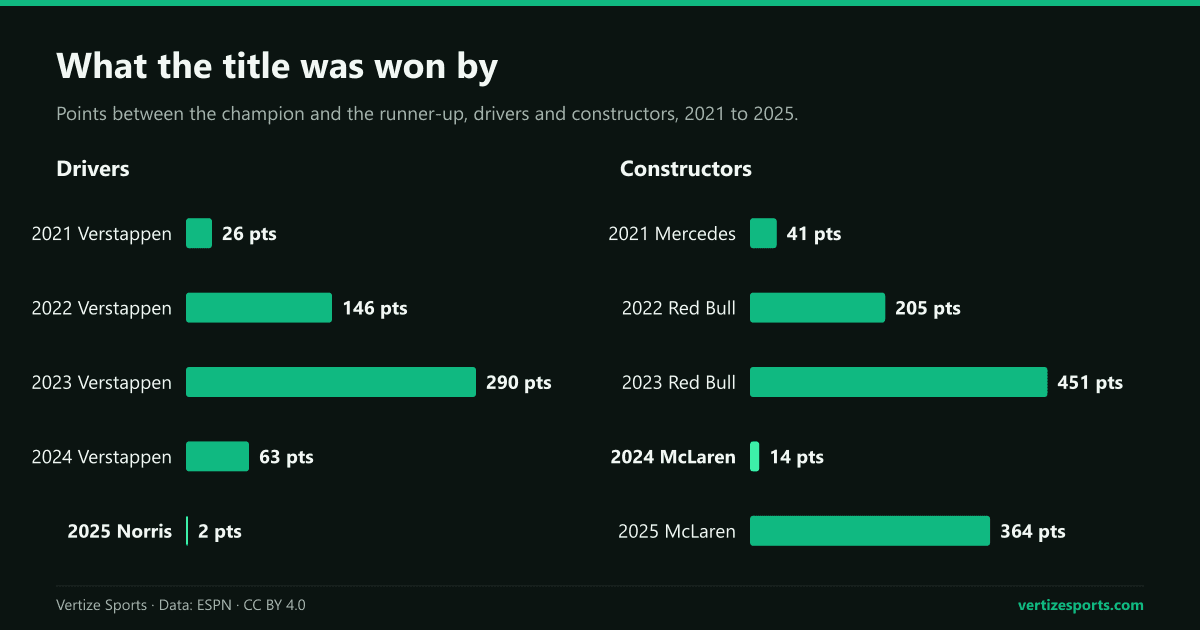
The championship is decided by addition, which sounds like it should make it predictable. It does not: the same scale delivers titles settled with four races to spare and titles settled on the last afternoon of the year. Here is how the points work, and what five seasons of them actually cost.
The scale
| Finish | Grand Prix | Sprint |
|---|---|---|
| 1st | 25 | 8 |
| 2nd | 18 | 7 |
| 3rd | 15 | 6 |
| 4th | 12 | 5 |
| 5th | 10 | 4 |
| 6th | 8 | 3 |
| 7th | 6 | 2 |
| 8th | 4 | 1 |
| 9th | 2 | - |
| 10th | 1 | - |
Ten of the twenty cars score in a grand prix and eight in a sprint, and that is the detail that shapes a season. The gap between a good car and a very good one is rarely a win; it is a run of finishes that separate by three or four points a weekend and then compound over nine months.
Two changes matter when reading older tables. Sprints arrived in 2021 and now pay eight points down to one across six weekends a year, and the bonus point for the fastest lap was scrapped from 2025 after teams started pitting late purely to take it. A 2025 total is therefore not strictly comparable with a 2021 one, which is what makes most-points-ever claims slippery.
What the titles were won by
| Season | Champion | Points | Won by | Rounds led |
|---|---|---|---|---|
| 2021 | Max Verstappen | 413.5 | 26 pts | 15 of 22 |
| 2022 | Max Verstappen | 454 | 146 pts | 18 of 23 |
| 2023 | Max Verstappen | 575 | 290 pts | 23 of 23 |
| 2024 | Max Verstappen | 437 | 63 pts | 24 of 24 |
| 2025 | Lando Norris | 423 | 2 pts | 9 of 24 |
The median champion of these five seasons finished on 437 points and won by 63. The extremes are what make that median useless on its own: Max Verstappen took 575 points in 2023 and won by 290, a season that stopped being a contest long before it stopped being a calendar, while Lando Norris won 2025 by two.
The year the champion spent behind
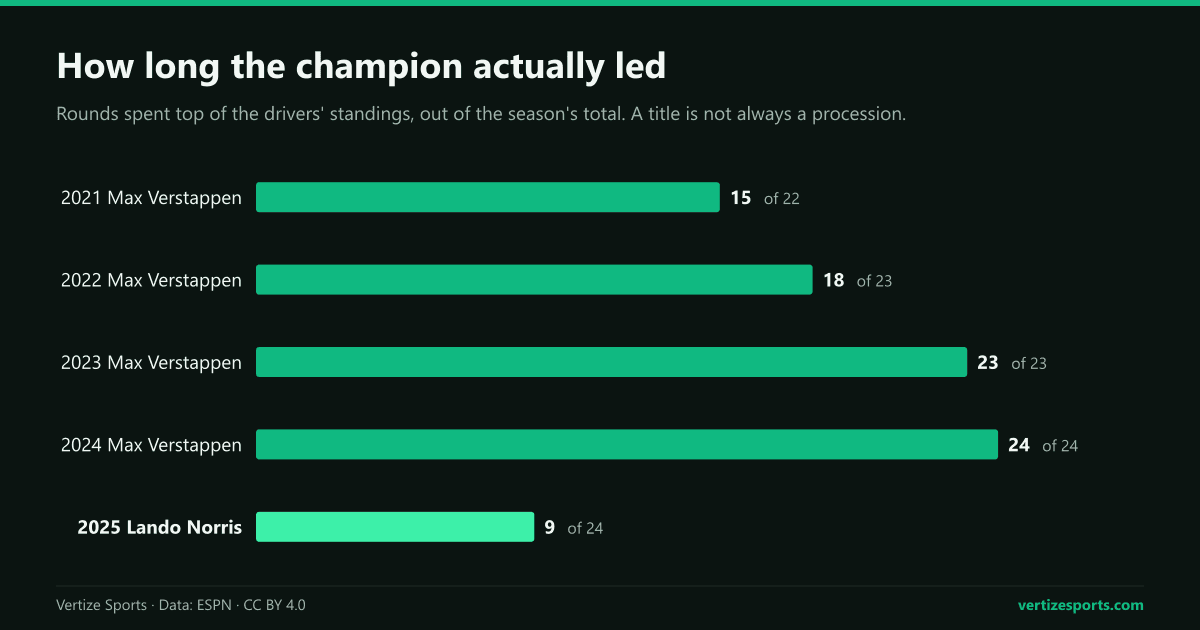
Lando Norris led the standings after only 9 of 24 rounds in 2025, and at his lowest he was 34 points behind. He did not take the lead for good until round 20 of 24. Set that against the two seasons before it, when the champion was top of the table after every single race, and you have one points system producing two completely different kinds of year.
It is also the argument for watching the arithmetic rather than the table. A driver twenty-five points behind with six rounds left is one retirement away from level, and a Sunday-night standings page does not tell you which of those two situations you are in.
What a comeback costs
Twenty-five points is a win, so a deficit only means something once you convert it into races. The 34 points Lando Norris trailed by in 2025 were, in race terms, a win and a third: recoverable in two bad afternoons for the other man, which is roughly how it happened.
A hundred points, the sort of gap that opens by midsummer in a one-team year, is four clear wins with nothing going wrong. That is why championships tend to be settled either very late or very early, and rarely in between.
The championship the teams actually care about
The constructors' title sets the prize money, and it is decided by adding both cars, which doubles the scale of everything. Red Bull scored 860 points in 2023 and won it by 451; McLaren took 833 in 2025, 364 clear of Mercedes.
And it is not always the more comfortable of the two. In 2024 McLaren won the constructors' championship by 14 points across a whole season, which is less than one car scores for finishing second in a single grand prix.
Follow it round by round
- The F1 standings carry both championships, drivers and constructors, as the season runs.
- The calendar has every round with its date, so what is still mathematically available is always one page away.
- For this season, we simulated where Kimi Antonelli can clinch the 2026 title, race by race and with or without Qatar and Abu Dhabi.
- For the same question in a league rather than a championship: what it takes to reach the playoffs and what promotion costs in Europe's second tiers.
Points and margins come from the final classification of each season, 2021 to 2025. Constructors' totals add both cars, which is why they run at roughly twice a driver's scale. Rounds led counts the standings after each grand prix, sprint points included.