To measure it, we rebuilt the drivers' standings after every Grand Prix of those 35 seasons, 649 races and 24 sprints, from the official results on formula1.com, the same source as our study of how often pole position wins. The count starts in 1991, the first season in which every result counted toward the title; until then drivers dropped their worst scores. Our totals match each season's official final standings for every driver.
How often the F1 championship leader wins the title
The leader after the opening race, always its winner, became champion 21 times in 35 seasons, 60 percent. From a fifth of the season to three fifths, the leader's record barely moves: between 71 and 74 percent at every step. It rises only after that, to 83 percent with a quarter of the season to go and 89 percent before the last race.
| Leader at this point | Won the title | Share | Seasons the leader lost |
|---|---|---|---|
| After the first race | 21 of 35 | 60% | 1997, 1999, 2003, 2005, 2010, 2012 to 2014, 2017 to 2022 |
| A quarter of the way | 26 of 35 | 74% | 1993, 1997, 1999, 2003, 2007, 2008, 2010, 2017, 2025 |
| Halfway | 26 of 35 | 74% | 1997, 2007, 2010, 2012, 2014, 2016, 2017, 2021, 2025 |
| Three quarters of the way | 29 of 35 | 83% | 1997, 2000, 2007, 2010, 2012, 2025 |
| Three races left | 31 of 35 | 89% | 1997, 2000, 2007, 2010 |
| Two races left | 32 of 35 | 91% | 2006, 2007, 2010 |
| Before the final race | 31 of 35 | 89% | 1997, 1999, 2007, 2010 |
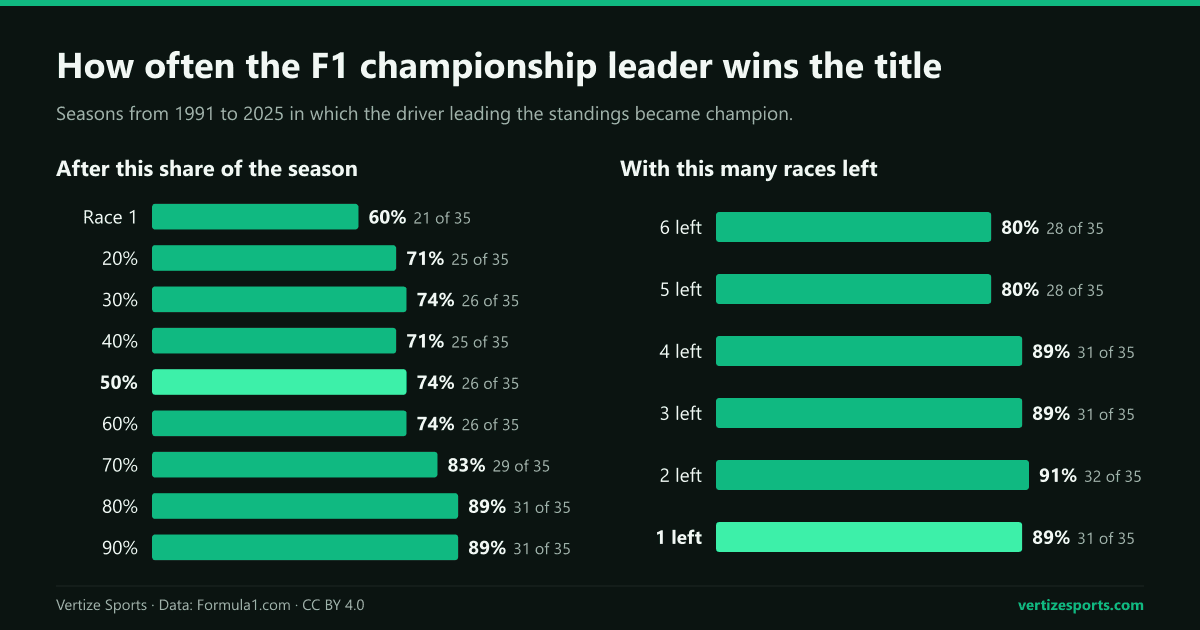
The leaders who lost are not spread evenly across the years. The halfway leader lost the title once in the 16 seasons from 1991 to 2006, Michael Schumacher in 1997, and eight times in the 19 seasons since, five of them in the 2010s alone: 2010, 2012, 2014, 2016 and 2017.
The F1 leader at the summer break
Since 2009 the calendar has had a gap of at least four weeks between races every summer, usually after the Hungarian Grand Prix. The only exception was 2020, and before 2009 no gap between races in July or August lasted more than three weeks. In the 16 seasons with a break, the driver who went into it leading the championship won the title only 9 times. The seven who lost:
- 2010: Mark Webber led by 4 points; Sebastian Vettel, 10 behind, won the title.
- 2012: Fernando Alonso led by 40; Vettel, 42 behind, won.
- 2014: Nico Rosberg led Lewis Hamilton by 11; Hamilton won.
- 2016: Hamilton led Rosberg by 19; Rosberg won.
- 2017: Vettel led Hamilton by 14; Hamilton won.
- 2021: Hamilton led Max Verstappen by 8; Verstappen won.
- 2025: Oscar Piastri led Lando Norris by 9; Norris won.
What mattered was the size of the lead. All five leaders who went into the break more than 40 points clear won the title, against 4 of the 11 with leads of 40 or less, and Alonso's 40 in 2012 is the biggest summer-break lead to be lost. This year Kimi Antonelli went into the break 50 points ahead of Lewis Hamilton.
The largest points deficits overcome in F1
In raw points, the biggest deficit a champion has overturned since 1991 is 46: Max Verstappen trailed Charles Leclerc by that much after three of the 22 races of 2022 and won the title by 146. From halfway on, the biggest was Sebastian Vettel's 44, after 10 of 20 races in 2012, and last year Lando Norris came back from 34 behind his McLaren teammate Oscar Piastri with nine races left.
Points are a poor yardstick across eras, though. A win was worth 10 points until 2009 and 25 since 2010, and sprints have added more since 2021. Measured as a share of the points still available, the most one driver could score in the races left, the ranking changes: the three biggest comebacks came in the last two races of a season.
| Season | Champion | Behind | Points left | Share | After |
|---|---|---|---|---|---|
| 2007 | Kimi Räikkönen | 17 | 20 | 85.0% | Japanese GP, 2 races left |
| 2010 | Sebastian Vettel | 15 | 25 | 60.0% | Brazilian GP, 1 race left |
| 1999 | Mika Häkkinen | 4 | 10 | 40.0% | Malaysian GP, 1 race left |
| 1997 | Jacques Villeneuve | 10 | 40 | 25.0% | Italian GP, 4 races left |
| 2012 | Sebastian Vettel | 39 | 175 | 22.3% | Italian GP, 7 races left |
| 2000 | Michael Schumacher | 6 | 40 | 15.0% | Belgian GP, 4 races left |
| 2014 | Lewis Hamilton | 29 | 200 | 14.5% | Belgian GP, 7 races left |
| 2025 | Lando Norris | 31 | 224 | 13.8% | Italian GP, 8 races left |
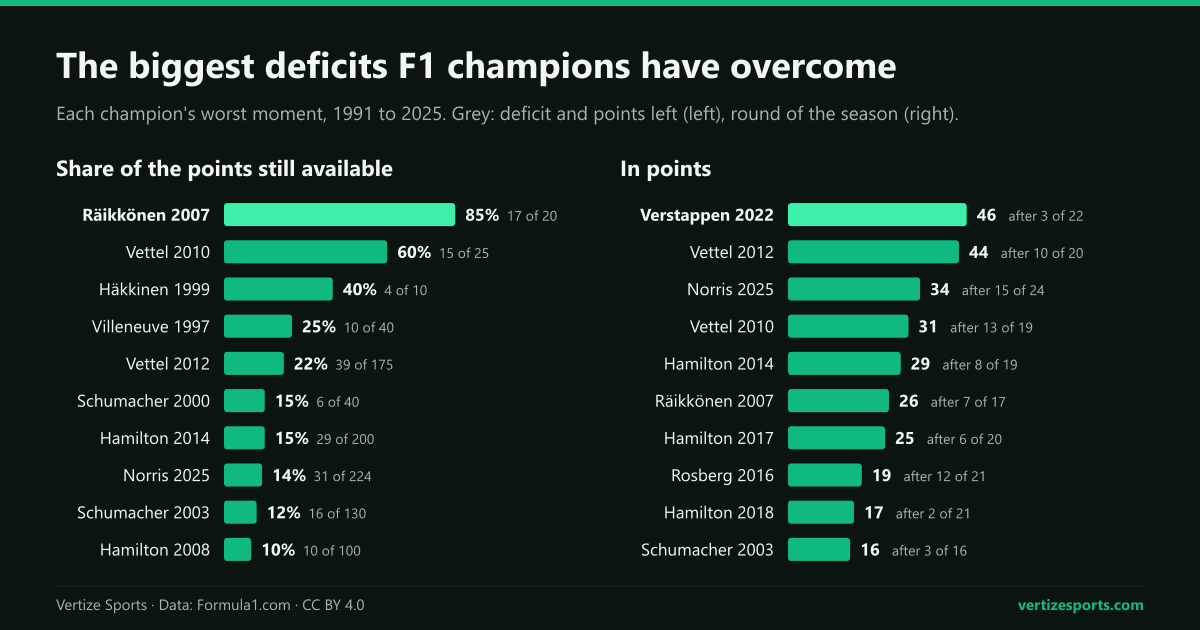
Räikkönen's 2007 is the extreme case. The Ferrari driver won the opening race in Australia and did not lead again until the season was over: he was 26 points behind Hamilton after seven races and still 17 behind with two to go. He then won in China, where Hamilton failed to score, and in Brazil, where Hamilton finished seventh and Fernando Alonso third, to take the title with 110 points to 109 for both McLaren drivers.
No runner-up since 1991 has recovered more ground than Max Verstappen last year. He was 104 points behind after the Dutch Grand Prix, with nine races left, and finished two points short of Norris.
F1 champions who never led until the last race
Sebastian Vettel in 2010 is the only champion since 1991 who was never top of the standings before the final race. The nearest he came was after Monaco, the sixth round, level on 78 points with his Red Bull teammate Mark Webber, who was ahead on wins. He went into Abu Dhabi third, 15 points behind Alonso and 7 behind Webber, won the race, and Alonso finished seventh.
Three more champions took the lead for good only at the last race, although they had led earlier in the season. Räikkönen had been top only after the 2007 opener. Mika Häkkinen went to Suzuka in 1999 four points behind Ferrari's Eddie Irvine, won, and Irvine finished third. Jacques Villeneuve went to Jerez in 1997 one point behind Michael Schumacher and finished third while Schumacher did not finish; the official 1997 table lists Schumacher as disqualified, with his 78 points.
At the other end, 13 of the 35 champions led the standings after every round of their season, most recently Max Verstappen in 2023 and 2024.
Antonelli's 66-point lead in historical context
After 15 of the 23 Grands Prix of 2026, Kimi Antonelli leads the drivers' standings with 302 points, 66 more than his Mercedes teammate George Russell, according to formula1.com's table today, and he has been top since the third round, in Japan. Eight Grands Prix are left on the calendar, plus a sprint in Singapore, so 208 points are still available and his lead is 32 percent of them.
No champion since 1991 has made up that much with eight or more races to go. The biggest such comeback was Räikkönen's in 2007, from 26 points behind with 100 left, 26 percent, and the biggest lead lost that early was Alonso's 40 with 225 left at the 2012 summer break, 18 percent. Seven drivers have led by at least that share of the points left with eight or more races to go, and all seven won the title, although Michael Schumacher's 1994 lead was down to one point before the final race.
This compares past seasons; it is not a forecast. The calendar may also shrink: F1 is expected to decide by mid-October whether the last two rounds, in Qatar and Abu Dhabi, go ahead, and without them or a replacement 158 points would be left, making the lead 42 percent. For the odds and dates, see where Antonelli can clinch the 2026 title; for how points add up, what recent F1 titles were won by.
F1 championship comebacks: frequently asked questions
What is the biggest comeback in F1 championship history? Since 1991, measured against the points still available, Kimi Räikkönen's in 2007: 17 points behind Lewis Hamilton with 20 left, he won the last two races and the title by one point.
How often does the F1 championship leader win the title? From 1991 to 2025, the leader at halfway won the title in 26 of 35 seasons, 74 percent, and the leader going into the final race in 31, 89 percent. The winner of the opening race became champion 21 times, 60 percent.
Does the leader at the summer break usually win the F1 title? Only just. Since 2009, the leader at the break has won 9 of 16 titles, although all five who led by more than 40 points won.
What is the largest points deficit overcome to win the F1 title? 46 points, by Max Verstappen, who trailed Charles Leclerc after three races in 2022 and won by 146. From halfway on, the biggest was Sebastian Vettel's 44 in 2012, after 10 of 20 races.
Which F1 champion never led until the last race? Sebastian Vettel in 2010, the only one since 1991. He was level on points with Mark Webber after Monaco but behind on wins, and he took the lead only by winning the final race, in Abu Dhabi.
How this was built: every Formula 1 season from 1991 to 2025, 649 Grands Prix and 24 sprints, plus 2026 through the Azerbaijan Grand Prix, from the official results on formula1.com, whose points already include half points, the double points of 2014 and the fastest-lap point. Standings after each round add that weekend's Grand Prix and sprint, with ties broken by countback. Every season matches formula1.com's final standings for every driver after one fix: the 2023 Saudi Arabian Grand Prix page gives Max Verstappen 0 points for second place although its own note credits him with the fastest-lap point, and 19 points restore his official 575. Points still available are the most one driver could still score. The summer break is the longest gap between races starting in July or August, when it lasted four weeks or more. 2026 standings and calendar from formula1.com, September 29, 2026.