We took the official race results, starting grids and qualifying results of all 19 races from formula1.com, the source of our study of pole position, our ranking of overtaking by circuit and our count of DNFs by season, and measured each race the way those studies did.
Every Malaysian Grand Prix winner, 1999 to 2017
Eddie Irvine won the first Malaysian Grand Prix for Ferrari in 1999, and Verstappen the last, as formula1.com recalled when it announced the 2026 race. In all, 11 drivers and seven teams won. Nine winners started from pole, 13 from the front row and 15 from the top three; the furthest back was Fernando Alonso, eighth for Ferrari in 2012, the lowest winning grid position in Malaysia.
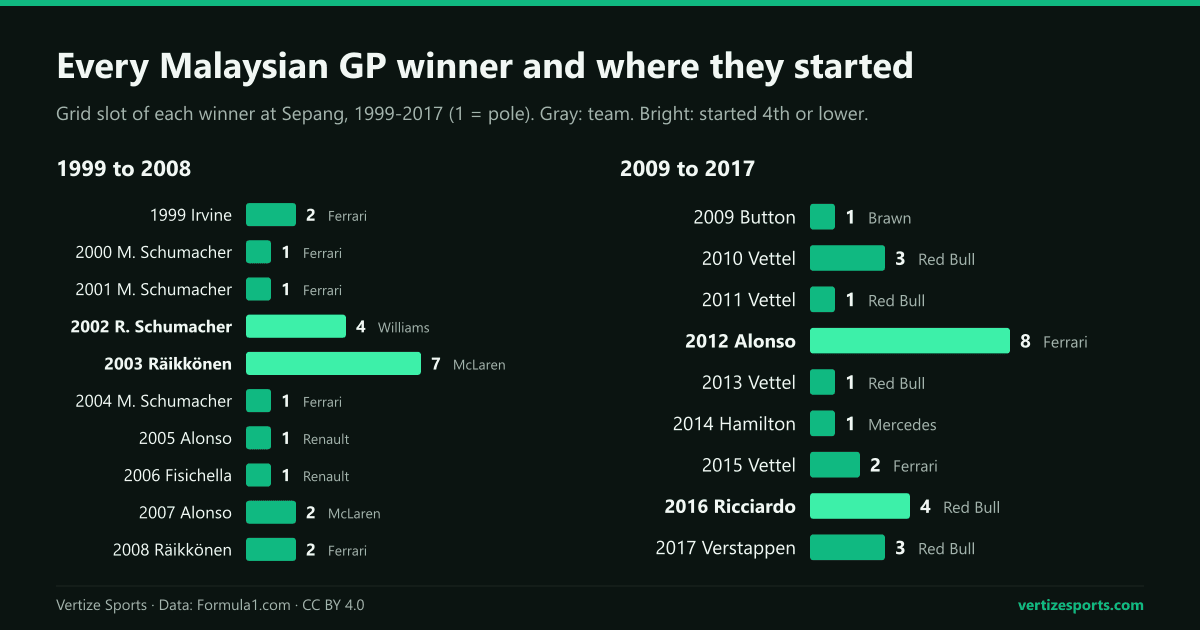
| Year | Winner | Team | Started | On pole |
|---|---|---|---|---|
| 1999 | Eddie Irvine | Ferrari | 2nd | Michael Schumacher |
| 2000 | Michael Schumacher | Ferrari | Pole | Michael Schumacher |
| 2001 | Michael Schumacher | Ferrari | Pole | Michael Schumacher |
| 2002 | Ralf Schumacher | Williams | 4th | Michael Schumacher |
| 2003 | Kimi Räikkönen | McLaren | 7th | Fernando Alonso |
| 2004 | Michael Schumacher | Ferrari | Pole | Michael Schumacher |
| 2005 | Fernando Alonso | Renault | Pole | Fernando Alonso |
| 2006 | Giancarlo Fisichella | Renault | Pole | Giancarlo Fisichella |
| 2007 | Fernando Alonso | McLaren | 2nd | Felipe Massa |
| 2008 | Kimi Räikkönen | Ferrari | 2nd | Felipe Massa |
| 2009 | Jenson Button | Brawn | Pole | Jenson Button |
| 2010 | Sebastian Vettel | Red Bull | 3rd | Mark Webber |
| 2011 | Sebastian Vettel | Red Bull | Pole | Sebastian Vettel |
| 2012 | Fernando Alonso | Ferrari | 8th | Lewis Hamilton |
| 2013 | Sebastian Vettel | Red Bull | Pole | Sebastian Vettel |
| 2014 | Lewis Hamilton | Mercedes | Pole | Lewis Hamilton |
| 2015 | Sebastian Vettel | Ferrari | 2nd | Lewis Hamilton |
| 2016 | Daniel Ricciardo | Red Bull | 4th | Lewis Hamilton |
| 2017 | Max Verstappen | Red Bull | 3rd | Lewis Hamilton |
Most wins at Sepang: Vettel, Schumacher, Alonso and Ferrari
Vettel won four Malaysian Grands Prix, the most of any driver: three for Red Bull, in 2010, 2011 and 2013, and one for Ferrari, in 2015. Michael Schumacher and Alonso won three each, Schumacher all for Ferrari and Alonso for three teams, Renault in 2005, McLaren in 2007 and Ferrari in 2012. Kimi Räikkönen won twice, for McLaren in 2003 and Ferrari in 2008, and seven drivers won once.
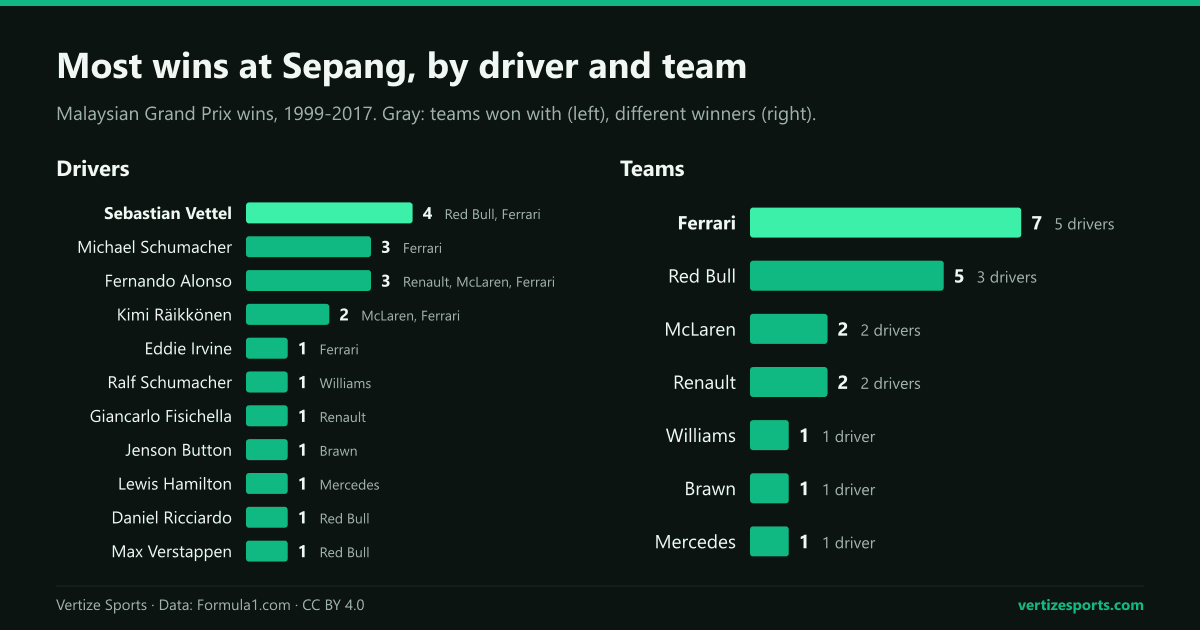
- Teams: Ferrari 7, with five different drivers; Red Bull 5; McLaren and Renault 2 each; Williams, Brawn and Mercedes 1 each.
- Podiums: Lewis Hamilton 6, the most; Michael Schumacher, Alonso and Vettel 5 each.
- Pole positions: Michael Schumacher and Hamilton, 5 each. Hamilton was on pole at the last four Malaysian Grands Prix and won only the first, in 2014.
- One-twos: 9 of the 19 races, three by Red Bull and two by Ferrari.
Sepang pole position win rate
The driver on pole won 9 of the 18 Malaysian Grands Prix from 2000 to 2017, 50 percent, as our pole study found, close to the 52 percent across all 518 Grands Prix since 2000. In 1999, which that study leaves out, Michael Schumacher took pole by nearly a second and let Irvine win. Every driver who started from pole at Sepang had also been fastest in qualifying.
What sets Sepang apart is what happened when pole did not win. Of the 18 winners from 2000, 12 started on the front row, 67 percent, against 76 percent in all Grands Prix since 2000, and four started fourth or lower, 22 percent against 14 percent:
- Ralf Schumacher, Williams, 2002: from fourth, in a Williams one-two.
- Kimi Räikkönen, McLaren, 2003: from seventh, for the first win of Räikkönen's career.
- Fernando Alonso, Ferrari, 2012: from eighth.
- Daniel Ricciardo, Red Bull, 2016: from fourth, after Hamilton, who started on pole, retired from the lead with an engine failure.
Retirements and places gained at Sepang
Fewer cars reached the finish at Sepang than in the average Grand Prix of its time. Across the 19 races, 110 of 408 starters were not classified at the finish, 27.0 percent, against 24.6 percent in all Grands Prix of the same seasons in our DNF study, and 13 of the 19 races had more unclassified cars than their season's average. The first race had the most, 11 of 22 starters, and the last the fewest, one of 19.
Retirements move the drivers behind them up the order, and Sepang heads the table in our overtaking study: from 2000 to 2017, a classified driver ended an average of 3.8 places away from their starting slot, the most of the 22 circuits with 10 or more Grands Prix, level after rounding with Albert Park and Hockenheim, against 3.2 in all 518 Grands Prix since 2000. With 1999 the figure stays at 3.8. Net, a finisher at Sepang gained 2.3 places, against 1.6 overall.
Race by race, the reshuffle ranged from 2.6 places per finisher in 2008 to 5.4 in 2010 and 5.1 in the rain-hit 2012 race. The biggest single climbs were 16 places: Felipe Massa from 21st to fifth in 2006, and Vettel from 20th, the back of the grid after a penalty, to fourth in 2017.
| Year | Not classified | Season average | Places changed |
|---|---|---|---|
| 1999 | 11 of 22 | 9.7 | 3.5 |
| 2000 | 9 of 22 | 8.1 | 3.5 |
| 2001 | 8 of 22 | 8.2 | 4.6 |
| 2002 | 9 of 22 | 8.2 | 4.2 |
| 2003 | 7 of 20 | 6.5 | 4.4 |
| 2004 | 4 of 20 | 5.2 | 2.9 |
| 2005 | 7 of 20 | 4.8 | 3.7 |
| 2006 | 8 of 22 | 6.6 | 4.9 |
| 2007 | 4 of 22 | 5.3 | 3.7 |
| 2008 | 5 of 22 | 4.4 | 2.6 |
| 2009 | 2 of 20 | 3.4 | 3.2 |
| 2010 | 6 of 23 | 5.4 | 5.4 |
| 2011 | 7 of 24 | 4.0 | 3.1 |
| 2012 | 2 of 24 | 3.8 | 5.1 |
| 2013 | 4 of 22 | 2.7 | 4.2 |
| 2014 | 6 of 21 | 4.0 | 3.8 |
| 2015 | 4 of 19 | 3.5 | 2.8 |
| 2016 | 6 of 22 | 3.5 | 3.9 |
| 2017 | 1 of 19 | 4.1 | 3.2 |
Sepang F1 history: rain, red flags and team orders
Formula1.com's race page for Sepang still warns that sudden tropical downpours can transform conditions, and in 2009 and 2012 rain stopped the race. Others are remembered for what happened at the front:
- 1999: Michael Schumacher raced 98 days after breaking a leg at Silverstone and helped Irvine, then fighting for the title, to win. Ferrari's one-two was disqualified over its barge boards and restored on appeal the following week. It was Irvine's last Grand Prix win.
- 2009: the rain stopped the race after 31 of the scheduled 56 laps, and it was not restarted. With less than 75 percent run, half points were awarded, five for the winner, Jenson Button, in the shortest Malaysian Grand Prix: 55 minutes and 30.622 seconds.
- 2012: in torrential rain, with red flags and a long delay, Alonso won from eighth and Sergio Perez finished second for Sauber, 2.263 seconds behind.
- 2013: Vettel passed Red Bull teammate Mark Webber for the win, ignoring the team's "multi 21" order to hold position.
- 2015: Vettel's first win for Ferrari, in a second race with the team.
F1 at Sepang in 2026: the Bahrain Grand Prix in Malaysia
The race on Sunday, October 4, is round 16 of 2026, officially the Formula 1 Gulf Air Bahrain Grand Prix in Malaysia. Formula 1 and the FIA announced on July 26 that Sepang would host it, under an agreement with the governments of Bahrain and Malaysia that, formula1.com said, saved a Grand Prix that would otherwise not have happened. Formula1.com's circuit guide notes that the race had been taken out of its April slot, and that it is the 22nd Bahrain Grand Prix and the first held away from the Bahrain International Circuit in Sakhir.
Times at the track, eight hours ahead of GMT, from formula1.com's event page: practice on Friday at 12:30 and 16:00 and on Saturday at 12:30, qualifying on Saturday at 16:00, and the race on Sunday at 15:00, which is 07:00 GMT and 3 a.m. Eastern. There is no sprint.
Verstappen took pole, the first of 2026 for both the driver and Red Bull, 0.298 seconds ahead of Hamilton's Ferrari. Isack Hadjar qualified third in the other Red Bull but takes a five-place penalty for a new power unit element, so on the official starting grid Kimi Antonelli starts third and George Russell, eighth in qualifying, seventh.
The title race arrives unchanged since Azerbaijan: Antonelli leads Russell, the Mercedes teammate, by 66 points, 302 to 236, in formula1.com's standings. As our title-clinch scenarios showed, Antonelli cannot clinch the championship in Malaysia; with the calendar as it stands, the earliest is Austin on October 25. Neither Mercedes driver has raced a Grand Prix at Sepang, unlike 10 drivers on the grid, three of them winners there: Alonso, Hamilton and Verstappen. The rest of the season is on the 2026 F1 schedule, and the points table on our F1 standings.
Malaysian Grand Prix winners: frequently asked questions
Who has won the most Malaysian Grands Prix? Sebastian Vettel, with four: 2010, 2011 and 2013 for Red Bull and 2015 for Ferrari. Michael Schumacher and Fernando Alonso won three each, and Ferrari, with seven, is the most successful team.
Who won the last Malaysian Grand Prix? Max Verstappen, for Red Bull in 2017, from third on the grid. It was the last Formula 1 race at Sepang before the 2026 Bahrain Grand Prix in Malaysia.
Why is the Bahrain Grand Prix being held in Malaysia? The race was taken out of its April slot, and Formula 1, the FIA and the governments of Bahrain and Malaysia agreed to stage it at Sepang on October 4. It keeps the Bahrain name and is round 16 of 2026.
How often does pole position win at Sepang? In 9 of the 19 Malaysian Grands Prix, and 9 of the 18 from 2000 to 2017, 50 percent, close to the 52 percent of all Grands Prix since 2000. Four winners started fourth or lower, the latest Daniel Ricciardo in 2016.
Which Malaysian Grand Prix was stopped for rain? The 2009 race, after 31 of its 56 laps. It was not restarted and half points were awarded. The 2012 race also had red flags in the rain, but went the full 56 laps.
How this was built: the official race results, starting grids and qualifying results of the 19 Malaysian Grands Prix, 1999 to 2017, from formula1.com, saved for our earlier F1 studies except the 1999 grid and qualifying, downloaded on October 3, 2026. Starters exclude drivers who did not start or were disqualified; a starter listed as NC is not classified. Places changed is the gap between grid slot and finish of each classified driver. Season averages and all-circuit figures are as published in our DNF, pole and overtaking studies; other race details come from the formula1.com articles linked above. The 2026 data were checked on formula1.com at 22:53 UTC on October 3, 2026, before the race.