We counted every starter in the official results on formula1.com, the source of our study of how often pole position wins and of overtaking by circuit, for the 664 Grands Prix from the 1991 United States Grand Prix to this year's race in Baku: 14,143 starts. Under the FIA's sporting regulations, a car that has covered less than 90 percent of the winner's laps is not classified, and one that has covered at least that much is classified even if it stopped before the flag. We count a start as a DNF when formula1.com lists the driver as not classified. The official results do not say why a car stopped, and a DNF can be a mechanical failure or a crash, so these figures show how often cars fail to finish, not why.
F1 DNF rate by season since 1991
The DNF rate has fallen decade by decade. From 1991 to 1999, 45 percent of starters were not classified; in the 2000s, 29 percent; in the 2010s, 17 percent; and from 2020 to 2025, 11 percent.
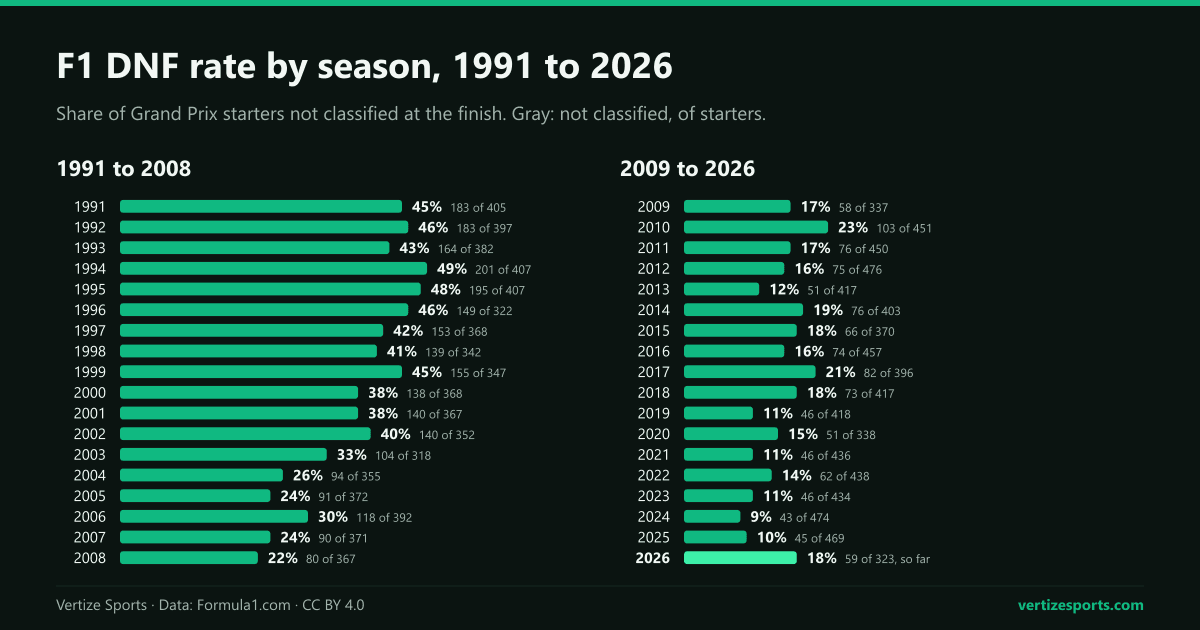
By this measure, the least reliable season in the period was 1994, when 201 of 407 starters, 49.4 percent, were not classified. The five worst seasons all came between 1991 and 1996, each above 45 percent. The best were the last two full seasons: 43 of 474 starters in 2024, 9.1 percent, and 45 of 469 in 2025, 9.6 percent, the only seasons under 10 percent.
| Season | Grands Prix | Starters | Not classified | DNF rate | Per race |
|---|---|---|---|---|---|
| 1991 | 16 | 405 | 183 | 45.2% | 11.4 |
| 1992 | 16 | 397 | 183 | 46.1% | 11.4 |
| 1993 | 16 | 382 | 164 | 42.9% | 10.3 |
| 1994 | 16 | 407 | 201 | 49.4% | 12.6 |
| 1995 | 17 | 407 | 195 | 47.9% | 11.5 |
| 1996 | 16 | 322 | 149 | 46.3% | 9.3 |
| 1997 | 17 | 368 | 153 | 41.6% | 9.0 |
| 1998 | 16 | 342 | 139 | 40.6% | 8.7 |
| 1999 | 16 | 347 | 155 | 44.7% | 9.7 |
| 2000 | 17 | 368 | 138 | 37.5% | 8.1 |
| 2001 | 17 | 367 | 140 | 38.1% | 8.2 |
| 2002 | 17 | 352 | 140 | 39.8% | 8.2 |
| 2003 | 16 | 318 | 104 | 32.7% | 6.5 |
| 2004 | 18 | 355 | 94 | 26.5% | 5.2 |
| 2005 | 19 | 372 | 91 | 24.5% | 4.8 |
| 2006 | 18 | 392 | 118 | 30.1% | 6.6 |
| 2007 | 17 | 371 | 90 | 24.3% | 5.3 |
| 2008 | 18 | 367 | 80 | 21.8% | 4.4 |
| 2009 | 17 | 337 | 58 | 17.2% | 3.4 |
| 2010 | 19 | 451 | 103 | 22.8% | 5.4 |
| 2011 | 19 | 450 | 76 | 16.9% | 4.0 |
| 2012 | 20 | 476 | 75 | 15.8% | 3.8 |
| 2013 | 19 | 417 | 51 | 12.2% | 2.7 |
| 2014 | 19 | 403 | 76 | 18.9% | 4.0 |
| 2015 | 19 | 370 | 66 | 17.8% | 3.5 |
| 2016 | 21 | 457 | 74 | 16.2% | 3.5 |
| 2017 | 20 | 396 | 82 | 20.7% | 4.1 |
| 2018 | 21 | 417 | 73 | 17.5% | 3.5 |
| 2019 | 21 | 418 | 46 | 11.0% | 2.2 |
| 2020 | 17 | 338 | 51 | 15.1% | 3.0 |
| 2021 | 22 | 436 | 46 | 10.6% | 2.1 |
| 2022 | 22 | 438 | 62 | 14.2% | 2.8 |
| 2023 | 22 | 434 | 46 | 10.6% | 2.1 |
| 2024 | 24 | 474 | 43 | 9.1% | 1.8 |
| 2025 | 24 | 469 | 45 | 9.6% | 1.9 |
| 2026 (so far) | 15 | 323 | 59 | 18.3% | 3.9 |
F1 retirements per race
Per race, the fall is even steeper, because grids used to be bigger. The 1994 season averaged 12.6 cars not classified a race, with up to 26 starters, and 2024 averaged 1.8, with up to 20. Over all 664 Grands Prix the average is 5.5.
Almost all of the unclassified cars had retired: formula1.com marks 3,619 of the 3,649 since 1991 as DNF, and 17 as too far behind to be classified. In another 364 starts the driver stopped before the flag but was still classified; those count here as finishers.
The first race since 1991 in which every starter was classified was the 2005 Italian Grand Prix. There have been 22 such races, 21 of them from 2011 on and four in each of the last two seasons; one, the 2021 Belgian Grand Prix, has an official result of a single lap.
The F1 races with the fewest finishers
Since 1991, the fewest classified finishers in a Grand Prix is six, at the 1996 Spanish Grand Prix and the 2005 United States Grand Prix. At Indianapolis in 2005, as formula1.com's result notes, the seven teams on Michelin tires withdrew after the formation lap on safety grounds; their 14 cars are listed as not classified, with no laps.
The 1996 Monaco Grand Prix had one more classified driver but fewer cars at the flag. Only Olivier Panis, David Coulthard and Johnny Herbert finished, the fewest of any race in the period; four more drivers had stopped after covering at least 90 percent of the distance and were classified.
| Grand Prix | Starters | Classified | Running at the end |
|---|---|---|---|
| 1996 Spanish GP | 19 | 6 | 6 |
| 2005 United States GP | 20 | 6 | 6 |
| 1993 South African GP | 25 | 7 | 5 |
| 1996 Monaco GP | 21 | 7 | 3 |
| 1994 German GP | 26 | 8 | 8 |
| 1995 Australian GP | 23 | 8 | 8 |
| 1996 Canadian GP | 22 | 8 | 8 |
| 1998 Belgian GP | 18 | 8 | 8 |
| 1999 Australian GP | 21 | 8 | 8 |
| 2002 Australian GP | 20 | 8 | 8 |
| 2008 Australian GP | 21 | 8 | 6 |
The most recent race with eight or fewer classified finishers was the 2008 Australian Grand Prix. Since 2009, the fewest is 11, at the 2015 Australian Grand Prix, which had only 15 starters.
Most DNFs in an F1 season
Every DNF record since 1991 was set in the 1990s, when grids were bigger and DNFs far more common. Counting starters not classified:
- Season: 201, in 1994.
- Race: 18, at the 1993 South African and 1994 German Grands Prix.
- Driver: 14 in 17 starts, by Rubens Barrichello for Stewart in 1997. Nine other drivers had 12 in a season, all between 1994 and 2000.
- Team: 25, by Pacific in 1995 and Stewart in 1997.
In the recent low-DNF seasons, the counts are far smaller: from 2020 to 2025, no driver was unclassified more than six times in a season. This year Lance Stroll has not been classified in 11 of 15 starts for Aston Martin, the most by any driver in a season since Adrian Sutil's 11 for Force India in 2008.
F1 reliability by team
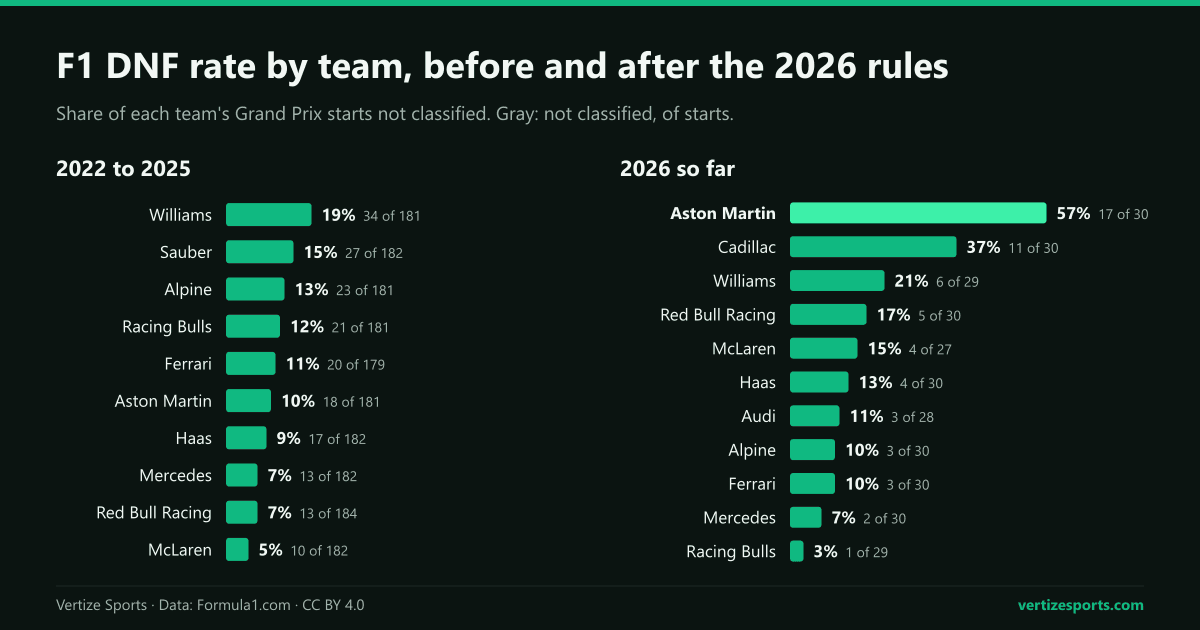
Over the four seasons before this year's rule change, 2022 to 2025, McLaren had the fewest cars not classified: 10 of 182 starts, 5.5 percent. Red Bull Racing and Mercedes had 13 each, 7.1 percent. Williams had the most, 34 of 181, 18.8 percent, followed by Sauber, 27 of 182, 14.8 percent. Sauber raced as Alfa Romeo in 2022 and 2023 before taking the Kick Sauber name, and Racing Bulls as AlphaTauri and then RB, as formula1.com's history of the 11 teams sets out; each is counted as one team here.
F1 DNFs in 2026 under the new rules
This season brought new technical rules. The cars are shorter and narrower, with a minimum weight of 768 kilograms instead of 800; the power units take about half their power from the electrical side and no longer have the MGU-H; the cars run on advanced sustainable fuel, with front and rear wings that move; and Cadillac has joined as an 11th team, for 22 cars on the grid.
Through the Azerbaijan Grand Prix, 59 of the 323 starters have not been classified, 18.3 percent, or 3.9 a race against 1.9 in 2025. Every race has had at least two, and Monaco and Baku had six each; after four races with every starter classified in each of the previous two seasons, 2026 has had none. Seven drivers have failed to start, four of them in China, against four in all of 2025.
Two teams account for almost half of this year's DNFs. Aston Martin has had 17 of its 30 starts end unclassified, 57 percent, a higher share than any team had over a season from 2003 to 2025, and Cadillac, the new team, 11 of 30. Without those two, the other nine teams' rate is 11.8 percent, still above 2025's 9.6. Mercedes, whose drivers Kimi Antonelli and George Russell are first and second in the drivers' standings, has had two.
| Team | Starts | Not classified | DNF rate | Did not start |
|---|---|---|---|---|
| Aston Martin | 30 | 17 | 56.7% | 0 |
| Cadillac | 30 | 11 | 36.7% | 0 |
| Williams | 29 | 6 | 20.7% | 1 |
| Red Bull Racing | 30 | 5 | 16.7% | 0 |
| McLaren | 27 | 4 | 14.8% | 3 |
| Haas | 30 | 4 | 13.3% | 0 |
| Audi | 28 | 3 | 10.7% | 2 |
| Alpine | 30 | 3 | 10.0% | 0 |
| Ferrari | 30 | 3 | 10.0% | 0 |
| Mercedes | 30 | 2 | 6.7% | 0 |
| Racing Bulls | 29 | 1 | 3.4% | 1 |
Eight Grands Prix are left on the 2026 calendar, and these are counts of what has happened so far, not a forecast. In a close title race one DNF can be decisive: Lewis Hamilton failed to finish the 2007 Chinese Grand Prix, the second-to-last race, and Kimi Räikkönen took the title by one point, completing one of the biggest comebacks in F1 championship history.
F1 DNFs and reliability: frequently asked questions
What is the DNF rate in F1? In 2025, 9.6 percent of starters were not classified, and in 2024 9.1 percent, the lowest of any season since 1991. In 2026 it is 18.3 percent so far.
Which F1 season had the most DNFs? Since 1991, 1994: 201 of 407 starters were not classified, 49.4 percent, or 12.6 a race.
Which F1 race had the fewest finishers? Since 1991, the 1996 Spanish Grand Prix and the 2005 United States Grand Prix had six classified finishers each, and at the 1996 Monaco Grand Prix only three cars were still running at the end.
Which F1 team is the most reliable? By DNF rate, McLaren from 2022 to 2025, with 10 of 182 starts not classified, 5.5 percent. In 2026 so far, Racing Bulls, with 1 of 29, followed by Mercedes with 2 of 30.
Is a driver who retires classified in F1? Yes, if they covered at least 90 percent of the winner's laps. Since 1991 that has happened 364 times.
How this was built: every Formula 1 Grand Prix from the 1991 United States Grand Prix to the 2026 Azerbaijan Grand Prix, 664 races, from the official race results on formula1.com. Starters are the drivers each result lists, less the 49 marked DNS (did not start) and the 23 disqualified or excluded; some older results leave disqualified drivers out altogether. A DNF is a starter listed as NC, not classified, whatever the status beside it: DNF (3,619), too far behind to be classified (17) or just "OK" (13, all at the 1995 Argentine Grand Prix). The classifications follow the 90 percent rule in every race except the 1994 Brazilian Grand Prix, where Ayrton Senna is classified 13th after 55 of 71 laps; we keep the official result. Sprints are not counted. Standings from formula1.com, September 30, 2026.