We measured the 72-hole total of every men's major champion since 2000, from the round-by-round scores in the PGA Tour's past results, against the par of the course that week: 107 tournaments, with no Open in 2020, when the R&A canceled it. The same scores give each major's 36-hole cut line and winning margin.
What score wins a major: the averages
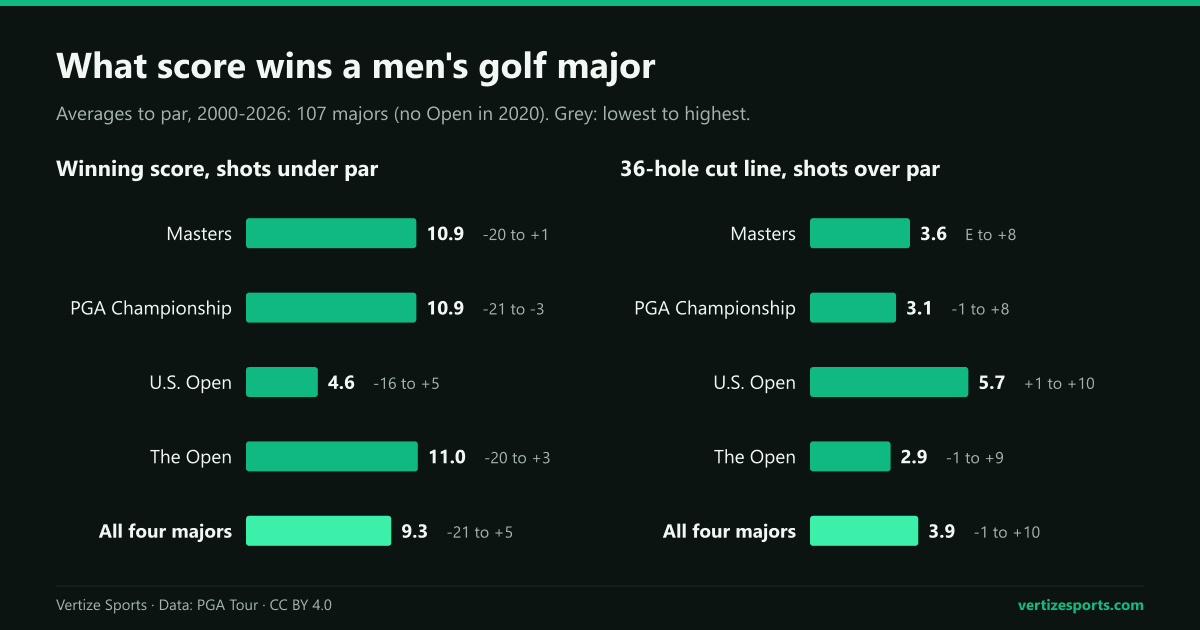
Across the four majors, 98 of the 107 champions finished under par, two at even par and seven over. About half, 53, got to 10 under or better, and 24 reached 15 under. The typical winning score is 10 or 11 under at the Masters, the PGA Championship and The Open, and 4 under at the U.S. Open.
| Major | Average | Median | Lowest | Highest | 10 under or better |
|---|---|---|---|---|---|
| Masters | -10.9 | -11 | -20 (2020) | +1 (2007) | 18 of 27 |
| PGA Championship | -10.9 | -10 | -21 (2024) | -3 (2008) | 14 of 27 |
| U.S. Open | -4.6 | -4 | -16 (2011, 2017) | +5 (2006, 2007) | 5 of 27 |
| The Open | -11.0 | -11 | -20 (2016, 2022) | +3 (2008) | 16 of 26 |
| All four majors | -9.3 | -9 | -21 | +5 | 53 of 107 |
Why the U.S. Open winning score is higher
The U.S. Open is the hardest of the four to go low in, on every measure against par. Its champions averaged 4.6 under par, 6.3 shots higher than the 10.9 under of the other three majors combined, and only five of its 27 winners reached 10 under; the lowest were Rory McIlroy in 2011 and Brooks Koepka in 2017, at 16 under.
It also produced both even-par champions, Michael Campbell in 2005 and Graeme McDowell in 2010, and five of the seven over par: Geoff Ogilvy and Ángel Cabrera at 5 over in 2006 and 2007, and Webb Simpson, Justin Rose and Koepka at 1 over in 2012, 2013 and 2018.
Part of the gap is par. Twenty of the 27 U.S. Opens since 2000 were played on par-70 courses, while the Masters is par 72 every year, and the same total reads eight shots higher against a par of 70. In raw strokes, U.S. Open champions averaged 276.6, slightly fewer than Masters champions at 277.1; against par, the way every leaderboard keeps score, they finish closest to even.
Masters, PGA Championship and Open winning scores
- Masters: average 10.9 under, median 11 under. Dustin Johnson's 268, 20 under in 2020, is the lowest in the tournament's history, and Zach Johnson, 1 over in 2007, is the only over-par champion since 2000. Every Masters since 2018 has been won at 10 under or better.
- PGA Championship: average 10.9 under, median 10 under, and the only major whose champions since 2000 all finished under par; the highest was Padraig Harrington's 3 under in 2008. Xander Schauffele's 263, 21 under in 2024, is an all-time major championship scoring record.
- The Open: average 11.0 under, median 11 under. Henrik Stenson in 2016 and Cameron Smith in 2022 won at 20 under, and Harrington at 3 over in the wind at Royal Birkdale in 2008.
Average winning score in majors has dropped since 2000
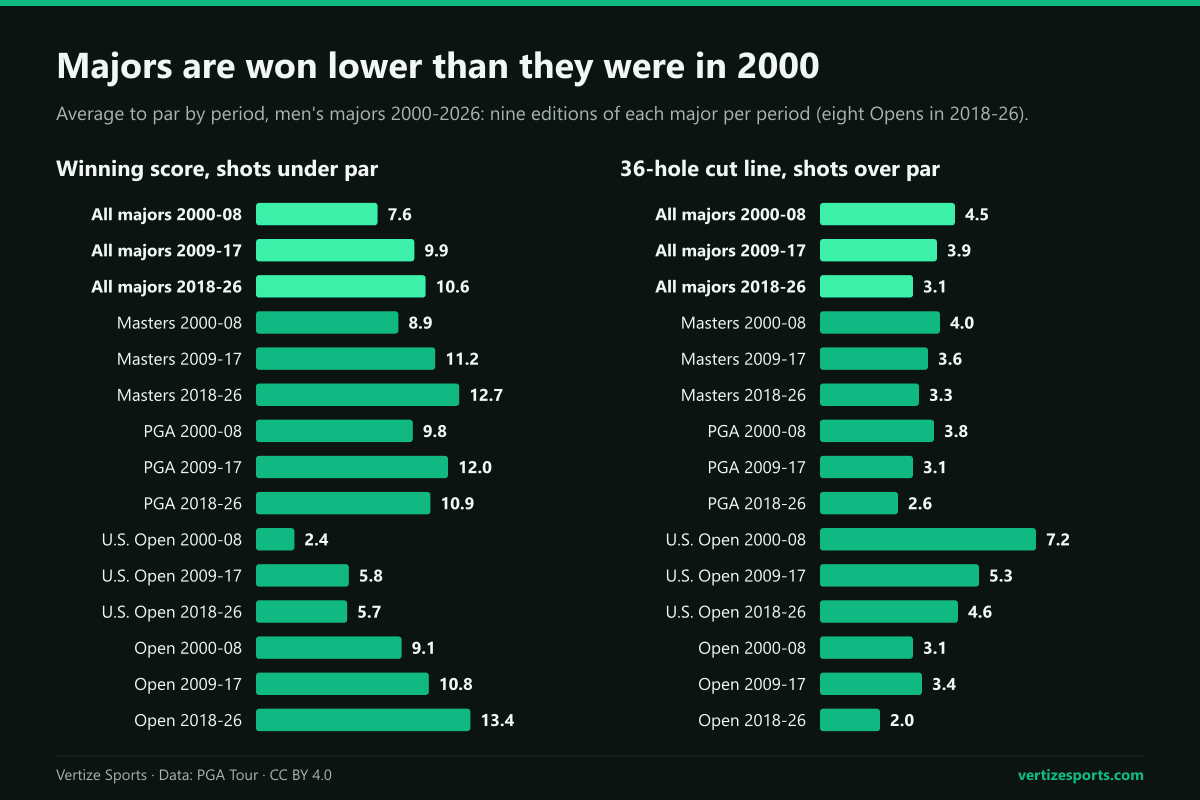
Majors are being won lower than they were. The average winning score went from 7.6 under in 2000-2008 to 9.9 under in 2009-2017 and 10.6 under in 2018-2026, and the majors won at 10 under or better rose from 14 of 36 to 21 of 35. A straight line through all 107 results falls about 1.2 shots a decade.
The clearest case is the Masters, the only major played on the same course every year, Augusta National: its average fell from 8.9 to 11.2 and then 12.7 under. The Open went from 9.1 to 10.8 and 13.4 under. The U.S. Open (5.8, then 5.7 under) and the PGA Championship (12.0, then 10.9) stopped falling after the first period.
The cut line, which tracks the middle of the field, fell too: from 4.5 over par in 2000-2008 to 3.1 over in 2018-2026, and at the U.S. Open from 7.2 to 4.6 over.
The major cut line: what score makes the weekend
After 36 holes each major cuts its field, and since 2000 the line has averaged 3.9 over par, with a median of 4 over. At the U.S. Open it averaged 5.7 over, reached 10 over in 2002 and 2007 and never fell to even par. Eight cuts in the period were at even par or better, two of them at 1 under: The Open in 2006 and the PGA Championship in 2024.
| Major | Average cut | Median | Lowest | Highest | Made the cut |
|---|---|---|---|---|---|
| Masters | +3.6 | +4 | E (2020) | +8 (2007) | 53 of 92 |
| PGA Championship | +3.1 | +4 | -1 (2024) | +8 (2003, 2008) | 76 of 156 |
| U.S. Open | +5.7 | +6 | +1 (2017) | +10 (2002, 2007) | 70 of 156 |
| The Open | +2.9 | +2.5 | -1 (2006) | +9 (2008) | 77 of 156 |
| All four majors | +3.9 | +4 | -1 | +10 | 69 of 140 |
The Masters is the exception in size: its field has been under 100 players every year since 2000, by Augusta National's own count, and about 53 make the cut, against 70 to 77 of roughly 156 starters at the other three.
Winning margins and major playoffs
Majors are usually close. The average winning margin since 2000 is 2.3 shots; 26 were won by one and 19 went to a playoff, so 45 of 107 (42 percent) were decided by a shot or less. Thirteen were won by five or more, led by Tiger Woods's 15 at the 2000 U.S. Open; the next four were by 8, two of them McIlroy's, at the 2011 U.S. Open and the 2012 PGA Championship.
The Masters has had the most playoffs, seven in 27 years, the latest in 2025, when McIlroy beat Rose on the first extra hole; the PGA Championship and The Open have had five each and the U.S. Open two. Each settles a tie its own way:
- Masters: sudden death, announced in 1976; its last six playoffs ended on the 18th hole or, one hole later, the 10th.
- PGA Championship: a three-hole aggregate (the 10th, 17th and 18th at Aronimink this year), then sudden death; used since 2000, when Woods beat Bob May.
- U.S. Open: a two-hole aggregate, then sudden death, since 2018. From 1954 to 2017 it was 18 holes the next day, the format of its two playoffs in this period: Retief Goosen over Mark Brooks in 2001 and Woods over Rocco Mediate in 2008.
- The Open: an aggregate over several holes, then sudden death. It switched to three holes in 2019 after using four since 1989, and has not had a playoff since 2015.
The 2026 majors: winning scores against history
Rory McIlroy won the Masters in April at 12 under, 276, tied for the eighth-lowest winning score of the 27 Masters since 2000 and a shot better than the average. In May, Aaron Rai won the PGA Championship at Aronimink at 9 under, 271 on a par-70 course, by three shots, about two shots above the PGA average.
In June, Wyndham Clark won the U.S. Open at Shinnecock Hills at 4 under, 276, exactly the U.S. Open median since 2000 and five shots better than Koepka's winning score there in 2018. Ryan Fox won The Open at Royal Birkdale in July at 10 under, 270, a shot above the Open average. Birkdale's Opens of 2008 and 2017 were won at 3 over by Harrington and at 12 under by Jordan Spieth.
Together the four 2026 champions averaged 8.75 under par, the fewest under par for a year since 2013. Three of the four majors were won by one shot, none went to a playoff, and the cut fell at 4 over at Augusta, Aronimink and Shinnecock Hills and at 1 over at Royal Birkdale.
The rest of the season is on our golf schedule, and the golf leaderboard follows the tournament in play on the PGA Tour, the LPGA and the DP World Tour, round by round and against par. Our study of 54-hole leaders in majors looks at who holds a lead, and the golf section links every page.
Every major winning score since 2000
| Year | Masters | PGA Championship | U.S. Open | The Open |
|---|---|---|---|---|
| 2026 | -12 | -9 | -4 | -10 |
| 2025 | -11* | -11 | -1 | -17 |
| 2024 | -11 | -21 | -6 | -9 |
| 2023 | -12 | -9 | -10 | -13 |
| 2022 | -10 | -5* | -6 | -20 |
| 2021 | -10 | -6 | -6 | -15 |
| 2020 | -20 | -13 | -6 | Not played |
| 2019 | -13 | -8 | -13 | -15 |
| 2018 | -15 | -16 | +1 | -8 |
| 2017 | -9* | -8 | -16 | -12 |
| 2016 | -5 | -14 | -4 | -20 |
| 2015 | -18 | -20 | -5 | -15* |
| 2014 | -8 | -16 | -9 | -17 |
| 2013 | -9* | -10 | +1 | -3 |
| 2012 | -10* | -13 | +1 | -7 |
| 2011 | -14 | -8* | -16 | -5 |
| 2010 | -16 | -11* | E | -16 |
| 2009 | -12* | -8 | -4 | -2* |
| 2008 | -8 | -3 | -1* | +3 |
| 2007 | +1 | -8 | +5 | -7* |
| 2006 | -7 | -18 | +5 | -18 |
| 2005 | -12* | -4 | E | -14 |
| 2004 | -9 | -8* | -4 | -10* |
| 2003 | -7* | -4 | -8 | -1 |
| 2002 | -12 | -10 | -3 | -6* |
| 2001 | -16 | -15 | -4* | -10 |
| 2000 | -10 | -18* | -12 | -19 |
Winning scores in majors: frequently asked questions
What score usually wins a major? About 9 under par: from 2000 to 2026 the average was 9.3 under and the median 9 under. At the U.S. Open the typical winner is 4 under.
What is the lowest winning score in a major? Xander Schauffele's 263, 21 under, at the 2024 PGA Championship. Four champions since 2000 finished at 20 under: Jason Day in 2015, Henrik Stenson in 2016, Dustin Johnson in 2020 and Cameron Smith in 2022.
What is the average winning score at the U.S. Open? 4.6 under par since 2000, with a median of 4 under; five U.S. Opens were won over par, the highest at 5 over in 2006 and 2007.
What is the cut line at a major? About 4 over par after 36 holes. From 2000 to 2026 it averaged 3.6 over at the Masters, 3.1 over at the PGA Championship, 5.7 over at the U.S. Open and 2.9 over at The Open.
How this was built: round-by-round scores of all 107 men's majors from 2000 to 2026, from the PGA Tour's past results for each tournament; the June 2021 U.S. Open, missing there, comes from its PGA Tour leaderboard. Winning score: the champion's 72-hole total against that week's par. Cut line: one shot better than the best 36-hole score that missed the cut. Margin: the gap to the runner-up; a tie after 72 holes is a playoff. Winning scores, pars and cut lines were checked against each major's Wikipedia page, and the Masters figures against masters.com; the one difference is the 2004 U.S. Open cut, 146 on Wikipedia and 145 in the scores.