Men's singles main-draw matches at the majors are best of five sets under the Grand Slam rulebook, and all other matches, women's singles included, best of three. We rebuilt every main-draw singles match at the four tournaments since 2000, 27,178 in 214 draws, from the official records of the ATP Tour and the WTA. Retirements, defaults and walkovers are left out, and so are five men's and four women's matches whose records conflict.
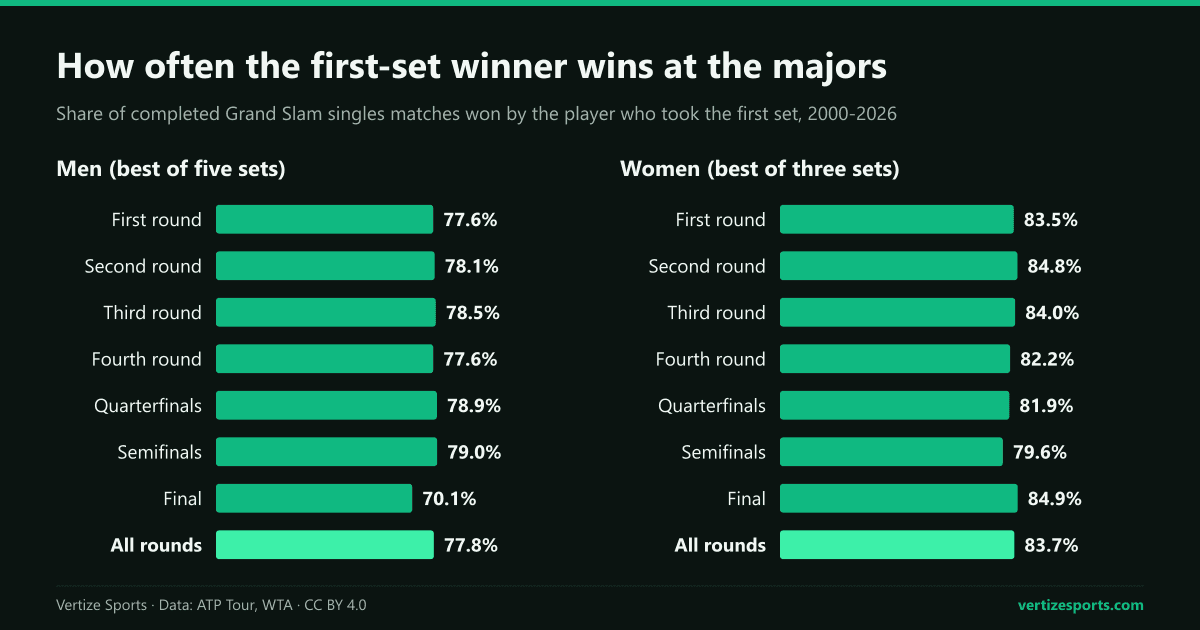
First set winner win percentage at the Grand Slams, by round
The rate holds steady through a draw. In men's singles the first-set winner won between 77.6 and 79.0 percent of matches in each round from the first to the semifinals; in women's, between 79.6 and 84.8 percent, higher than the men's in every round. The one low point is the men's final: the first-set winner won 75 of 107, 70 percent, the lowest of any round in either draw, though 107 matches is a small sample. In women's finals the first-set winner won 90 of the 106 completed.
| Round | Men | Women |
|---|---|---|
| First round | 77.6% (6,549) | 83.5% (6,743) |
| Second round | 78.1% (3,283) | 84.8% (3,364) |
| Third round | 78.5% (1,637) | 84.0% (1,683) |
| Fourth round | 77.6% (818) | 82.2% (837) |
| Quarterfinals | 78.9% (407) | 81.9% (426) |
| Semifinals | 79.0% (205) | 79.6% (211) |
| Final | 70.1% (107) | 84.9% (106) |
| All rounds | 77.8% (13,006) | 83.7% (13,370) |
Best of five vs best of three: why the first set counts for more in women's matches
Part of the gap is arithmetic. If every set after the first were a coin flip, the player who won the first set would win 75 percent of best-of-three matches, because one of the next two sets is enough, but only 68.75 percent of best-of-five matches, which take two of the next four. The format alone is worth 6.25 points.
The real gap is 5.8 points, close to what the format predicts, because both draws beat the coin flip by a similar margin: 9.1 points for men and 8.7 for women. The first set is no less telling in a men's match; the player who loses it simply has more sets left in which to recover, and the favorites use them, as the seeding numbers below show.
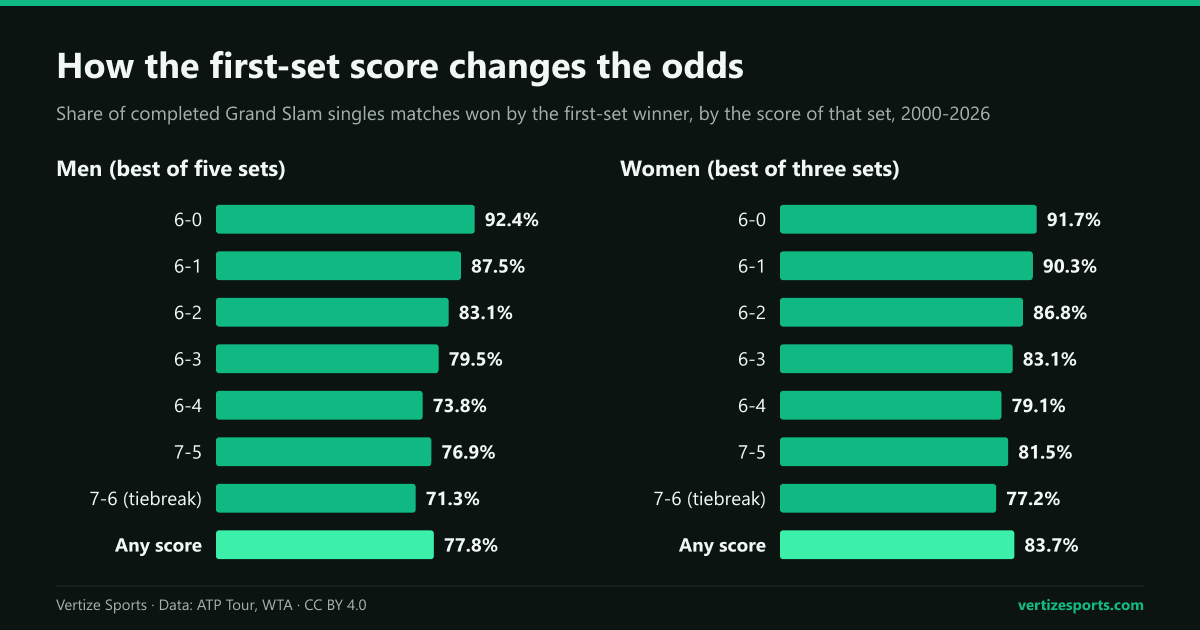
First set win rate by score: from 6-0 to the tiebreak
The score of that first set matters too. Men who took it 6-1 went on to win 88 percent of their matches and women 90 percent; after a first-set tiebreak the share fell to 71 percent for men and 77 percent for women, the lowest after any score. A 7-5 set was worth more than a 6-4 in both draws: 77 percent against 74 percent for men, 82 percent against 79 percent for women.
| First-set score | Men | Women |
|---|---|---|
| 6-0 | 92.4% (262) | 91.7% (744) |
| 6-1 | 87.5% (1,202) | 90.3% (1,840) |
| 6-2 | 83.1% (1,683) | 86.8% (2,435) |
| 6-3 | 79.5% (3,200) | 83.1% (3,089) |
| 6-4 | 73.8% (3,086) | 79.1% (2,677) |
| 7-5 | 76.9% (1,163) | 81.5% (1,244) |
| 7-6 (tiebreak) | 71.3% (2,410) | 77.2% (1,341) |
Comebacks after losing the first set at a Grand Slam, by seed
Seeding moves the odds more than anything else measured here. A seeded man who lost the first set to an unseeded opponent still won 49 percent of those matches, so an unseeded man who took the first set off a seed was close to a coin flip to finish the job. A seeded woman in the same spot came back 36 percent of the time.
The No. 1 seed came back after losing the first set in 68 of 105 men's matches and 54 of 112 women's. The other way round, an unseeded player who lost the first set to a seed won 9 percent of men's matches and 7 percent of women's.
| Player who lost the first set | Men | Women |
|---|---|---|
| No. 1 seed | 64.8% (105) | 48.2% (112) |
| Seed, against an unseeded player | 49.4% (1,989) | 35.7% (1,933) |
| Higher seed, against a lower seed | 42.4% (556) | 28.6% (563) |
| Neither player seeded | 25.0% (4,447) | 18.8% (4,597) |
| Lower seed, against a higher seed | 11.7% (1,040) | 12.4% (995) |
| Unseeded, against a seed | 8.6% (4,974) | 6.5% (5,282) |
Men vs women first set win rate at each major
Surface makes little difference. In men's singles the first-set winner's share ranged from 77.2 percent at the US Open to 79.3 at the French Open, and in women's from 83.1 at Wimbledon to 84.7 at the US Open: spreads that chance alone could produce in samples of about 3,300 matches per major. The 2000s, the 2010s and the seasons since 2020 are just as close: between 77.0 and 78.6 percent for men and between 82.8 and 84.2 for women.
| Major | Surface | Men | Women |
|---|---|---|---|
| Australian Open | Hard | 77.6% (3,284) | 83.8% (3,375) |
| French Open | Clay | 79.3% (3,292) | 83.2% (3,368) |
| Wimbledon | Grass | 77.3% (3,182) | 83.1% (3,246) |
| US Open | Hard | 77.2% (3,248) | 84.7% (3,381) |
First-set winners at the 2026 Grand Slams
In 2026 the first-set winner won 369 of 485 completed men's matches at the four majors, 76.1 percent, and 422 of 501 women's, 84.2 percent, both within two points of their averages since 2000. The finals split by tour: two of the four men's titles went to the player who lost the first set, and none of the women's.
- Australian Open: in the men's final, Carlos Alcaraz beat Novak Djokovic 2-6 6-2 6-3 7-5 from a set down; in the women's final, Elena Rybakina beat Aryna Sabalenka 6-4 4-6 6-4.
- French Open: Alexander Zverev beat Flavio Cobolli 6-1 4-6 6-4 6-7 6-1 in the men's final, and Mirra Andreeva beat Maja Chwalinska 6-3 6-2 in the women's final.
- Wimbledon: Jannik Sinner beat Zverev 6-7 7-6 6-3 6-4 from a set down in the men's final, and Linda Noskova beat Karolina Muchova 6-2 5-7 6-3 in the women's final.
- US Open: Zverev beat Ben Shelton 6-3 7-6 5-7 6-2 in the men's final, and Rybakina beat Sabalenka 6-4 5-7 6-2 in the women's final.
Three of the four women's finals went to a third set after the runner-up leveled at a set all, and the player who won the first set took the decider each time.
Finals have been won from a set down more often since 2020: the first-set winner has won 16 of the 27 men's finals and 21 of the 27 women's in that span, against 32 of 40 and 36 of 40 in the 2010s. No season since 2000 has had more than two men's finals won from a set down.
Results from the tournaments in play are on the Vertize tennis scores page, and the rest of the tour is in the tennis section. What happens after two lost sets is covered in comebacks from two sets down, and how often the No. 1 seed wins a major is a separate piece.
First set winners at the Grand Slams: frequently asked questions
How often does the first set winner win at Grand Slams? In 77.8 percent of completed men's singles matches and 83.7 percent of women's since 2000, about four times in five.
Does the first set matter more in women's tennis? At the majors the first-set winner wins more often in women's singles, 83.7 percent of the time against 77.8 for men, mostly because of the format: women play best of three sets, so one of the next two is enough, while men play best of five.
How often do seeds come back after losing the first set? Since 2000, a seeded man who lost the first set to an unseeded player won 49 percent of those matches, and a seeded woman 36 percent.
Who won a 2026 Grand Slam final after losing the first set? Two men: Carlos Alcaraz at the Australian Open and Jannik Sinner at Wimbledon. All four women's finals went to the player who won the first set.
How this was built: every main-draw singles match at the four majors from the 2000 Australian Open to the 2026 US Open, 13,589 men's and 13,589 women's in 107 draws each (Wimbledon was not played in 2020). Men's scores come from the ATP Tour results archive and women's from the WTA's official match records: each player's season record for 2000-2024 and the tournament records for 2025 and 2026. Only matches played to the end count: 578 men's and 215 women's retirements, defaults and walkovers are left out, as are five men's and four women's matches whose records conflict. Every match was checked against the Wikipedia draw pages, which agree on the winner of every set in every match counted; 19 men's and 17 women's matches differ there only in the games of a set, 6 and 7 of them in the first set, and the official score was kept. Three sets recorded with tiebreak points but as 7-5 or 7-3, two men's and one women's, were counted as 7-6, as Wikipedia has them. Seeds are as recorded in the official draws; see also our methodology. Data collected September 28-30, 2026.