Men's singles matches at the majors are best of five sets under the Grand Slam rulebook, and women's best of three. Both follow the same final-set rule, but this piece covers the men's draw, where every match can reach a fifth set. We rebuilt every men's singles match at the four majors since 2000, set by set and with the score of every tiebreak, from the official draws in the ATP Tour results archive: 48,209 sets in 13,006 completed matches.
How often sets go to a tiebreak at the Grand Slams
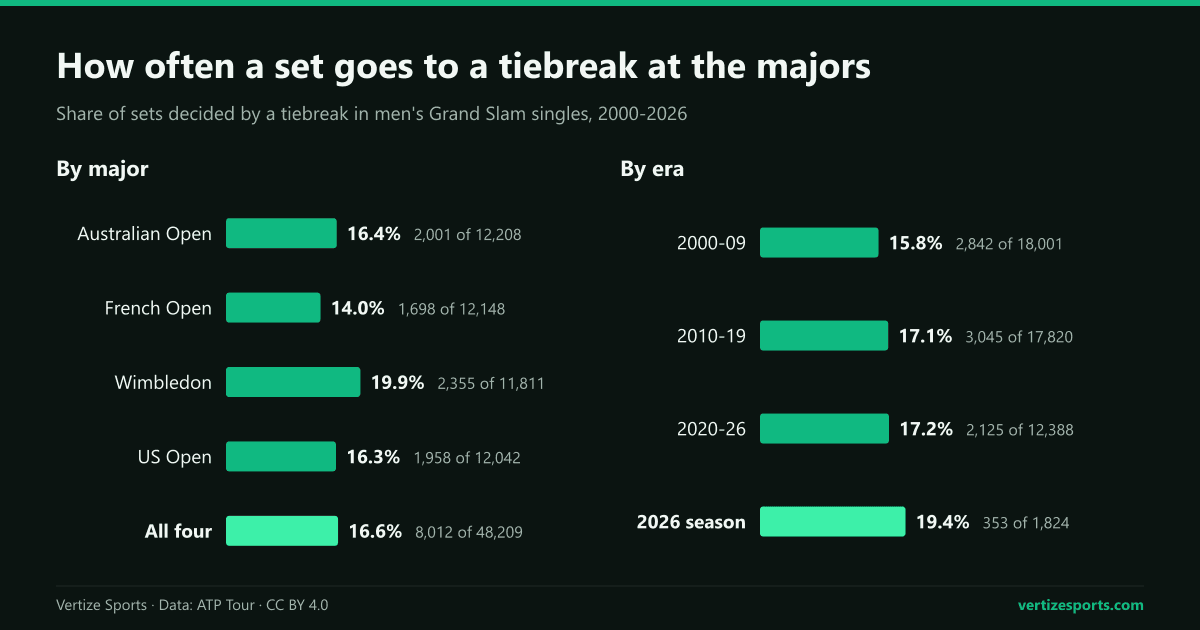
In men's Grand Slam singles since 2000, 8,012 of 48,209 sets were decided by a tiebreak, 16.6 percent, and 47 percent of completed matches had at least one. Wimbledon, on grass, had the most: 19.9 percent of sets, with a tiebreak in 55 percent of matches. The French Open, on clay, had the fewest, 14.0 percent of sets and 41 percent of matches, with the Australian Open (16.4) and the US Open (16.3) in between.
Tiebreaks have become slightly more common, from 15.8 percent of sets in the 2000s to 17.1 in the 2010s and 17.2 since 2020. The biggest rise came at the Australian Open, from 14.2 to 18.6 percent, while the US Open went the other way, from 16.9 to 15.5.
Final set tiebreak rules at each Grand Slam since 2000
From 2000 to 2018, only the US Open had a tiebreak in the final set. It brought the tiebreak to the Grand Slams in 1970 and switched to the seven-point version in 1975. The other three played the final set to advantage, so it went on until one player was two games ahead.
- 2019: the Australian Open moved to a 10-point tiebreak at 6-all in the final set, and Wimbledon to a seven-point tiebreak at 12-all.
- 2022: the four tournaments, through the Grand Slam Board, adopted a single rule on March 16: at 6-all in the final set, a tiebreak won by the first player to reach 10 points with a two-point margin. The French Open applied it first, at its 2022 edition.
- 2026: the 10-point final-set tiebreak, first announced as a trial, is part of the Grand Slam rulebook.
| Final-set rule | Where and when | Fifth sets | Reached 6-all |
|---|---|---|---|
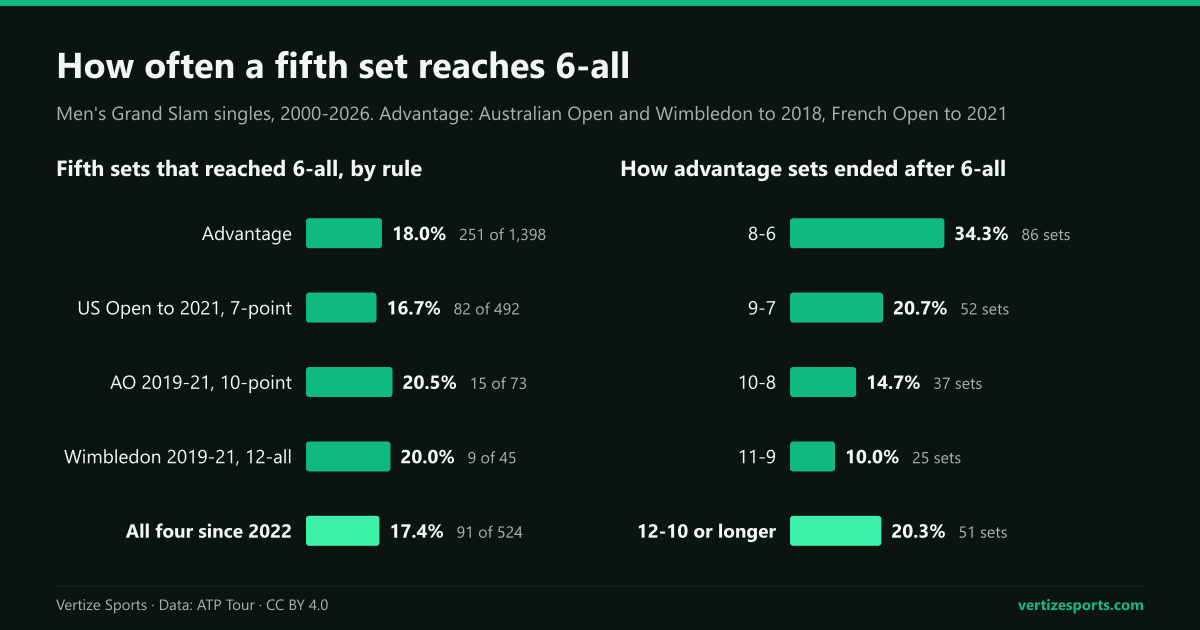
| No tiebreak (advantage) | Australian Open and Wimbledon 2000-18, French Open 2000-21 | 1,398 | 251 (18.0%) |
| 7-point tiebreak at 6-all | US Open 2000-21 | 492 | 82 (16.7%) |
| 10-point tiebreak at 6-all | Australian Open 2019-21 | 73 | 15 (20.5%) |
| 7-point tiebreak at 12-all | Wimbledon 2019 and 2021 | 45 | 9 (20.0%) |
| 10-point tiebreak at 6-all | All four, 2022-26 | 524 | 91 (17.4%) |
The rule has not changed how often a fifth set reaches 6-all: between 16.7 and 20.5 percent under every format. It changed what happens next.
Fifth set tiebreak vs. advantage: the longest deciding sets
Under advantage, the 251 fifth sets that reached 6-all averaged 18.7 games, 18.3 without the longest, against a maximum of 13 with a tiebreak. About a third ended 8-6, but one in five ran to 12-10 or longer, and 25 went beyond 12-all, the point at which Wimbledon's 2019 rule would have stepped in. Wimbledon had 28 of the 51 that reached 10-all.
| Major | Round | Winner | Loser | Fifth set |
|---|---|---|---|---|
| Wimbledon 2010 | First round | John Isner | Nicolas Mahut | 70-68 |
| Wimbledon 2018 | Semifinals | Kevin Anderson | John Isner | 26-24 |
| Australian Open 2017 | First round | Ivo Karlovic | Horacio Zeballos | 22-20 |
| Australian Open 2003 | Quarterfinals | Andy Roddick | Younes El Aynaoui | 21-19 |
| Wimbledon 2000 | Third round | Mark Philippoussis | Sjeng Schalken | 20-18 |
| Wimbledon 2016 | Third round | Jo-Wilfried Tsonga | John Isner | 19-17 |
| French Open 2012 | Second round | Paul-Henri Mathieu | John Isner | 18-16 |
| French Open 2014 | First round | Facundo Bagnis | Julien Benneteau | 18-16 |
| French Open 2020 | First round | Lorenzo Giustino | Corentin Moutet | 18-16 |
John Isner played in four of the nine longest and won only the longest, 70-68 against Nicolas Mahut at Wimbledon in 2010: 138 games, nearly three times the next. Wimbledon announced its tiebreak at 12-all in October 2018, after a review of match data from the previous 20 Championships; earlier that year, Kevin Anderson had beaten Isner 26-24 in the fifth set of a semifinal. It was used twice in the men's draw: in the 2019 final, the first Wimbledon final settled by a final-set tiebreak, which Novak Djokovic won 13-12 over Roger Federer, and in a 2021 first-round match that Oscar Otte won over Arthur Rinderknech.
The 10-point tiebreak at Grand Slams since 2022
In the 20 majors since 2022, 91 of the 524 men's fifth sets reached 6-all and went to the 10-point tiebreak: 27 at Wimbledon, 23 at the US Open, 22 at the Australian Open and 19 at the French Open. The most at one tournament was nine, at the 2024 Australian Open and at Wimbledon in 2026. The most common score was 10-7, 19 times, and the longest was Matteo Berrettini's 15-13 over Francisco Comesana at the 2026 French Open.
Who wins them has been close to a coin flip. When a seeded player met an unseeded one, the seed won 19 of 40, fewer than half, although seeds won 78 percent of all their matches against unseeded players in those seasons and 128 of 202 five-setters settled before 6-all. The player who won the fourth set to force a fifth won 45 of the 91, and across all 190 final-set tiebreaks since 2000, under every rule, exactly half, 95. The samples are small.
Since 2022, Andrey Rublev has won the most of these tiebreaks, four, against two losses; Alexander Zverev is 3-0, and Ben Shelton, Holger Rune and Jakub Mensik are 3-1. Three major finals since 2000 have been decided by a final-set tiebreak, each under a different rule: Djokovic over Federer at 12-all in 2019, Dominic Thiem over Zverev 7-6 (8-6) at the 2020 US Open, and Carlos Alcaraz over Jannik Sinner 7-6 (10-2) at the 2025 French Open, the only final so far to reach the 10-point tiebreak.
Most tiebreaks won at Grand Slams since 2000
Federer won the most tiebreaks at the majors in the period, 152 of 225, ahead of Djokovic, 142 of 220, and Isner, 125 of 195. Among the 19 men who played at least 100, Milos Raonic had the best record, 82-37, or 68.9 percent, just ahead of Federer at 67.6 and Zverev at 67.2. Only Ivo Karlovic, 78-85, and Fernando Verdasco, 57-58, lost more than they won.
| Player | Tiebreaks | Won-lost | Win rate |
|---|---|---|---|
| Milos Raonic | 119 | 82-37 | 68.9% |
| Roger Federer | 225 | 152-73 | 67.6% |
| Alexander Zverev | 125 | 84-41 | 67.2% |
| Novak Djokovic | 220 | 142-78 | 64.5% |
| Andy Murray | 123 | 79-44 | 64.2% |
| John Isner | 195 | 125-70 | 64.1% |
| Rafael Nadal | 145 | 91-54 | 62.8% |
| Andy Roddick | 116 | 71-45 | 61.2% |
Of the men who played a major in 2026 and have at least 50 tiebreaks, Sinner has the best record, 35-16 (68.6 percent); Alcaraz is 34-22. The counts start in 2000 and include completed matches only.
Tiebreaks at the 2026 Grand Slams
The 2026 season had the highest share of tiebreaks of the 27 in our data, 19.4 percent of sets, and Wimbledon 2026 the highest of the 107 tournaments, 24.3 percent, just ahead of Wimbledon 2014. It also had 22 fifth-set tiebreaks, second only to the 24 of 2024, nine of them at Wimbledon.
Two came in the quarterfinals of the US Open: Shelton, the eighth seed, beat Alcaraz, the second, 10-7, and Frances Tiafoe beat Alex Michelsen 10-6. At Wimbledon, Djokovic, seeded seventh, beat the third seed, Felix Auger-Aliassime, 10-4 in the quarterfinals. The wildcard Arthur Fery won two in a row, over Zizou Bergs and Grigor Dimitrov, on the way to the semifinals, and three qualifiers beat seeds in first-round deciding tiebreaks, among them Otto Virtanen over Shelton, the fourth seed, 11-9, and Roman Safiullin over Rublev, the 12th seed, 14-12.
Results from the tournaments in play are on the Vertize tennis scores page, and the rest of the tour is in the tennis section. Two related pieces measure comebacks from two sets down and how often the No. 1 seed wins a major.
Grand Slam tiebreak rules: frequently asked questions
What is the final set tiebreak rule at the Grand Slams? At all four majors since 2022, a final set that reaches 6-all is decided by a tiebreak won by the first player to 10 points with a two-point margin.
When did Wimbledon get a final set tiebreak? In 2019, at 12-all. Since 2022 it has used the 10-point tiebreak at 6-all, like the other three majors.
Does the French Open have a fifth set tiebreak? Yes, since 2022. Until 2021 the final set was played to advantage, and the longest fifth sets there since 2000 went 18-16, three times.
Who has won the most tiebreaks at the Grand Slams? Since 2000, Roger Federer, with 152 in men's singles, followed by Novak Djokovic with 142 and John Isner with 125.
How often does a set go to a tiebreak? In men's Grand Slam singles since 2000, 16.6 percent of the time, about one set in six.
How this was built: every men's singles match at the four majors from the 2000 Australian Open to the 2026 US Open, 13,589 in 107 draws (Wimbledon was not played in 2020), taken set by set, with tiebreak scores, from the ATP Tour results archive. A set counts as a tiebreak when it ended 7-6, or 13-12 under Wimbledon's 2019-2021 rule. Shares use the 13,006 completed matches, leaving out retirements, defaults, walkovers and five matches with conflicting records. Every match was checked against the Wikipedia draw pages: the ATP gives the points of 7,993 of the 8,012 tiebreaks and Wikipedia agrees on 7,971, and two sets the ATP lists as 7-5 with tiebreak points were counted as 7-6, as Wikipedia has them. Seeds are as printed in the official draw, and the rules come from the tournaments' announcements and the Grand Slam rulebook; see also our methodology. Data collected September 28, 2026.