We took every winner from the NCAA's list of award winners, checked it against Wikipedia's list of Heisman winners, and matched each with the final Associated Press (AP) poll of the same season, from College Poll Archive; that poll's No. 1 is the AP national champion. Every champion, record, title game and playoff result comes from the NCAA's Football Bowl Subdivision (FBS) record book, and the official list of winners is on the Heisman Trust's site.
How often the Heisman winner wins the national championship
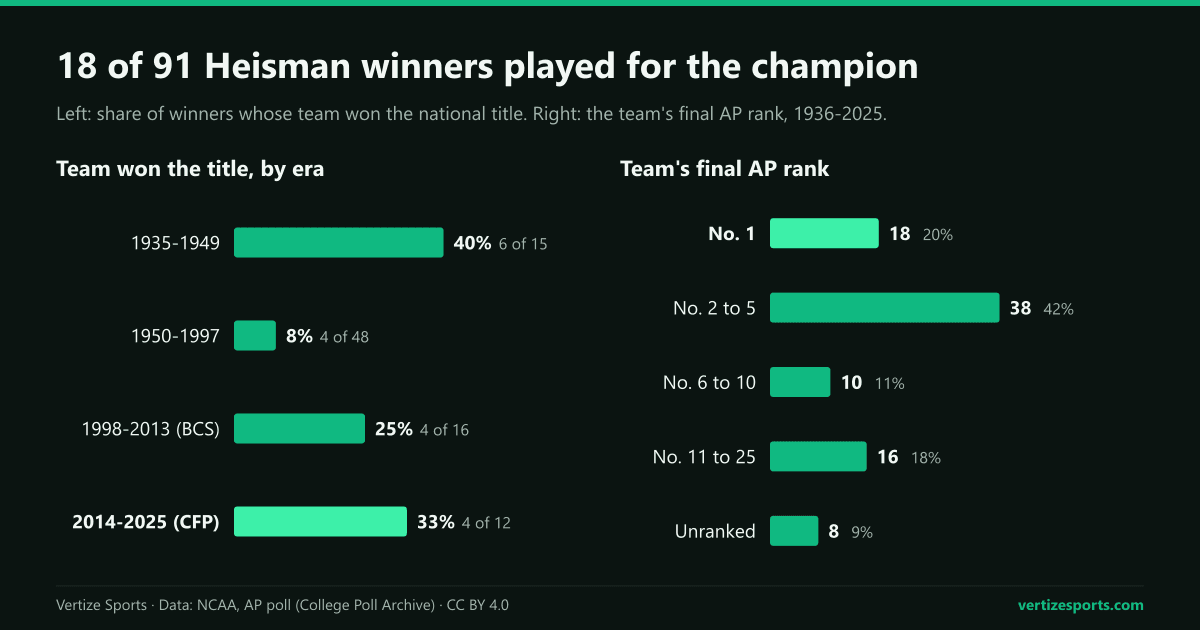
Eighteen winners' teams finished No. 1 in the final AP poll. Notre Dame and Alabama account for six of them:
- Notre Dame: Angelo Bertelli in 1943, Johnny Lujack in 1947 and Leon Hart in 1949.
- Alabama: Mark Ingram II in 2009, Derrick Henry in 2015 and DeVonta Smith in 2020.
- Florida State: Charlie Ward in 1993 and Jameis Winston in 2013.
- Once each: Davey O'Brien of Texas Christian (TCU) in 1938, Bruce Smith of Minnesota in 1941, Doc Blanchard of Army in 1945, Tony Dorsett of Pittsburgh in 1976, Danny Wuerffel of Florida in 1996, Charles Woodson of Michigan in 1997, Matt Leinart of Southern California (USC) in 2004, Cam Newton of Auburn in 2010, Joe Burrow of Louisiana State (LSU) in 2019 and Mendoza in 2025.
The rate has swung with the eras. Six of the first 15 winners, through 1949, played for the champion, four of them at Notre Dame or Army. Then came 26 straight seasons without one, from 1950 to 1975, and only 4 of 48 from 1950 to 1997. In the Bowl Championship Series (BCS) era, 1998 to 2013, it was 4 of 16, and since the playoff began in 2014 it has been 4 of 12.
| Seasons | Heisman winners | Team won national title | Share | Team in final AP top 5 |
|---|---|---|---|---|
| 1935-1949 | 15 | 6 | 40% | 10 of 14 |
| 1950-1997 | 48 | 4 | 8% | 26 of 48 |
| 1998-2013 (BCS) | 16 | 4 | 25% | 12 of 16 |
| 2014-2025 (CFP) | 12 | 4 | 33% | 8 of 12 |
| All | 91 | 18 | 20% | 56 of 90 |
Two of the titles come with footnotes. Michigan shared 1997 with Nebraska, the coaches' poll champion, and the BCS later vacated USC's 2004 championship, although the AP title stands. In the other direction, Notre Dame was the National Football Foundation (NFF) champion in 1964, John Huarte's season, but third in the AP poll; counting every consensus champion the NCAA lists since 1950 would add only that one.
The Heisman winner's team record and final AP ranking
The 18 title teams were mostly dominant. Fourteen went unbeaten and untied, according to the NCAA's records, from TCU at 11-0 in 1938 to Indiana at 16-0 last season. The other four lost once: Notre Dame in 1943, Florida State in 1993, Florida in 1996 and Alabama in 2015.
The other 72 teams since the AP poll began in 1936 often came close: 38 finished between second and fifth in the final poll, 12 of them second, most recently Alabama in 2021. In all, the winner's team finished in the top five in 56 of 90 seasons, 62 percent.
Eight winners' teams finished unranked, four of them from 1961 to 1967, when the AP ranked only 10 teams. The others were Notre Dame in 1956, which went 2-8 in Paul Hornung's season, the only time a player from a losing team has won; Oklahoma in 1969, with Steve Owens; South Carolina in 1980, with George Rogers; and Auburn in 1985, with Bo Jackson. Every winner's team since has made the final AP Top 25, Colorado only just: 25th in 2024, with Travis Hunter.
Heisman winners in the title game and the College Football Playoff
Since the BCS began in 1998, the Heisman winner's team has played in the title game 16 times in 28 seasons and won half of those games. Most of the losses came early: from 2000 to 2008 the winner's team lost six of seven title games, and since 2009 it has won seven of nine. The eight losses:
- 2000: Florida State, with Chris Weinke, lost 13-2 to Oklahoma in the Orange Bowl.
- 2001: Nebraska, with Eric Crouch, lost 37-14 to Miami (Fla.) in the Rose Bowl.
- 2003: Oklahoma, with Jason White, lost 21-14 to LSU in the Sugar Bowl.
- 2005: USC, with Reggie Bush, lost 41-38 to Texas in the Rose Bowl.
- 2006: Ohio State, with Troy Smith, lost 41-14 to Florida in the BCS National Championship Game.
- 2008: Oklahoma, with Sam Bradford, lost 24-14 to Florida in the BCS National Championship Game.
- 2014: Oregon, with Marcus Mariota, lost 42-20 to Ohio State in the playoff final.
- 2021: Alabama, with Bryce Young, lost 33-18 to Georgia in the playoff final.
In the playoff era, 8 of the 12 winners' teams made the field: four won the title, two lost the final and Oklahoma lost in the semifinals in both 2017 and 2018. Louisville in 2016, USC in 2022, LSU in 2023 and Colorado in 2024 missed the playoff. In the two seasons of the 12-team format, Colorado missed and Indiana won it all.
Heisman winners by position: the run of quarterbacks
Over the full history, running backs lead quarterbacks 44 to 39, counting the halfbacks and fullbacks of the early decades. The balance flipped around 2000: quarterbacks won 18 of the 65 trophies through 1999 and 21 of the 26 since, 81 percent.
The longest runs of quarterbacks are five in a row, from 2000 to 2004 and from 2010 to 2014. Running backs once won 11 straight, from John Cappelletti of Penn State in 1973 to Mike Rozier of Nebraska in 1983, a run that Doug Flutie of Boston College, a quarterback, ended in 1984.
| Decade | Winners | Quarterbacks | Running backs | Other positions | Team won title |
|---|---|---|---|---|---|
| 1930s (1935-39) | 5 | 1 | 3 | 1 | 1 |
| 1940s | 10 | 2 | 7 | 1 | 5 |
| 1950s | 10 | 1 | 9 | 0 | 0 |
| 1960s | 10 | 5 | 5 | 0 | 0 |
| 1970s | 10 | 2 | 7 | 1 | 1 |
| 1980s | 10 | 3 | 6 | 1 | 0 |
| 1990s | 10 | 4 | 4 | 2 | 3 |
| 2000s | 10 | 8 | 2 | 0 | 2 |
| 2010s | 10 | 9 | 1 | 0 | 4 |
| 2020s (2020-25) | 6 | 4 | 0 | 2 | 2 |
| Total | 91 | 39 | 44 | 8 | 18 |
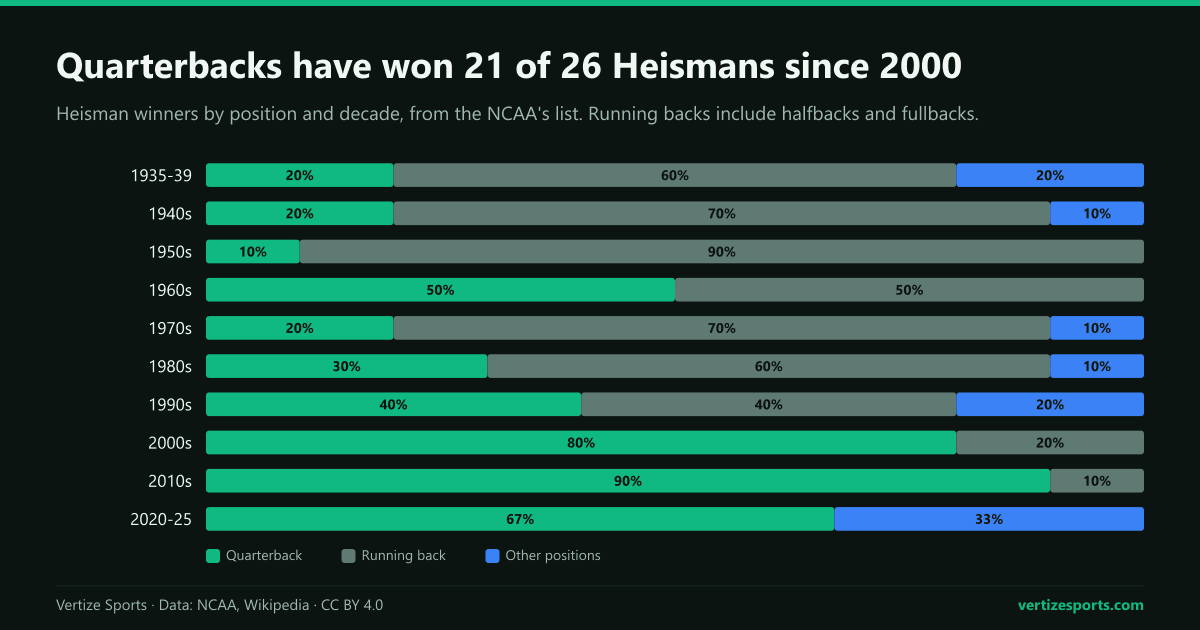
Quarterback winners have also been likelier to finish with the title. Their teams won it in 10 of 39 seasons, against 5 of 44 for running backs and 3 of 8 for the other positions.
Non-quarterback Heisman winners and the last running back to win
Five non-quarterbacks have won since 2000: running backs Reggie Bush of USC in 2005, Ingram in 2009 and Henry in 2015, wide receiver Smith in 2020 and Hunter in 2024, whom the NCAA lists as a defensive back and wide receiver. Ingram, Henry and Smith all played for Alabama, and all three won the national title that season.
Henry is the most recent running back to win. Wide receivers have won four times, starting with Johnny Rodgers of Nebraska in 1972, followed by Tim Brown of Notre Dame in 1987, Desmond Howard of Michigan in 1991 and Smith. Two ends won in the early years, Larry Kelley of Yale in 1936 and Hart in 1949, and Woodson and Hunter are the only winners who played mainly on defense, both as defensive backs.
Heisman winners by class
Underclassmen have taken over along with quarterbacks. The NCAA and Wikipedia agree that 17 of the 26 winners since 2000 were juniors, sophomores or freshmen, against 13 of the 65 through 1999. The first sophomore to win was Tim Tebow of Florida in 2007 and the first freshman was Johnny Manziel of Texas A&M in 2012, according to Wikipedia.
From Tebow through Lamar Jackson of Louisville in 2016, 10 straight winners were underclassmen, including the only two freshmen, Manziel and Winston in 2013. Winston's Florida State won the title; Manziel's Texas A&M finished fifth.
Two-time Heisman winners
Archie Griffin of Ohio State is the only player to win twice, in 1974 and 1975, so 91 trophies have gone to 90 players. Ohio State finished fourth in the final AP poll both years.
In the NCAA's lists of the top four in every vote, the only other winner to finish as high as second the next year was Billy Sims of Oklahoma, runner-up in 1979 to Charles White of USC. Five later winners came back to finish third: Ty Detmer of Brigham Young (BYU) in 1991, Jason White of Oklahoma in 2004, Leinart in 2005, Tebow in 2008 and Jackson in 2017.
When the 2026 Heisman Trophy is presented
The 2026 trophy will be presented on Saturday, Dec. 12, ESPN reports, six days before the first round of the 12-team playoff on Dec. 18 and 19 and 44 days before the final, on Jan. 25, 2027, in Las Vegas, according to the CFP. The field is set on Selection Day, Sunday, Dec. 6, and the vote is decided before any playoff game is played.
The electorate is 870 media voters, 145 from each of six regions, plus the former winners and one vote from a public ballot, according to Wikipedia. Until the ceremony, the weekly AP Top 25 is on our college football rankings and the games ahead are on the FBS schedule. We have also measured how often the AP preseason No. 1 wins the national title and how many losses a College Football Playoff team can have.
Every Heisman Trophy winner and the team's finish
| Season | Winner | Position | Class | School | Team's final AP rank and result |
|---|---|---|---|---|---|
| 1935 | Jay Berwanger | HB | – | Chicago | No AP poll yet |
| 1936 | Larry Kelley | E | Sr. | Yale | 12 |
| 1937 | Clint Frank | HB | Sr. | Yale | 12 |
| 1938 | Davey O'Brien | QB | Sr. | TCU | 1, champion |
| 1939 | Nile Kinnick | HB | Sr. | Iowa | 9 |
| 1940 | Tom Harmon | HB | Sr. | Michigan | 3 |
| 1941 | Bruce Smith | HB | Sr. | Minnesota | 1, champion |
| 1942 | Frank Sinkwich | HB | Sr. | Georgia | 2 |
| 1943 | Angelo Bertelli | QB | Sr. | Notre Dame | 1, champion |
| 1944 | Les Horvath | QB/HB | Sr. | Ohio State | 2 |
| 1945 | Doc Blanchard | FB | Jr. | Army | 1, champion |
| 1946 | Glenn Davis | HB | Sr. | Army | 2 |
| 1947 | Johnny Lujack | QB | Sr. | Notre Dame | 1, champion |
| 1948 | Doak Walker | HB | Jr. | SMU | 10 |
| 1949 | Leon Hart | E | Sr. | Notre Dame | 1, champion |
| 1950 | Vic Janowicz | HB | Jr. | Ohio State | 14 |
| 1951 | Dick Kazmaier | HB | Sr. | Princeton | 6 |
| 1952 | Billy Vessels | HB | Sr. | Oklahoma | 4 |
| 1953 | Johnny Lattner | HB | Sr. | Notre Dame | 2 |
| 1954 | Alan Ameche | FB | Sr. | Wisconsin | 9 |
| 1955 | Howard Cassady | HB | Sr. | Ohio State | 5 |
| 1956 | Paul Hornung | QB | Sr. | Notre Dame | NR |
| 1957 | John David Crow | HB | Sr. | Texas A&M | 9 |
| 1958 | Pete Dawkins | HB | Sr. | Army | 3 |
| 1959 | Billy Cannon | HB | Sr. | LSU | 3 |
| 1960 | Joe Bellino | HB | Sr. | Navy | 4 |
| 1961 | Ernie Davis | HB | Sr. | Syracuse | NR |
| 1962 | Terry Baker | QB | Sr. | Oregon State | NR |
| 1963 | Roger Staubach | QB | Jr. | Navy | 2 |
| 1964 | John Huarte | QB | Sr. | Notre Dame | 3 (NFF champion) |
| 1965 | Mike Garrett | HB | Sr. | USC | 10 |
| 1966 | Steve Spurrier | QB | Sr. | Florida | NR |
| 1967 | Gary Beban | QB | Sr. | UCLA | NR |
| 1968 | O. J. Simpson | HB | Sr. | USC | 4 |
| 1969 | Steve Owens | HB | Sr. | Oklahoma | NR |
| 1970 | Jim Plunkett | QB | Sr. | Stanford | 8 |
| 1971 | Pat Sullivan | QB | Sr. | Auburn | 12 |
| 1972 | Johnny Rodgers | WR | Sr. | Nebraska | 4 |
| 1973 | John Cappelletti | RB | Sr. | Penn State | 5 |
| 1974 | Archie Griffin | RB | Jr. | Ohio State | 4 |
| 1975 | Archie Griffin | RB | Sr. | Ohio State | 4 |
| 1976 | Tony Dorsett | RB | Sr. | Pittsburgh | 1, champion |
| 1977 | Earl Campbell | RB | Sr. | Texas | 4 |
| 1978 | Billy Sims | RB | Jr. | Oklahoma | 3 |
| 1979 | Charles White | RB | Sr. | USC | 2 |
| 1980 | George Rogers | RB | Sr. | South Carolina | NR |
| 1981 | Marcus Allen | RB | Sr. | USC | 14 |
| 1982 | Herschel Walker | RB | Jr. | Georgia | 4 |
| 1983 | Mike Rozier | RB | Sr. | Nebraska | 2 |
| 1984 | Doug Flutie | QB | Sr. | Boston College | 5 |
| 1985 | Bo Jackson | RB | Sr. | Auburn | NR |
| 1986 | Vinny Testaverde | QB | Sr. | Miami (Fla.) | 2 |
| 1987 | Tim Brown | WR | Sr. | Notre Dame | 17 |
| 1988 | Barry Sanders | RB | Jr. | Oklahoma State | 11 |
| 1989 | Andre Ware | QB | Jr. | Houston | 14 |
| 1990 | Ty Detmer | QB | Jr. | BYU | 22 |
| 1991 | Desmond Howard | WR | Jr. | Michigan | 6 |
| 1992 | Gino Torretta | QB | Sr. | Miami (Fla.) | 3 |
| 1993 | Charlie Ward | QB | Sr. | Florida State | 1, champion |
| 1994 | Rashaan Salaam | RB | Jr. | Colorado | 3 |
| 1995 | Eddie George | RB | Sr. | Ohio State | 6 |
| 1996 | Danny Wuerffel | QB | Sr. | Florida | 1, champion |
| 1997 | Charles Woodson | DB | Jr. | Michigan | 1, champion (shared) |
| 1998 | Ricky Williams | RB | Sr. | Texas | 15 |
| 1999 | Ron Dayne | RB | Sr. | Wisconsin | 4 |
| 2000 | Chris Weinke | QB | Sr. | Florida State | 5, lost BCS title game |
| 2001 | Eric Crouch | QB | Sr. | Nebraska | 8, lost BCS title game |
| 2002 | Carson Palmer | QB | Sr. | USC | 4 |
| 2003 | Jason White | QB | – | Oklahoma | 3, lost BCS title game |
| 2004 | Matt Leinart | QB | Jr. | USC | 1, champion |
| 2005 | Reggie Bush | RB | Jr. | USC | 2, lost BCS title game |
| 2006 | Troy Smith | QB | – | Ohio State | 2, lost BCS title game |
| 2007 | Tim Tebow | QB | So. | Florida | 13 |
| 2008 | Sam Bradford | QB | So. | Oklahoma | 5, lost BCS title game |
| 2009 | Mark Ingram II | RB | So. | Alabama | 1, champion |
| 2010 | Cam Newton | QB | Jr. | Auburn | 1, champion |
| 2011 | Robert Griffin III | QB | Jr. | Baylor | 13 |
| 2012 | Johnny Manziel | QB | Fr. | Texas A&M | 5 |
| 2013 | Jameis Winston | QB | Fr. | Florida State | 1, champion |
| 2014 | Marcus Mariota | QB | Jr. | Oregon | 2, lost CFP final |
| 2015 | Derrick Henry | RB | Jr. | Alabama | 1, won CFP title |
| 2016 | Lamar Jackson | QB | So. | Louisville | 21, missed CFP |
| 2017 | Baker Mayfield | QB | Sr. | Oklahoma | 3, lost CFP semifinal |
| 2018 | Kyler Murray | QB | Jr. | Oklahoma | 4, lost CFP semifinal |
| 2019 | Joe Burrow | QB | Sr. | LSU | 1, won CFP title |
| 2020 | DeVonta Smith | WR | Sr. | Alabama | 1, won CFP title |
| 2021 | Bryce Young | QB | So. | Alabama | 2, lost CFP final |
| 2022 | Caleb Williams | QB | So. | USC | 12, missed CFP |
| 2023 | Jayden Daniels | QB | – | LSU | 12, missed CFP |
| 2024 | Travis Hunter | DB/WR | Jr. | Colorado | 25, missed CFP |
| 2025 | Fernando Mendoza | QB | Jr. | Indiana | 1, won CFP title |
Heisman winners and the national title: frequently asked questions
How often does the Heisman winner win the national championship? In 18 of 91 seasons from 1935 to 2025, 20 percent. In the College Football Playoff era, 4 of the 12 winners played for the champion: Derrick Henry, Joe Burrow, DeVonta Smith and Fernando Mendoza.
Who was the last Heisman winner to win the national title? Fernando Mendoza of Indiana, in 2025. Indiana went 16-0 and beat Miami (Fla.) 27-21 in the playoff final; before that, Alabama won with DeVonta Smith in 2020.
Which position has won the most Heisman Trophies? Running backs, with 44 counting halfbacks and fullbacks, to 39 for quarterbacks. Since 2000, though, quarterbacks have won 21 of 26.
Has anyone won the Heisman Trophy twice? Only Archie Griffin of Ohio State, in 1974 and 1975. The closest to a repeat since was Billy Sims of Oklahoma, the 1978 winner, who finished second in 1979.
When is the 2026 Heisman Trophy ceremony? Saturday, Dec. 12, six days before the first round of the College Football Playoff, so the winner is chosen before any playoff game.
How this was built: every Heisman Trophy winner from 1935 to 2025, with school and position, from the NCAA's list of award winners, checked against Wikipedia's list, which agrees on every year and school. Positions are the NCAA's; Les Horvath (1944), listed as QB/HB by the NCAA and HB/QB by Wikipedia, is counted as a halfback. Class is given where the two lists agree and left out for Jay Berwanger, Jason White, Troy Smith and Jayden Daniels, whom the NCAA lists as juniors and Wikipedia as seniors. The NCAA's list still marks Reggie Bush's 2005 trophy as forfeited; the Heisman Trust reinstated it in 2024. The team's finish is its rank in the final AP poll of each season from 1936, when the poll began, to 2025, from College Poll Archive, and the national champion is that poll's No. 1; champions, their records, BCS title games and playoff results come from the NCAA's FBS record book. The final AP poll came out before the bowl games until 1967, except in 1965. The 2026 dates are from ESPN and the CFP, as of Sept. 30, 2026.