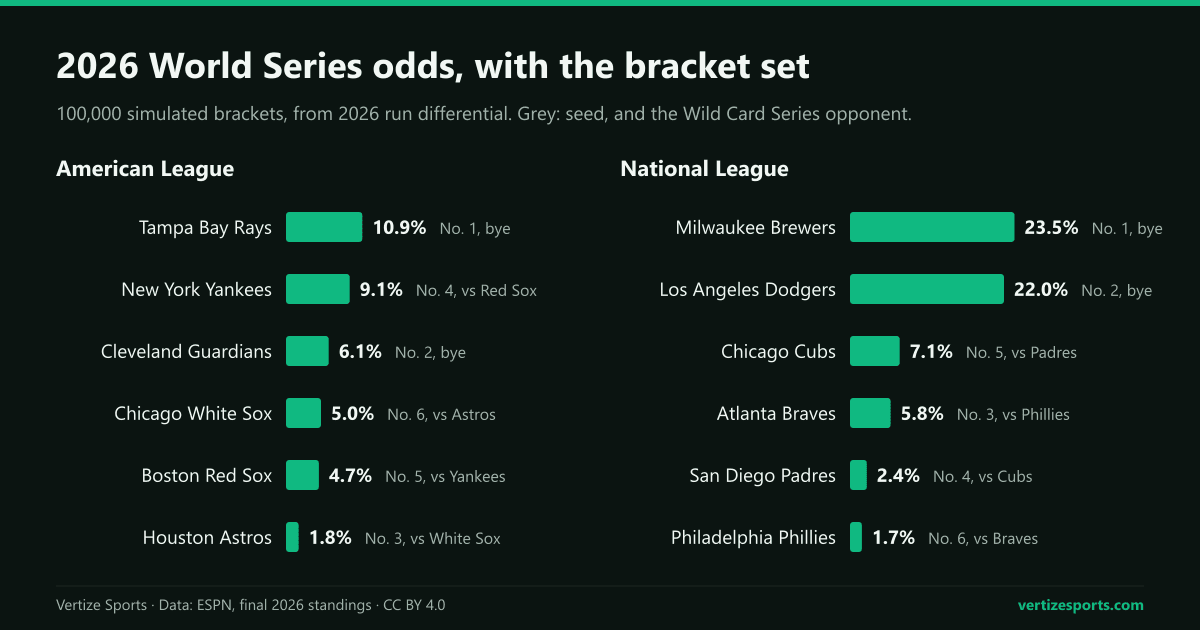
Every October the same argument comes back. The two best division winners in each league skip the Wild Card Series and wait four or five days while everyone else plays, and when one of them loses its Division Series the layoff gets the blame. The theory had its best years in 2022 and 2023, when five of the eight teams with a bye went out in their first series, the 111-win Dodgers among them.
So we checked it with the game model behind the Vertize MLB simulator, then ran the same model forward through this year's bracket, set on the last day of the regular season.
How the MLB playoff format works
- Twelve teams make it, six per league: the three division winners and the three best records among the rest, the wild cards. Getting in has taken about 87 wins in a typical year.
- Division winners are seeded one to three by record, whatever that record is. Wild cards are seeded four to six.
- The top two seeds in each league get a bye straight into the Division Series.
- Seeds three to six play a best-of-three Wild Card Series, three against six and four against five, with every game at the higher seed's park.
- The Division Series is best-of-five, with the higher seed at home in games one, two and five. The League Championship Series and the World Series are best-of-seven, played 2-3-2.
- There are no tiebreaker games any more. Since 2022, ties are settled on paper, head-to-head record first and then record within the division.
The bye was designed as a reward, and whether it is one depends on a trade-off that is easy to state. A team with a bye cannot lose a short Wild Card Series, but it arrives at the Division Series without a game that counts for most of a week, against an opponent that has just won one. This year the top seeds finished on Sunday, September 27 and play again on Saturday, October 3.
Rust or rest: what four Octobers say
We took every Division Series played by a team coming off a bye since the format began in 2022, 16 in all, and asked what each team's chance of advancing should have been. The model knows each side's run differential per game in that regular season, the small home edge and the 2-2-1 format, and nothing else: not the rest, not the rotation, not who was hurt.
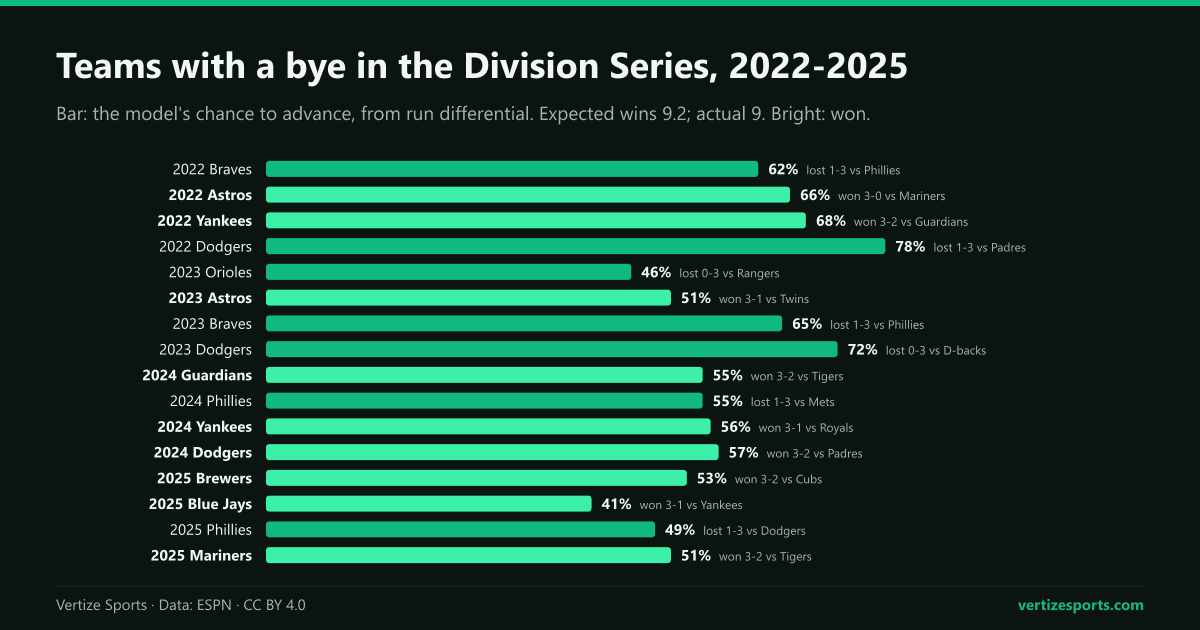
Its forecast was 9.2 series wins for the 16 teams with a bye. They won 9. The bad years were real: the Braves and the Dodgers each went out as clear favorites in both 2022 and 2023, and the 111-win Dodgers of 2022 lost 3-1 to San Diego with a 78 percent chance of advancing. But in 2024 and 2025 six of the eight went through, and over four years the total lands within a quarter of a series of what the teams' quality predicted.
Four Octobers is a small sample, and a genuine rust effect of a few percentage points could hide inside it. What the data does rule out is the version you hear on broadcasts: that a week off turns a good team into an underdog. Teams with a bye won their Division Series about as often as teams of their strength should, rested or not.
The one split that looks bad is at the very top. The six 100-win teams with a bye won a single Division Series between them, the 2022 Astros, although the model made them 65 percent favorites on average; the ten teams below 100 wins won eight, as 54 percent favorites. MLB.com counts a longer version of the same run: of the ten teams to win 100 games this decade before this year's Brewers, eight lost their first playoff series. Six series are too few to tell a real effect from a bad streak, and nothing about rest should hurt only the best teams, but it is why the argument never goes away.
The 2026 postseason bracket
The regular season ended on Sunday, September 27, and the bracket is set. In the National League the Brewers took their first 100-win season and the No. 1 seed at 103-59, and the Dodgers (100-62) have the other bye. The Braves (94-68) host the Phillies (88-74), who held off the Diamondbacks (86-76) for the last wild card, and the Padres (91-71) host the Cubs (89-73).
In the American League the Rays (98-64) have the best record and the No. 1 seed, and the Guardians (85-77) won the Central and the second bye. The Astros host the White Sox (84-78), in the playoffs two years after a record 121-loss season, and the Yankees (93-68) host the Red Sox (87-75).
The quirk of the format is on show in the American League. The Yankees have the league's best run differential by a distance, +138, but the Rays won the East, so New York is the fourth seed and has to play a best-of-three. The bye went instead to Cleveland, the Central champion, who finished eight wins behind New York with a run differential of +11.
The West is stranger still. Houston won it at 81-81, a game ahead of Texas at 80-82, and became the first division champion without a winning record in a full season; the previous low for a playoff team was the 82-80 of the 2005 Padres. The Astros were outscored by 32 runs this year and host a Wild Card Series anyway, as the third seed. The model gives them 43 percent to get past the White Sox, who have the better run differential.
What the bye is worth in 2026
| Team | Record | Seed and first series | Pennant | World Series |
|---|---|---|---|---|
| Milwaukee Brewers | 103-59 | Bye (No. 1) | 35.1% | 23.5% |
| Los Angeles Dodgers | 100-62 | Bye (No. 2) | 33.4% | 22.0% |
| Tampa Bay Rays | 98-64 | Bye (No. 1) | 27.8% | 10.9% |
| New York Yankees | 93-68 | No. 4, vs Red Sox | 19.8% | 9.1% |
| Chicago Cubs | 89-73 | No. 5, vs Padres | 12.1% | 7.1% |
| Cleveland Guardians | 85-77 | Bye (No. 2) | 19.5% | 6.1% |
| Atlanta Braves | 94-68 | No. 3, vs Phillies | 10.4% | 5.8% |
| Chicago White Sox | 84-78 | No. 6, vs Astros | 13.9% | 5.0% |
| Boston Red Sox | 87-75 | No. 5, vs Yankees | 12.3% | 4.7% |
| San Diego Padres | 91-71 | No. 4, vs Cubs | 5.0% | 2.4% |
| Houston Astros | 81-81 | No. 3, vs White Sox | 6.8% | 1.8% |
| Philadelphia Phillies | 88-74 | No. 6, vs Braves | 4.0% | 1.7% |
The Brewers and the Dodgers, the two best teams in baseball by run differential, both have byes, and between them they win 45 percent of our simulated World Series. The bye is a large part of that. If Milwaukee had to beat the sixth seed, Philadelphia, in a best-of-three at home first, the model would give them 67 percent to survive it, and their title chances would fall from 23 percent to about 16.
Across the whole bracket, 62 percent of simulated titles go to the four teams with a bye, a third of the field. The rest is spread over eight teams, which is the other lesson of October: even the best team in baseball wins the World Series less than one time in four.
That is the arithmetic of short series. A team that beats a given opponent 60 percent of the time, a huge edge in baseball, is only a 65 percent favorite over three games, 68 percent over five and 71 percent over seven. Every round is a new chance for the better team to lose, and the bye is the only way to remove one.
The 2026 postseason schedule
The dates are MLB's own. The last games of each series are played only if needed, so every round can end earlier than the dates below.
- Wild Card Series: Tuesday, September 29 to Thursday, October 1.
- Division Series: from Saturday, October 3. The last possible games are October 9 in the National League and October 10 in the American League.
- League Championship Series: the NLCS from Sunday, October 11 and the ALCS from Monday, October 12.
- World Series: from Friday, October 23, with a possible Game 7 on Saturday, October 31.
MLB playoff bye: frequently asked questions
Which teams get a bye in the MLB playoffs? The two division winners with the best records in each league. They go straight to the Division Series and skip the best-of-three Wild Card Series.
Do MLB teams with a bye do worse in the playoffs? Not by any measure we can find. From 2022 to 2025 they won 9 of 16 Division Series against a model expectation of 9.2, which is what teams of their strength should win.
Why can a team with a better record have to play the Wild Card Series? Because division winners are seeded first. A wild card with more wins than a division champion is still seeded fourth at best, and only seeds one and two get the bye.
Who is favored to win the 2026 World Series? The Brewers, at 23 percent in our simulations, just ahead of the Dodgers at 22. No American League team reaches 11 percent.
How this was built: every game is simulated with the model from the Vertize MLB simulator. The home side starts 0.05 runs ahead, each run of season run differential per game is worth a run of expected margin, and the rest is randomness with a spread of 4.44 runs per game. The 2022-2025 test uses each season's final ESPN standings and postseason results. The 2026 odds use each team's final 2026 run differential and play out the set bracket 100,000 times. Injuries, rotations and rest are not in the model.