We took the result of every Finals from Wikipedia's list of NBA champions, which also marks the team with home-court advantage, and rebuilt each series game by game, 461 games in all: from 1984 with NBA.com's official game logs, and before that from the game-by-game pages Wikipedia keeps for each postseason, such as the 1970 playoffs. Every result matches NBA.com's list of champions except 1952, which it gives as 4-1; that Final went seven games.
How many games are in the NBA Finals?
Four to seven. Every Finals since the first in 1947 has been a best-of-seven, won by the first team to four victories, and the 80 series have averaged 5.76 games. Five in eight, 50 of them, needed at least six.
| Finals length | 1947-1984 | 1985-2013 (2-3-2) | 2014-2026 (2-2-1-1-1) | All 80 Finals |
|---|---|---|---|---|
| Four games (sweep) | 4 | 4 | 1 | 9 (11%) |
| Five games | 9 | 7 | 5 | 21 (26%) |
| Six games | 12 | 13 | 5 | 30 (38%) |
| Seven games | 13 | 5 | 2 | 20 (25%) |
| Average length (games) | 5.89 | 5.66 | 5.62 | 5.76 |
| Team with home court won | 27 of 38 | 21 of 29 | 9 of 12 | 57 of 79 (72%) |
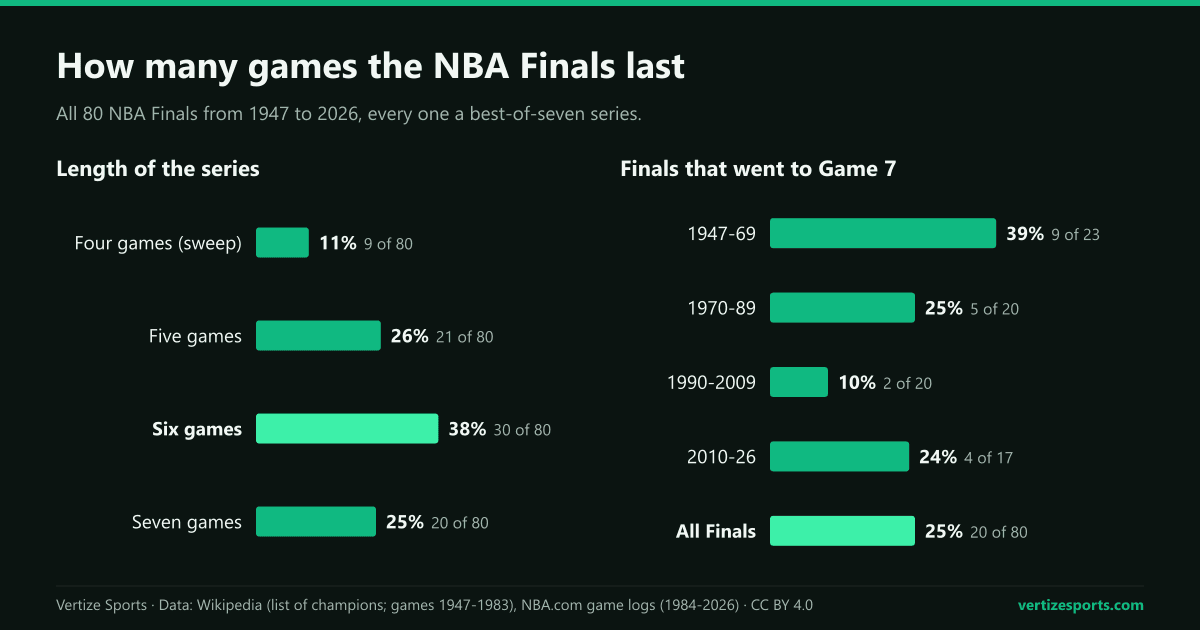
The Finals ran longest in their first decades: from 1947 to 1969, 9 of 23 went seven games, 39 percent. From 1990 to 2009 only two of 20 did, in 1994 and 2005, and the 10 Finals between them are the longest run without a Game 7.
NBA Finals sweeps: every 4-0 series
Nine Finals have ended in four games, 11 percent, five of them since 1984. The last came in 2018, and the eight Finals since have all gone at least five games; the longest gap between sweeps was 11 Finals, from 1960 to 1970. Seven of the nine sweeps were by the team with home-court advantage:
- 2018: Golden State Warriors over the Cleveland Cavaliers.
- 2007: San Antonio Spurs over the Cleveland Cavaliers.
- 2002: Los Angeles Lakers over the New Jersey Nets.
- 1995: Houston Rockets over the Orlando Magic, without home-court advantage.
- 1989: Detroit Pistons over the Los Angeles Lakers.
- 1983: Philadelphia 76ers over the Los Angeles Lakers.
- 1975: Golden State Warriors over the Washington Bullets, without home-court advantage.
- 1971: Milwaukee Bucks over the Baltimore Bullets.
- 1959: Boston Celtics over the Minneapolis Lakers.
The Lakers have been on the losing end of three sweeps, in 1959 in Minneapolis and in 1983 and 1989 in Los Angeles. The Cavaliers and the Bullets, in Baltimore and then Washington, were swept twice each.
How often the NBA Finals go to Game 7
Twenty times in 80, one Finals in four. The most recent was on June 22, 2025, when the Thunder beat the Pacers 103-91 at home. Home teams have won 16 of the 20 Finals Game 7s, as our study of playoff comebacks also found, and every one was hosted by the team with home-court advantage.
Only four champions won Game 7 on the road: the Boston Celtics at the Los Angeles Lakers in 1969 and at the Milwaukee Bucks in 1974, the Washington Bullets at the Seattle SuperSonics in 1978, and the Cavaliers at the Warriors in 2016. The latest six-game Finals came in 2022, when Golden State beat the Boston Celtics, and the latest five-game one in 2026.
Home-court advantage in the NBA Finals
The team with home-court advantage has won 57 of 79 Finals, 72 percent, leaving out 2020, when the Los Angeles Lakers beat the Miami Heat without fans in the Walt Disney World bubble. Since 1984 that team has always had a regular-season record at least as good as its opponent's, and it has won 31 of 42 Finals.
Game 1 is a weaker sign. Its winner has gone on to the title 56 times in 80, 70 percent, and 29 times in 43 since 1984, the lowest rate of any round in our study of Game 1 winners.
In 2026 the San Antonio Spurs, 62-20, had home court against the 53-29 New York Knicks and lost: the Knicks won all three games in San Antonio, and home teams won only one game of the five. New York became the 22nd champion without home-court advantage, the first since the 2021 Milwaukee Bucks. Across all Finals, home teams have won 280 of 455 games outside the bubble, 62 percent, but 36 of 67 since 2014, 54 percent, in line with the shrinking home edge across the playoffs.
The 2-3-2 NBA Finals format vs. 2-2-1-1-1
From 1985 to 2013 the team with home-court advantage hosted Games 1, 2, 6 and 7 and its opponent Games 3, 4 and 5, and every game of those 29 Finals was played where that 2-3-2 schedule put it. In October 2013 the NBA Board of Governors voted to switch the Finals to 2-2-1-1-1 from 2014, so that every playoff round would use the same format; the league said better air travel and technology had largely removed the reasons for 2-3-2. Most earlier Finals had used 2-2-1-1-1 as well, at least 28 of the 38 from 1947 to 1984, although 1949 and 1953 to 1955 went 2-3-2.
The format made little difference to the result. The team with home court won 21 of the 29 Finals under 2-3-2, 72 percent, and 9 of 12 under 2-2-1-1-1 since 2014, 2020 aside, against 27 of 38 before 1985. Series under 2-3-2 averaged 5.66 games, and those since 2014 5.62.
The three middle games were where a 2-3-2 series could turn. Three teams without home court won all three in their own building and went on to the title: the 2004 Detroit Pistons, the 2006 Heat and the 2012 Heat. Three teams with home court won all three on the road and clinched in Game 5: the 1990 Pistons, the 1991 Chicago Bulls and the 2001 Lakers.
Are the NBA Finals longer than earlier playoff rounds?
No more than the rounds before them. Since 1984 the Finals have averaged 5.67 games, against 5.66 for the conference finals, 5.69 for the conference semifinals and 5.48 for first-round series since they became best-of-seven in 2003. All 493 best-of-seven series of those postseasons averaged 5.60.
| Round, 1984-2026 | Series | 4 games | 5 games | 6 games | 7 games | Average |
|---|---|---|---|---|---|---|
| First round (2003-2026) | 192 | 39 | 57 | 60 | 36 | 5.48 |
| Conference semifinals | 172 | 24 | 52 | 49 | 47 | 5.69 |
| Conference finals | 86 | 16 | 17 | 33 | 20 | 5.66 |
| Finals | 43 | 5 | 12 | 18 | 8 | 5.67 |
| All best-of-seven series | 493 | 84 | 138 | 160 | 111 | 5.60 |
The Finals stand out at the ends. They have been swept 12 percent of the time since 1984, the lowest rate of any round, and gone to Game 7 19 percent of the time, against 18 and 23 percent for the 450 best-of-seven series in the other rounds. Six games, the most common Finals length, came up in 42 percent of Finals and 32 percent of the other series.
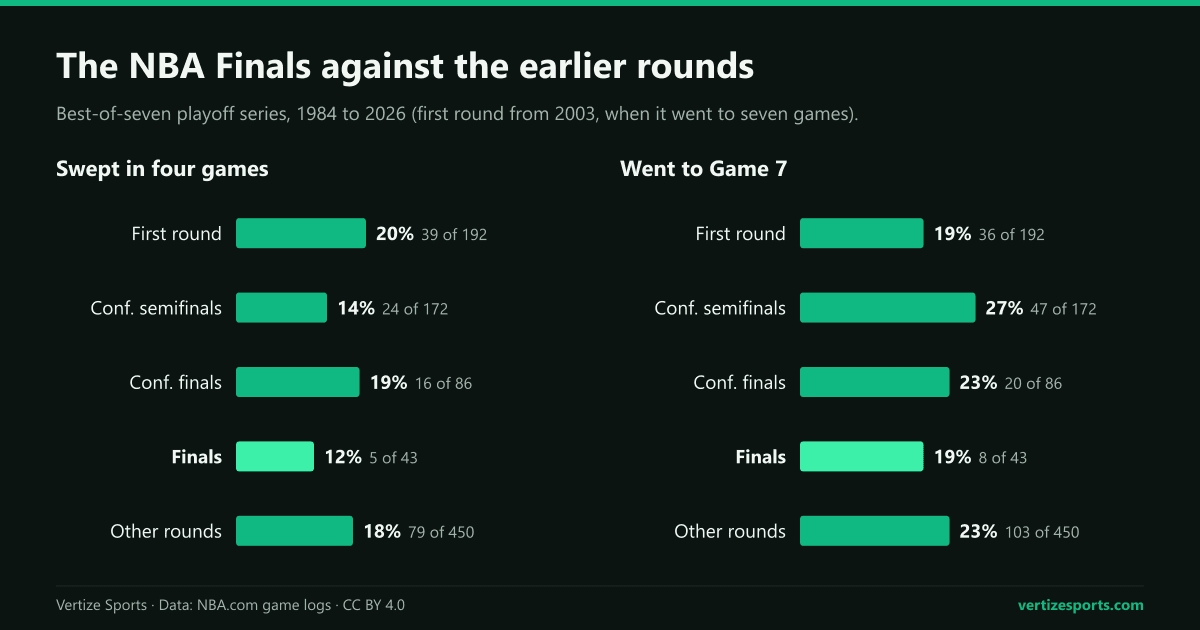
Set against the other series of the same postseason, the Finals went more games than a conference final 35 times in 86 and fewer 30 times, more than a conference semifinal 64 times in 172 and fewer 67, and more than a best-of-seven first-round series 82 times in 192 and fewer 54. Only against the first round did the Finals clearly run longer.
The 2026 NBA Finals and the 2026-27 season
The 2026 Finals took five games. The Knicks won 105-95 and 105-104 in San Antonio, lost Game 3 115-111 at Madison Square Garden, won Game 4 107-106 and clinched 94-90 in San Antonio on June 13 for their first title since 1973. Two of the five were one-point games, as in the 1975 sweep and no other Finals. NBA.com's season review calls it the first Finals in which every game was within five points in the last five minutes.
The 2026-27 regular season began on Tuesday, October 20 and runs to April 11, 2027. The Knicks opened their title defense with a 106-100 home loss to the Philadelphia 76ers and were 3-4 through Nov. 2; they meet the Spurs again on Christmas Day at Madison Square Garden. The NBA schedule lists every game, the NBA simulator plays the season out from the standings, and our study of defending champions shows that 23 of 79 champions won the next title.
NBA Finals length: frequently asked questions
How many games are in the NBA Finals? Up to seven. The Finals are a best-of-seven, so a series lasts four to seven games, and six has been the most common length, 30 times in 80 since 1947.
When was the last NBA Finals sweep? In 2018, when the Golden State Warriors beat the Cleveland Cavaliers 4-0. It was the ninth sweep in Finals history.
When was the last NBA Finals Game 7? In 2025, when the Oklahoma City Thunder beat the Indiana Pacers 103-91 at home. Twenty Finals have gone seven games, and home teams have won 16 of them.
Does home-court advantage matter in the NBA Finals? The team that has it has won 57 of 79 Finals, 72 percent, not counting the 2020 bubble. The 2026 San Antonio Spurs had it and lost to the Knicks in five games.
What is the 2-3-2 format in the NBA Finals? From 1985 to 2013 the team with home-court advantage hosted Games 1, 2, 6 and 7 and the other team Games 3, 4 and 5. Since 2014 the Finals have used 2-2-1-1-1, like the other playoff rounds.
How this was built: all 80 NBA Finals from 1947 to 2026, 461 games. Results and the team with home-court advantage come from Wikipedia's list of NBA champions; games from 1984 on come from NBA.com's official game logs, and earlier ones from Wikipedia's game-by-game playoff pages, checked against the series score each page gives after every game. In every Finals but 2020 the team marked with home court hosted Game 1, and Game 7 when there was one. Round comparisons use all 493 best-of-seven playoff series from 1984 to 2026, placed in rounds by counting back from the Finals, without the best-of-five first rounds of 1984 to 2002. Home-court figures leave out the 2020 bubble. The 2026-27 schedule is from NBA Communications as of October 15, 2026.