Three games is less than a fifth of an NFL season, but it is enough to decide most of them. We went through every team's record after two, three and four games since 2002, when the league went to 32 teams and eight divisions, and checked who was still playing in January. Then we ran the rest of 2026 through a model built from the same seasons.
How often 0-3 teams make the playoffs
| Start | Teams | Made the playoffs | Share |
|---|---|---|---|
| 0-2 | 200 | 24 | 12.0% |
| 1-1 | 360 | 152 | 42.2% |
| 2-0 | 200 | 124 | 62.0% |
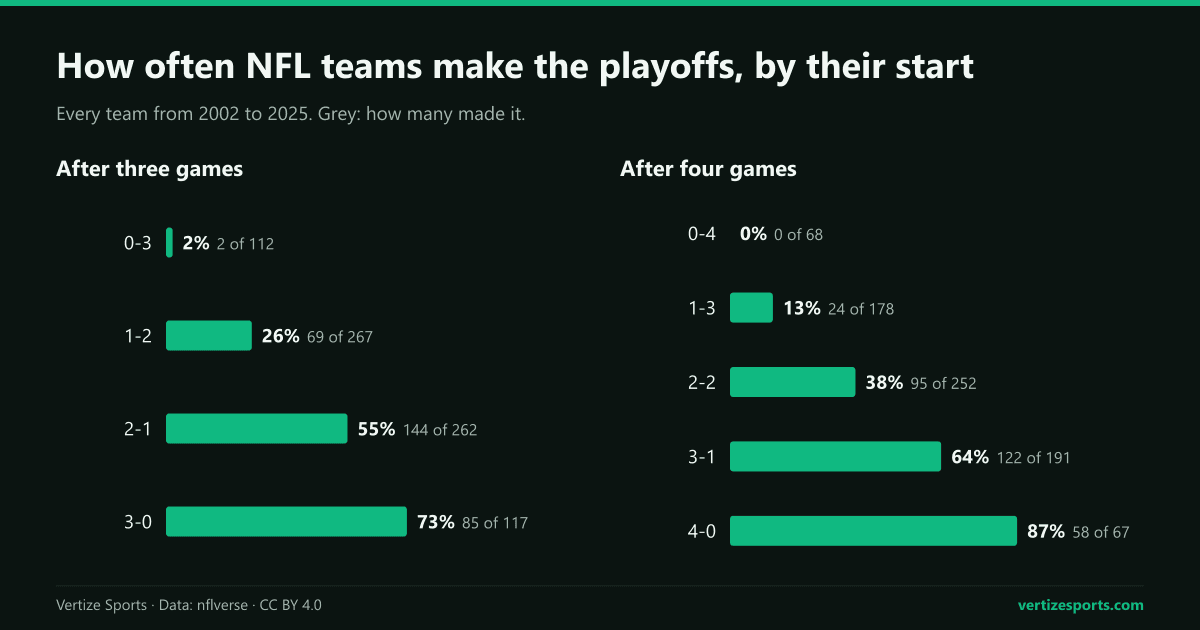
| 0-3 | 112 | 2 | 1.8% |
| 1-2 | 267 | 69 | 25.8% |
| 2-1 | 262 | 144 | 55.0% |
| 3-0 | 117 | 85 | 72.6% |
| 0-4 | 68 | 0 | 0.0% |
| 1-3 | 178 | 24 | 13.5% |
| 2-2 | 252 | 95 | 37.7% |
| 3-1 | 191 | 122 | 63.9% |
| 4-0 | 67 | 58 | 86.6% |
The drop is steep and it comes early. A 2-1 team makes the playoffs a little over half the time, a 1-2 team about a quarter of the time, and an 0-3 team almost never. One more loss closes the door completely: none of the 68 teams that started 0-4 since 2002 made it.
The arithmetic explains it. The last team into the playoffs has needed a 9-8 record in a typical 17-game season, so a team that starts 0-3 has to go at least 9-5 over its last 14 games, a pace only good teams sustain. The teams that start 0-3 are usually not good: on average they won 37 percent of their remaining games.
The two exceptions: Houston in 2018 and 2025
In 2018 the Texans lost to New England, Tennessee and the Giants, then won their next nine games. They finished 11-5, won the AFC South by a game over Indianapolis and lost to the Colts in the wild card round.
In 2025 they did it again from a deeper hole. After 0-3 they were still 3-5 after eight games, then won their last nine to finish 12-5, a wild card behind a 13-4 Jacksonville. They won at Pittsburgh 30-6 in the wild card round before losing at New England in the divisional round, the furthest any 0-3 team has gone since 2002.
Two comebacks by the same franchise are a coincidence, not a method. But they share a thread with the one number that stands out below: both Houston teams were better than their start. The model sees the same thing in this year's Texans.
Did the 14-team playoff change the odds?
A little. Since 2020 the league has taken seven teams from each conference instead of six, and the extra wild card shows up in the numbers: from 2020 to 2025, 8 of 51 teams that started 0-2 made the playoffs, 16 percent, against 12 percent over the whole period. For 0-3 teams it is one of 25, Houston last season, which is too few to call a trend. How the seeds and the wild cards are decided is in our guide to the NFL tiebreakers.
The 2026 0-3 teams: Buccaneers, Texans, Chargers, Titans and Dolphins
Five teams lost their first three games this year. To put odds on each, we used a model fitted to the same 24 seasons: a team's point differential over the rest of the season is predicted from last season's differential and from its first three games, weighted 0.28 and 0.26 per point. Three games, in other words, count for almost as much as the whole of the previous season.
| Team | Record | Diff. per game, 2025 | Diff. per game, 2026 | Playoffs |
|---|---|---|---|---|
| Tampa Bay Buccaneers | 0-3 | -1.8 | -5.7 | 16% |
| Houston Texans | 0-3 | +6.4 | -7.0 | 15% |
| Los Angeles Chargers | 0-3 | +1.6 | -10.7 | 4% |
| Tennessee Titans | 0-3 | -11.4 | -7.3 | 2% |
| Miami Dolphins | 0-3 | -4.5 | -16.7 | 1% |
| Buffalo Bills | 3-0 | +6.8 | +7.7 | 92% |
| San Francisco 49ers | 3-0 | +3.9 | +16.0 | 92% |
| Minnesota Vikings | 3-0 | +0.6 | +10.0 | 90% |
| Kansas City Chiefs | 3-0 | +2.0 | +12.7 | 90% |
| Las Vegas Raiders | 3-0 | -11.2 | +11.3 | 63% |
Tampa Bay (16%) and Houston (15%) are the ones with a real chance. The Buccaneers play in a division where nobody has started better than 1-2, so the NFC South alone gives them 13%. Houston had the AFC's fourth-best point differential last season, +6.4 a game, and the model reads their -7.0 start as a slump rather than a new level; it rates them about as good as an average team from here, which is far better than a typical 0-3 side.
The other three are close to done. The Chargers (4%) have been outscored by almost 11 points a game, Tennessee (2%) was one of the league's four weakest teams by point differential last season, and Miami (1%), outscored by almost 17 points a game so far, is now the lowest-rated team in the model. Together the five average 7.5%, well above the 1.8 percent history suggests, because two of them are better teams than their record.
The same logic cuts the other way at the top. Buffalo, San Francisco, Kansas City and Minnesota are 3-0 and make the playoffs in about nine of ten simulations. Las Vegas is 3-0 as well, but the Raiders were outscored by 11.2 points a game last season, and the model still gives them only 63%, below the 73 percent of 3-0 teams since 2002.
You can play out the rest of the season yourself in the Vertize NFL simulator, which starts from the real standings, or check what comes next on the Week 4 schedule.
NFL starts and the playoffs: frequently asked questions
Can an 0-3 team make the NFL playoffs? Yes, but rarely. From 2002 to 2025, 2 of 112 teams that started 0-3 made it, 1.8 percent, and both were the Houston Texans, in 2018 and 2025.
Has an 0-4 team ever made the playoffs? Not since the league went to 32 teams in 2002: none of the 68 teams that started 0-4 reached the postseason.
What percentage of 0-2 teams make the playoffs? Twelve percent from 2002 to 2025, 24 of 200, and 16 percent since the playoff field grew to 14 teams in 2020.
Has a Super Bowl champion started 0-3? Not since 2002. The 2007 Giants came closest: they lost their first two games, were 1-2 after three and won the Super Bowl. The 2018 Patriots also started 1-2.
How this was built: results of every game from 2002 to 2025 from nflverse. A team counts as a playoff team if it played any postseason game, byes included through the divisional round. The model is a regression on 736 team seasons from 2003 to 2025: rest-of-season point differential per game against the previous season's differential and the first three games' (R squared 26%). Home teams won by 2.3 points more than the model's ratings predicted, and the spread of results around the prediction is 14.0 points a game, both measured on 4,793 games. The 2026 odds play the 225 remaining games 20,000 times with those numbers, including Philadelphia at Chicago on Monday night, and seed each conference with four division winners and three wild cards; ties are broken by record, head-to-head, division and conference record. On past 0-3 teams the model expected a .395 winning percentage the rest of the way and they managed .372, so these odds lean slightly generous.