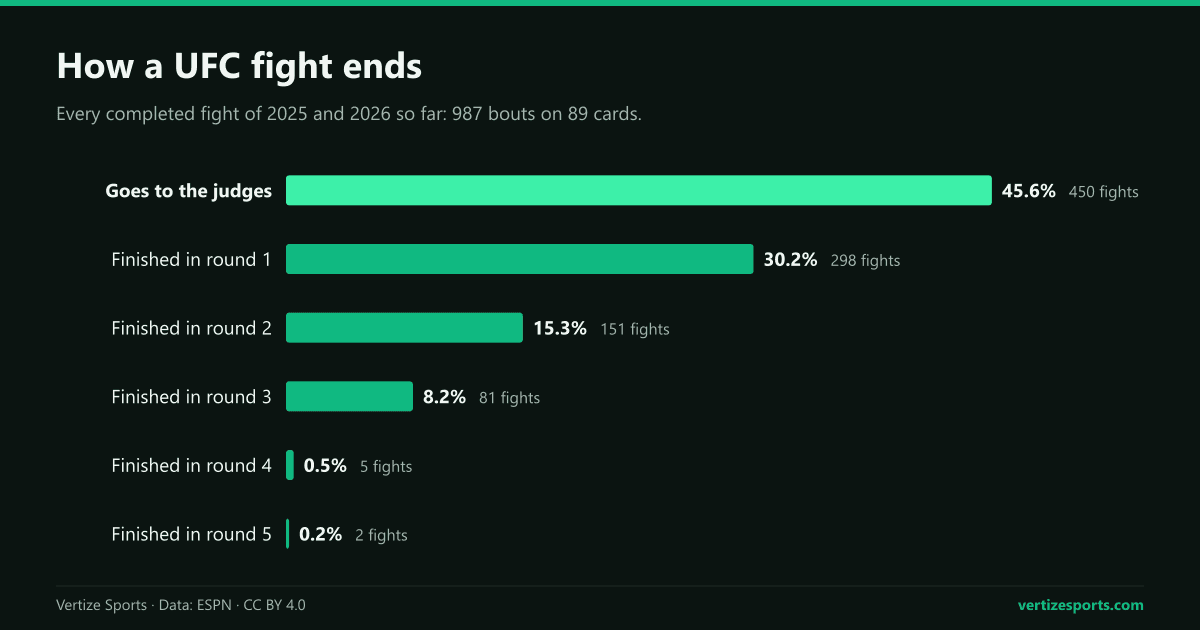
We took every completed UFC fight of 2025 and 2026 so far, 987 of them across 89 cards, and recorded how each one finished: the round it ended in, and whether it reached the end of its final scheduled round. That last detail is what separates a finish from a decision, and it is all the arithmetic this needs.
Almost half go to the judges
| How it ended | Share of all fights | Fights |
|---|---|---|
| Went to the judges | 45.6% | 450 |
| Finished in round 1 | 30.2% | 298 |
| Finished in round 2 | 15.3% | 151 |
| Finished in round 3 | 8.2% | 81 |
| Finished in round 4 | 0.5% | 5 |
| Finished in round 5 | 0.2% | 2 |
45.6 percent of fights are scored rather than finished. The other way to read the same table is that 54.4 percent end early, and that most of those end quickly: 298 fights, 30.2 percent of everything on these cards, were over inside the first five minutes. By round three the finishing rate has collapsed to 8.2 percent, which is what you would expect from two tired fighters who have already survived each other twice.
The practical version: if you sit down for a card of twelve fights, about five will be settled by the judges, four will end in the first round, and the rest will be spread across rounds two and three.
The first five minutes are the whole show
Round one is where a third of everything happens. 30.2 percent of all fights end there, more than rounds two and three put together, and the drop from 30.2 to 15.3 to 8.2 is the shape of the sport: the longer two fighters stay upright, the more likely it is that nobody will put the other away.
It also explains the strange rhythm of a card. A fight that survives the first round has, in effect, changed category: it is now far more likely to be scored than finished, and the crowd noise usually tells you the room knows it.
Three rounds or five
Every fight on a card runs to three rounds except the main event, which gets five. The longer fight does not produce more scorecards, it produces fewer: 45.9 percent of the 901 three-round fights went the distance against 41.9 percent of the 86 five-rounders. Two extra rounds are two more chances for something to end it.
The median fight in this sample lasted 12.9 minutes, which is most of the way through a three-round bout. A fight that goes the full fifteen is not the exception; it is the single most common outcome.
What a card looks like
The median UFC card carries 12 fights, and the range is narrow: from 5 to 14. A numbered event, the pay-per-view kind, runs a median of 12.5 across the 20 in this sample, against 12 for the 69 Fight Nights. The difference between the two is the names on the poster, not the amount of fighting.
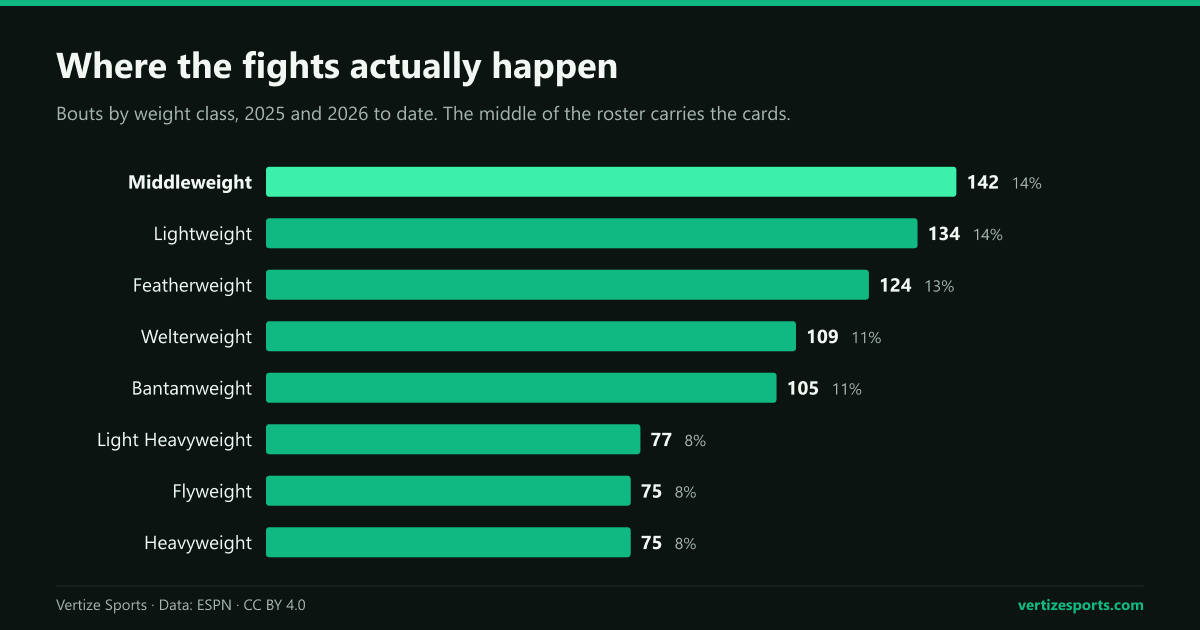
The weight classes are lopsided in the same way every year. Middleweight alone accounts for 14 percent of the bouts we counted, and together with lightweight, featherweight, welterweight and bantamweight it makes up the bulk of every card. Heavyweight, the division that sells the sport, appears far less often than the middle of the roster that fills it.
Why a simulator is harder here than in a league
Every other section of this site ends with a model: a season simulator that plays out games a team has not yet had. Fighting resists that, and the numbers above are the reason. A season has hundreds of games that average out into a table; a card has twelve independent fights, and nearly half of them are handed to three judges rather than settled in the cage.
So the UFC section is a schedule rather than a simulator: every event of the year with its full card, from the main event down to the prelims, with the winners filled in as they land. If a model ever goes in, it will be about divisions and rankings, not about picking the winner of a single fight.
Follow the cards
- The UFC schedule has every event of the year and its complete card, in fight order.
- Past events keep their results, so a card you missed still tells you who won and in which round.
- For the leagues that do get a model, the playoff line and what home advantage is worth explain what it is built on.
Counted from the ESPN feed that fills the schedule on this site, which records the round and the time on the clock but not the method, so a knockout and a submission are both simply a finish here. Fights that ended before the bell of their last round are finishes; fights that reached it are decisions, which includes the handful that end in a draw.