Most Ballon d'Or wins by player
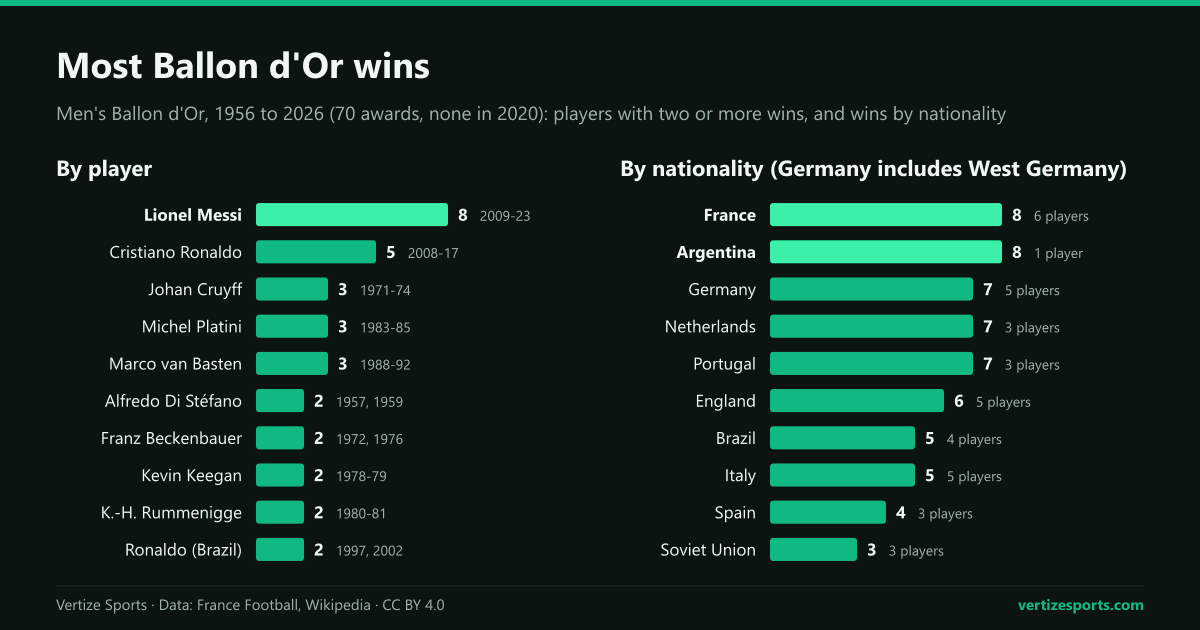
Messi won in 2009, 2010, 2011, 2012, 2015, 2019, 2021 and 2023, in three decades and with three clubs, Barcelona, Paris Saint-Germain (PSG) and Inter Miami; no other player has won it with more than two clubs. Cristiano Ronaldo won five times between 2008 and 2017, and Johan Cruyff, Michel Platini and Marco van Basten three each. Ronaldo and Messi also lead the list of most goals in football history.
Ten men have won more than once and hold 32 of the 70 awards between them; the other 38 winners won it once. Messi's four in a row, from 2009 to 2012, is the longest run, ahead of Platini's three from 1983 to 1985.
Ballon d'Or winners list: every winner since 1956
France Football created the award in 1956, UEFA notes. The table follows its official list of winners, which includes the six FIFA Ballon d'Or awards of 2010 to 2015.
| Year | Winner | Nationality | Club |
|---|---|---|---|
| 2026 | Harry Kane | England | Bayern Munich |
| 2025 | Ousmane Dembélé | France | Paris Saint-Germain |
| 2024 | Rodri | Spain | Manchester City |
| 2023 | Lionel Messi | Argentina | Inter Miami |
| 2022 | Karim Benzema | France | Real Madrid |
| 2021 | Lionel Messi | Argentina | Paris Saint-Germain |
| 2019 | Lionel Messi | Argentina | Barcelona |
| 2018 | Luka Modrić | Croatia | Real Madrid |
| 2017 | Cristiano Ronaldo | Portugal | Real Madrid |
| 2016 | Cristiano Ronaldo | Portugal | Real Madrid |
| 2015 | Lionel Messi | Argentina | Barcelona |
| 2014 | Cristiano Ronaldo | Portugal | Real Madrid |
| 2013 | Cristiano Ronaldo | Portugal | Real Madrid |
| 2012 | Lionel Messi | Argentina | Barcelona |
| 2011 | Lionel Messi | Argentina | Barcelona |
| 2010 | Lionel Messi | Argentina | Barcelona |
| 2009 | Lionel Messi | Argentina | Barcelona |
| 2008 | Cristiano Ronaldo | Portugal | Manchester United |
| 2007 | Kaká | Brazil | AC Milan |
| 2006 | Fabio Cannavaro | Italy | Real Madrid |
| 2005 | Ronaldinho | Brazil | Barcelona |
| 2004 | Andriy Shevchenko | Ukraine | AC Milan |
| 2003 | Pavel Nedvěd | Czech Republic | Juventus |
| 2002 | Ronaldo | Brazil | Real Madrid |
| 2001 | Michael Owen | England | Liverpool |
| 2000 | Luís Figo | Portugal | Real Madrid |
| 1999 | Rivaldo | Brazil | Barcelona |
| 1998 | Zinedine Zidane | France | Juventus |
| 1997 | Ronaldo | Brazil | Inter Milan |
| 1996 | Matthias Sammer | Germany | Borussia Dortmund |
| 1995 | George Weah | Liberia | AC Milan |
| 1994 | Hristo Stoichkov | Bulgaria | Barcelona |
| 1993 | Roberto Baggio | Italy | Juventus |
| 1992 | Marco van Basten | Netherlands | AC Milan |
| 1991 | Jean-Pierre Papin | France | Marseille |
| 1990 | Lothar Matthäus | Germany | Inter Milan |
| 1989 | Marco van Basten | Netherlands | AC Milan |
| 1988 | Marco van Basten | Netherlands | AC Milan |
| 1987 | Ruud Gullit | Netherlands | AC Milan |
| 1986 | Igor Belanov | Soviet Union | Dynamo Kyiv |
| 1985 | Michel Platini | France | Juventus |
| 1984 | Michel Platini | France | Juventus |
| 1983 | Michel Platini | France | Juventus |
| 1982 | Paolo Rossi | Italy | Juventus |
| 1981 | Karl-Heinz Rummenigge | West Germany | Bayern Munich |
| 1980 | Karl-Heinz Rummenigge | West Germany | Bayern Munich |
| 1979 | Kevin Keegan | England | Hamburg |
| 1978 | Kevin Keegan | England | Hamburg |
| 1977 | Allan Simonsen | Denmark | Borussia Mönchengladbach |
| 1976 | Franz Beckenbauer | West Germany | Bayern Munich |
| 1975 | Oleg Blokhin | Soviet Union | Dynamo Kyiv |
| 1974 | Johan Cruyff | Netherlands | Barcelona |
| 1973 | Johan Cruyff | Netherlands | Barcelona |
| 1972 | Franz Beckenbauer | West Germany | Bayern Munich |
| 1971 | Johan Cruyff | Netherlands | Ajax |
| 1970 | Gerd Müller | West Germany | Bayern Munich |
| 1969 | Gianni Rivera | Italy | AC Milan |
| 1968 | George Best | Northern Ireland | Manchester United |
| 1967 | Flórián Albert | Hungary | Ferencváros |
| 1966 | Bobby Charlton | England | Manchester United |
| 1965 | Eusébio | Portugal | Benfica |
| 1964 | Denis Law | Scotland | Manchester United |
| 1963 | Lev Yashin | Soviet Union | Dynamo Moscow |
| 1962 | Josef Masopust | Czechoslovakia | Dukla Prague |
| 1961 | Omar Sívori | Italy | Juventus |
| 1960 | Luis Suárez | Spain | Barcelona |
| 1959 | Alfredo Di Stéfano | Spain | Real Madrid |
| 1958 | Raymond Kopa | France | Real Madrid |
| 1957 | Alfredo Di Stéfano | Spain | Real Madrid |
| 1956 | Stanley Matthews | England | Blackpool |
Ballon d'Or winners by country and by club
France and Argentina lead with eight wins each, but all of Argentina's are Messi's, while France's are spread across six players, from Raymond Kopa in 1958 to Dembélé. Germany (counting West Germany), the Netherlands and Portugal have seven each, England six, Brazil and Italy five and Spain four. France Football lists the 1961 winner, Omar Sívori, under Argentina, his first national team, although he had become an Italian citizen that year and played for Italy; that would give Argentina nine.
By club at the time, Barcelona and Real Madrid have 12 wins each, AC Milan and Juventus eight, Bayern Munich six and Manchester United four, out of 22 clubs. Before 1995, winners came from clubs in 10 countries; since then, only from Spain, Italy, England, France and Germany, plus Messi's Inter Miami in 2023.
Rodri, in 2024, was the first Spain player to win since Luis Suárez in 1960, and Kane, in 2026, the first England player since Michael Owen in 2001. Germany has not had a winner since Matthias Sammer in 1996, Italy since Fabio Cannavaro in 2006 and Brazil since Kaká in 2007.
How often the Ballon d'Or winner also won the Champions League or the World Cup
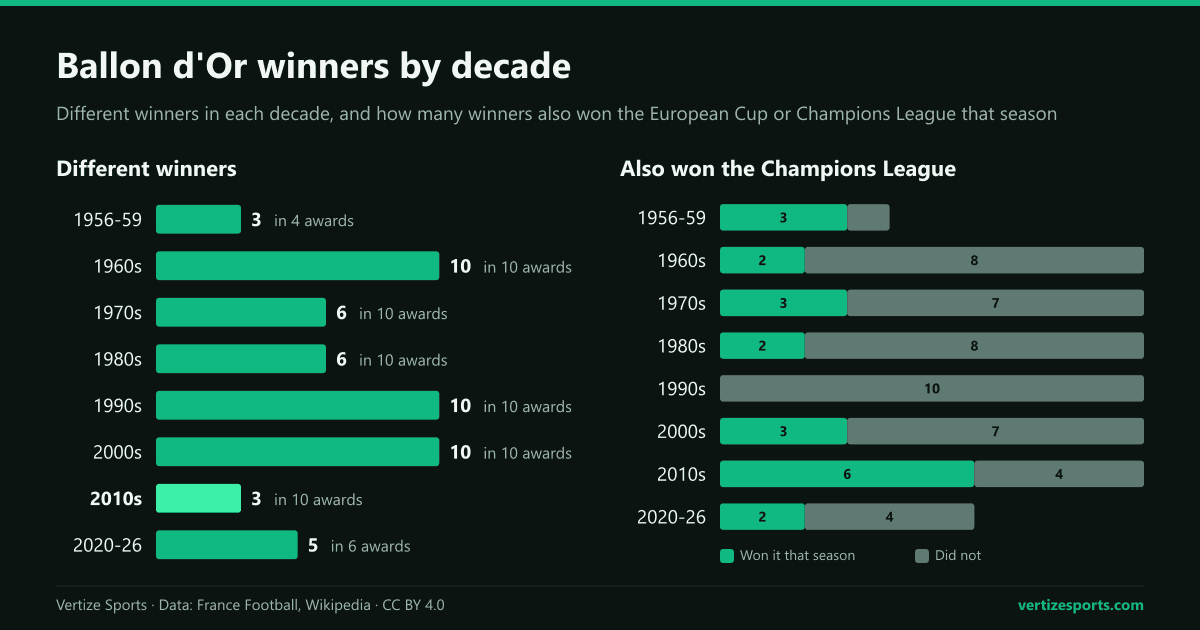
Twenty-one of the 70 winners, 30 percent, also won the European Cup or Champions League that season (see our list of every final). None did from 1990 to 2006, 17 awards in a row, but 11 of the 19 winners since 2007 did, 58 percent, from Kaká to Dembélé, whose PSG won it for the first time in 2025. Kane, whose Bayern Munich reached the 2026 semifinals, was not one of them.
Eighteen World Cups have fallen within an award's year or season, and seven times the award went to a world champion: Bobby Charlton in 1966, Paolo Rossi in 1982, Lothar Matthäus in 1990, Zinedine Zidane in 1998, the Brazilian striker Ronaldo in 2002, Cannavaro in 2006 and Messi in 2023, for the 2022 World Cup. Six of the other 11 were won by Brazil or Argentina while their players were ineligible; in 1974, 2010, 2014, 2018 and 2026, Cruyff, Messi, Cristiano Ronaldo, Luka Modrić and Kane won instead of a world champion. In 2026 Spain beat Argentina 1-0 after extra time in the final on July 19, and its best-placed players in the vote were Lamine Yamal, third, and Rodri, fourth.
Ballon d'Or winners by decade, position and age
Ten different players won in each of the 1960s, 1990s and 2000s. In the 2010s only three did, and Modrić, in 2018, was the decade's one first-time winner. The 2020s have had five different winners in six awards.
Forwards have won 46 of the 70 awards and midfielders 19. Four went to a defender, Franz Beckenbauer in 1972 and 1976, Sammer in 1996 and Cannavaro in 2006, and one to a goalkeeper, Lev Yashin in 1963. Since 2008, 16 of the 18 winners have been forwards; the other two, Modrić and Rodri, are midfielders.
The average winner was 27.7 years old. Ronaldo was the youngest, at 21 in 1997, and Stanley Matthews the oldest, at 41 in 1956, ahead of Messi at 36 in 2023. The award has grown older: six of the eight winners since 2018 were 32 or older, including Kane at 33, against five of the previous 62 awards.
The 1995 rule change, the FIFA years and the canceled 2020 Ballon d'Or
Until 1995 only European players were eligible, which is why Pelé and Diego Maradona later received honorary trophies, UEFA notes. The award was then opened to players of any nationality at European clubs, and Liberia's George Weah won it that year; since 2007 every professional player has been eligible.
From 2010 to 2015 it was merged with FIFA's world player award as the FIFA Ballon d'Or. In 2020 Groupe Amaury, which owns France Football, gave no award because of the COVID-19 pandemic. Since 2022 the award has covered a season rather than a calendar year, and UEFA has co-organized it since 2024.
Messi and Cristiano Ronaldo's share of the Ballon d'Or
The two have won 13 of the 70 awards, 19 percent, and 13 of the 18 since 2008. From 2008 to 2017 they won 10 in a row and finished first and second in nine of those votes, all but 2010, when Andrés Iniesta and Xavi completed a Barcelona top three. One of them finished in the top three in every vote from 2007 to 2021.
Women's Ballon d'Or winners since 2018
| Year | Winner | Nationality | Club |
|---|---|---|---|
| 2026 | Alexia Putellas | Spain | Barcelona |
| 2025 | Aitana Bonmatí | Spain | Barcelona |
| 2024 | Aitana Bonmatí | Spain | Barcelona |
| 2023 | Aitana Bonmatí | Spain | Barcelona |
| 2022 | Alexia Putellas | Spain | Barcelona |
| 2021 | Alexia Putellas | Spain | Barcelona |
| 2019 | Megan Rapinoe | United States | Reign FC |
| 2018 | Ada Hegerberg | Norway | Lyon |
Bonmatí won three in a row, from 2023 to 2025, and Alexia Putellas in 2021, 2022 and 2026, so two Barcelona midfielders hold six of the eight women's awards, and Spain's players have won the last six. Ada Hegerberg of Lyon won the first, in 2018, and Megan Rapinoe of Reign FC, the only American winner, won in 2019. Five of the eight winners also won the Women's Champions League that season, and both awards given in a World Cup year went to a world champion: Rapinoe in 2019 and Bonmatí, with Spain, in 2023.
The 2026 Ballon d'Or: Harry Kane and Alexia Putellas
Harry Kane of Bayern Munich won the 2026 men's award at 33, the fifth Englishman to win it and the first since Michael Owen in 2001, ballondor.com reports. He had 1,055 points and 40 first-place votes to Kylian Mbappé's 1,027 and 23, a gap of 28 points, with Lamine Yamal third on 881; Rodri was fourth, Messi fifth and Dembélé, the holder, seventh. Kane scored 73 goals for club and country in 2025-26, led the Bundesliga's scorers for the third season in a row and scored 14 in the Champions League as Bayern reached the semifinals.
Alexia Putellas won her third women's award, UEFA reports, after 2021 and 2022, level with Bonmatí as a three-time winner. She had 618 points to Ewa Pajor's 532, and Khadija Shaw was third with 344. Putellas won the Women's Champions League with Barcelona in 2025-26 and joined London City Lionesses in July, so UEFA lists her with both clubs; our table shows Barcelona, her club that season.
The year before, Dembélé won the 2025 award at 28, ahead of Yamal and his PSG teammate Vitinha, after a season of 37 goals and 15 assists in which he was named the Champions League's player of the season. Bonmatí won again although Barcelona lost the Women's Champions League final 1-0 to Arsenal.
The 70th edition was held on Monday, October 26, at the London Palladium, the first ceremony in London, a tribute to the first winner, Matthews. Our Premier League and La Liga tables track the current season.
Ballon d'Or winners: frequently asked questions
Who has won the most Ballon d'Or awards? Lionel Messi, with eight, the latest in 2023; Cristiano Ronaldo has five.
Who won the 2026 Ballon d'Or? Harry Kane of Bayern Munich won the men's award, ahead of Kylian Mbappé and Lamine Yamal, and Alexia Putellas the women's award, her third. The 2025 winners were Ousmane Dembélé and Aitana Bonmatí.
When was the 2026 Ballon d'Or ceremony? On Monday, October 26, 2026, at the London Palladium, the first Ballon d'Or ceremony held in London.
Why was there no Ballon d'Or in 2020? Groupe Amaury, the owner of France Football, decided not to give the award because of the COVID-19 pandemic.
Has a goalkeeper ever won the Ballon d'Or? Once: Lev Yashin, in 1963. Four awards went to defenders, the last to Fabio Cannavaro in 2006.
How this was built: the winners are France Football's official list, 70 men's awards from 1956 to 2026 and eight women's from 2018, checked year by year against Wikipedia's results tables, which give clubs and nationalities; the two differ only on Sívori. A club is the one listed with the winner, so the nine who moved during the award year, such as Luís Figo in 2000 and Messi in 2023, count for the new club; Putellas, who signed for London City Lionesses after the 2025-26 season, is listed with Barcelona. Positions are the first listed on each winner's Wikipedia page, where wingers count as midfielders, except Sammer, a sweeper by 1996. Ages are on December 31 of the award year until 2021 and on the day of the ceremony since 2022. Champions League and World Cup titles come from each winner's honors (the final of the award year; a World Cup within its year or season), checked against our list of finals and Wikipedia's World Cup finals. See our methodology. Data collected October 21, 2026; the 2026 winners were added on November 3.