We went through the official results and starting grids of all 1,155 World Championship Grands Prix from 1950 to this year's Singapore Grand Prix on formula1.com, and measured every run of consecutive races in which a driver or team won, reached the podium, scored or started from pole. A run ends at the first Grand Prix without it, a missed race included, and runs on across seasons. The United States and Mexico City Grands Prix, run since, are outside the tables and appear only in the section on 2026. Season-long dominance is covered in our studies of the most dominant teams and different winners per season.
The longest winning streaks in F1 by a driver
Verstappen's run took in Miami, Monaco, Spain, Canada, Austria, Britain, Hungary, Belgium, the Netherlands and Italy, and ended in Singapore, where Carlos Sainz won for Ferrari and Verstappen was fifth. Verstappen then won the last seven Grands Prix of 2023 and the first two of 2024, and Sainz ended that run of nine too, in Australia.
| Driver | Wins in a row | First | Last | Team | Next race, result |
|---|---|---|---|---|---|
| Max Verstappen | 10 | Miami GP 2023 | Italian GP 2023 | Red Bull | Singapore GP 2023, 5th |
| Alberto Ascari* | 9 | Belgian GP 1952 | Belgian GP 1953 | Ferrari | French GP 1953, 4th |
| Sebastian Vettel | 9 | Belgian GP 2013 | Brazilian GP 2013 | Red Bull | Australian GP 2014, not classified |
| Max Verstappen | 9 | Japanese GP 2023 | Saudi Arabian GP 2024 | Red Bull | Australian GP 2024, not classified |
| Michael Schumacher | 7 | European GP 2004 | Hungarian GP 2004 | Ferrari | Belgian GP 2004, 2nd |
| Nico Rosberg | 7 | Mexican GP 2015 | Russian GP 2016 | Mercedes | Spanish GP 2016, not classified |
| Michael Schumacher | 6 | Italian GP 2000 | Malaysian GP 2001 | Ferrari | Brazilian GP 2001, 2nd |
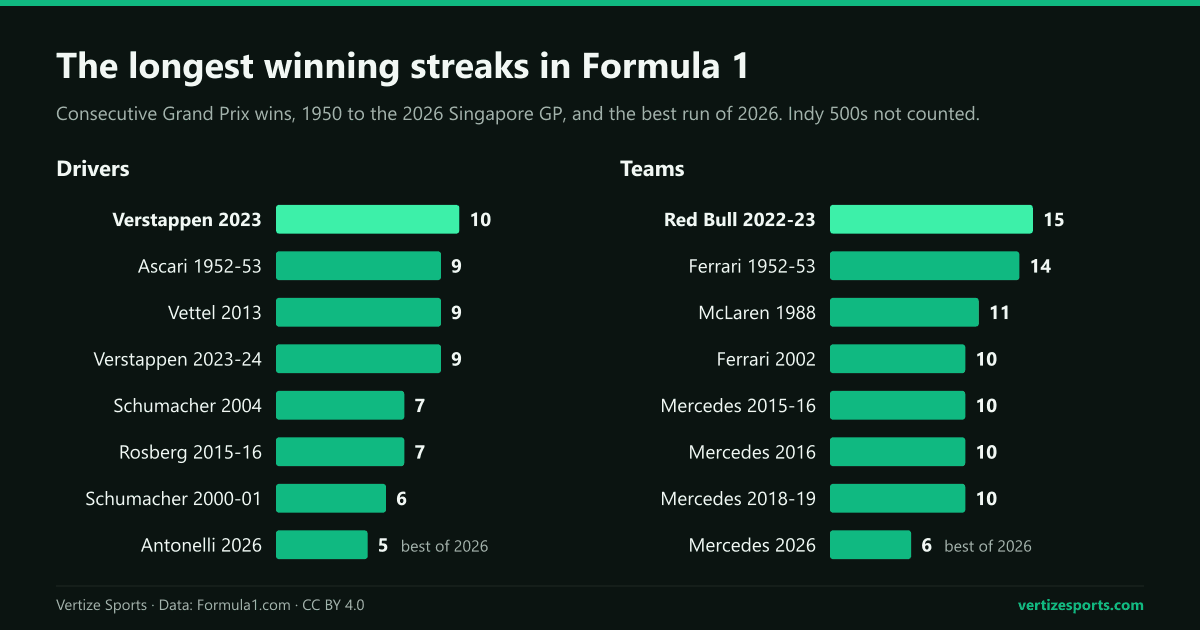
Sebastian Vettel won the last nine races of 2013 for Red Bull, and Alberto Ascari won nine for Ferrari from the 1952 Belgian Grand Prix to the 1953 Belgian Grand Prix. In all, 10 drivers have won five or more in a row, the latest Kimi Antonelli in 2026.
Ascari's nine or seven: the Indianapolis 500 in F1 records
The Indianapolis 500 counted for the drivers' championship from 1950 to 1960, and formula1.com's 1953 results list it between the Argentine and Dutch Grands Prix, but Grand Prix drivers hardly raced there: of its 33 starters each year, only Ascari in 1952 and Rodger Ward in 1959 also started a Grand Prix that season.
We leave its 11 editions out, so Ascari's run covers nine Grands Prix. Lists that count every round, such as Wikipedia's driver records, stop it at seven, at the 1953 Argentine Grand Prix, because Ascari did not race at Indianapolis that May, and note that some sources count nine. Either way, Verstappen's 10 is the record, as Formula 1 reported after Monza.
The same choice decides the team record before 2023. Ferrari won all seven Grands Prix of 1952 and the first seven of 1953, but the Indianapolis 500 fell inside that run both years. Counting it, Ferrari's longest run in those years is seven, McLaren's 11 of 1988 was the record, and Red Bull broke it with a 12th straight win in Hungary in July 2023, as Formula 1 reported.
Three 1950s Grands Prix were won by two drivers sharing a car, the 1951 French, 1956 Argentine and 1957 British; both drivers are credited with the win, as on formula1.com, and none of the three is part of a winning run longer than two.
Most consecutive wins by an F1 team
Red Bull's 15 began with Verstappen's win in Abu Dhabi, the last race of 2022, and ran through the first 14 of 2023; Verstappen won 13 of the 15 and Sergio Pérez two. McLaren's 11 all came in the 1988 season, from Brazil to Belgium, seven for Ayrton Senna and four for Alain Prost, before Gerhard Berger won for Ferrari at Monza.
| Team | Wins in a row | First | Last | Winners |
|---|---|---|---|---|
| Red Bull | 15 | Abu Dhabi GP 2022 | Italian GP 2023 | Verstappen 13, Pérez 2 |
| Ferrari | 14 | Swiss GP 1952 | Swiss GP 1953 | Ascari 11, Farina, Hawthorn, Taruffi |
| McLaren | 11 | Brazilian GP 1988 | Belgian GP 1988 | Senna 7, Prost 4 |
| Ferrari | 10 | Canadian GP 2002 | Japanese GP 2002 | Schumacher 6, Barrichello 4 |
| Mercedes | 10 | Japanese GP 2015 | Russian GP 2016 | Rosberg 7, Hamilton 3 |
| Mercedes | 10 | Monaco GP 2016 | Singapore GP 2016 | Hamilton 6, Rosberg 4 |
| Mercedes | 10 | Brazilian GP 2018 | French GP 2019 | Hamilton 8, Bottas 2 |
Mercedes has three runs of 10, more than any other team. Alfa Romeo won all six Grands Prix of 1950 and three more in 1951, until José Froilán González gave Ferrari its first win, at the British Grand Prix.
How long F1 streak records stood before they fell
Counting only Grands Prix, Ascari's nine stood from June 1953 to September 2023, 70 years. Vettel equaled it in 2013, and Verstappen at Zandvoort on August 27, the day Red Bull drew level with Ferrari's 14; both records fell a week later at Monza. With the Indianapolis 500 counted, Ascari's seven lasted almost 61 years, until Vettel's eighth straight win in 2013, and McLaren's 11 lasted 35.
| Streak | Record | Held by | Record before | How long it stood |
|---|---|---|---|---|
| Wins, driver | 10 | Max Verstappen, 2023 | Alberto Ascari, 9 (1952-53) | 70 years |
| Wins, team | 15 | Red Bull, 2022-23 | Ferrari, 14 (1952-53) | 70 years |
| Podiums, driver | 19 | Michael Schumacher, 2001-02 | Alberto Ascari, 9 (1952-53) | 49 years |
| Podiums, team | 53 | Ferrari, 1999-2002 | Ferrari, 35 (1950-55) | 46 years |
| Poles, driver | 8 | Ayrton Senna, 1988-89; Max Verstappen, 2023-24 | Stirling Moss, 6 (1959-60) | 29 years |
| Front-row lockouts | 9 | Mercedes, 2014-15 | McLaren, 8 (1989) | 26 years |
| Poles, team | 24 | Williams, 1992-93 | McLaren, 17 (1988-89) | 4 years |
| 1-2 finishes | 6 | Ferrari, 1952 | Alfa Romeo, 3 (1950) | 2 years |
| Points, driver | 48 | Lewis Hamilton, 2018-20 | Lewis Hamilton, 33 (2016-18) | 2 years |
| Points, team | 81 | Ferrari, 2010-14 | McLaren, 64 (2010-13) | 5 months |
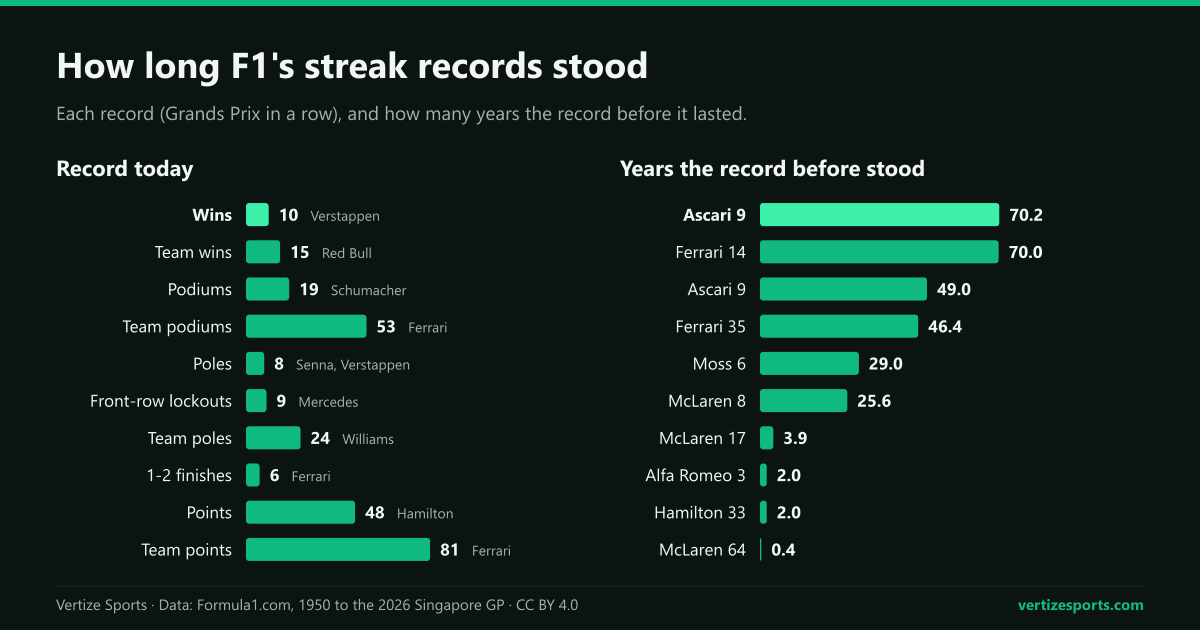
Michael Schumacher's 19 straight podiums and Ferrari's 53 straight races with a car in the top three both ended at the 2002 Japanese Grand Prix and have stood for 24 years, and Williams' 24 straight poles, in 1992 and 1993, for 33 years.
Most consecutive podiums, points finishes and poles in F1
Schumacher's 19 podiums, from the 2001 United States Grand Prix to the 2002 Japanese Grand Prix, include every race of 2002, the only season in which one driver was in the top three every time. Lewis Hamilton's 16 in 2014 and 2015 come next, then 15 each for Fernando Alonso and Verstappen.
Since 2010 the top 10 in every Grand Prix have scored points, and all 10 of the longest scoring runs started in 2001 or later. Hamilton's 48, from the 2018 British Grand Prix to the 2020 Bahrain Grand Prix, ended when Hamilton missed the Sakhir Grand Prix, where George Russell drove for Mercedes. Verstappen's 43 and Oscar Piastri's 34 come next.
Ayrton Senna's eight straight poles, from the 1988 Spanish Grand Prix to the 1989 United States Grand Prix, stood alone for 35 years until Verstappen matched them in 2023 and 2024. Mercedes' nine front-row lockouts in a row in 2014 and 2015, with its two cars in the first two grid places, are the longest such run.
F1 streaks within one season and across seasons
Many long streaks span a winter: four of the 15 runs of five or more wins, 10 of the 19 runs of nine or more podiums and all 10 of the longest points runs. The longest inside a single season:
- Wins: Verstappen's 10 in 2023; for a team, Red Bull's 14 in 2023.
- Podiums: Schumacher's 17, every race of 2002.
- Points: Verstappen's 22, every race of 2023.
- Poles: seven, by Alain Prost in 1993, Hamilton in 2015 and Verstappen in 2024; for a team, 15, by Williams, Red Bull and Mercedes.
The longest F1 streaks of 2026
Kimi Antonelli has the longest winning run of 2026, five, from China in March to Monaco in June, tied for eighth on the all-time list. Mercedes won the first six Grands Prix and has had a driver on the podium in all 19 through Mexico City, according to formula1.com's 2026 results. The longest runs this season, after the Mexico City Grand Prix on November 1:
- Wins: Antonelli 5, China to Monaco; Mercedes 6, Australia to Monaco.
- Podiums: Verstappen 7, Italy to Mexico City; Antonelli 6, Australia to Monaco; Mercedes 19, every race.
- Points: Hamilton 13, Australia to Italy; Mercedes, Ferrari and Red Bull in all 19.
- Poles: Antonelli 3, China to Miami; Mercedes 10, Australia to Belgium.
Going into Austin, Verstappen had won the last two Grands Prix from pole, the Bahrain Grand Prix at Sepang in Malaysia on October 4 and Singapore on October 11, and Antonelli had scored in eight straight races and led the standings, 340 points to Russell's 238. Antonelli then won in Austin from pole on October 25, which ended Verstappen's run, and Verstappen won again in Mexico City on November 1, from fifth on the grid, for three wins in the last four races. Mexico City made seven straight podiums for Verstappen, now the longest podium run of 2026, and 10 straight scoring finishes for Antonelli.
Kimi Antonelli clinched the 2026 drivers' championship at the Mexico City Grand Prix on November 1, finishing third, with four Grands Prix still to run, and left Mexico City with 380 points to Max Verstappen's 261, 119 points ahead with 100 left. Four Grands Prix are left on formula1.com's calendar: São Paulo on November 8, Las Vegas on November 21, Qatar on November 29 and Abu Dhabi on December 6. None of the records above changed in the two races.
Longest winning streaks in F1: frequently asked questions
What is the longest winning streak in F1? Max Verstappen's 10 consecutive Grand Prix wins for Red Bull in 2023, from Miami to Monza. Sebastian Vettel and Verstappen have also won nine in a row, as did Alberto Ascari in 1952 and 1953 if the Indianapolis 500 is left out.
What is the longest winning streak by an F1 team? Red Bull's 15, from the 2022 Abu Dhabi Grand Prix to the 2023 Italian Grand Prix, ahead of Ferrari's 14 in 1952 and 1953, counting only Grands Prix, and McLaren's 11 in 1988.
Who has the most consecutive podiums in F1? Michael Schumacher, with 19 from the 2001 United States Grand Prix to the 2002 Japanese Grand Prix.
Who has the most consecutive pole positions in F1? Ayrton Senna, in 1988 and 1989, and Max Verstappen, in 2023 and 2024, with eight each.
How this was built: the race result and starting grid of all 1,155 World Championship Grands Prix from 1950 to the 2026 Singapore Grand Prix, from formula1.com. A streak is a run of consecutive Grands Prix, across seasons, ended by any race without the result, a missed one included. Teams are counted by chassis, points are any the race result credits and pole is the first grid place, as in our pole-position study; Indianapolis 500s and sprints are left out, and both drivers of a shared winning car are credited. formula1.com shows no points for Verstappen's second place at the 2023 Saudi Arabian Grand Prix; we counted it as a scoring finish. Every record with a counterpart in Wikipedia's lists, drawn from Stats F1, matches it, except where those count the Indianapolis 500. The 2026 pages were read on October 20, 2026; the United States and Mexico City results, used only in the section on 2026, were read on November 3, 2026.