Champions, points and teams come from formula1.com's final standings. Wins and the deciding round come from our rebuild of all 1,157 Grands Prix through Mexico City.
Who has the most F1 world championships
Hamilton and Schumacher share the record with seven titles. Juan Manuel Fangio has five, and Alain Prost, Sebastian Vettel and Max Verstappen four each; those six hold 40 percent of all titles. Nineteen of the 36 champions won once. By country: our study of champions by nationality.
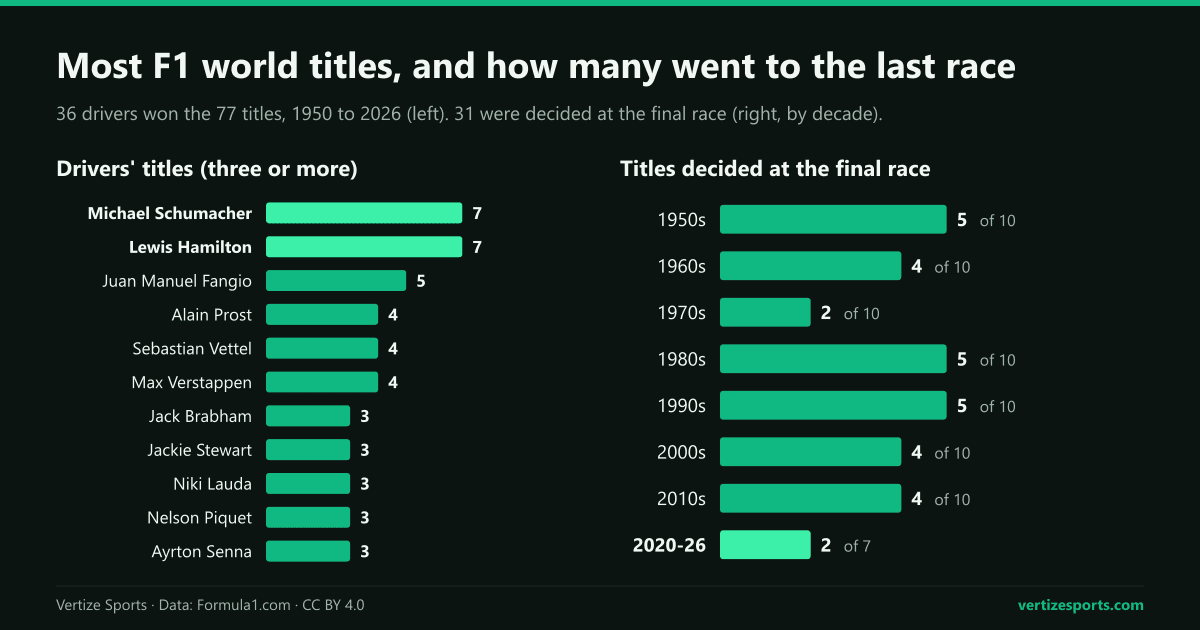
Ten drivers won with more than one team, Fangio with four. Niki Lauda's seven-year gap between titles, 1977 to 1984, is the longest.
F1 world champions list by year
| Season | Champion | Team | Pts | Wins | Margin | Left |
|---|---|---|---|---|---|---|
| 2026 | Kimi Antonelli | Mercedes | 380* | 9/19* | 119* | 4 |
| 2025 | Lando Norris | McLaren | 423 | 7/24 | 2 | 0 |
| 2024 | Max Verstappen | Red Bull† | 437 | 9/24 | 63 | 2 |
| 2023 | Verstappen | Red Bull | 575 | 19/22 | 290 | 5 |
| 2022 | Verstappen | Red Bull | 454 | 15/22 | 146 | 4 |
| 2021 | Verstappen | Red Bull† | 395.5 | 10/22 | 8 | 0 |
| 2020 | Lewis Hamilton | Mercedes | 347 | 11/17 | 124 | 3 |
| 2019 | Hamilton | Mercedes | 413 | 11/21 | 87 | 2 |
| 2018 | Hamilton | Mercedes | 408 | 11/21 | 88 | 2 |
| 2017 | Hamilton | Mercedes | 363 | 9/20 | 46 | 2 |
| 2016 | Nico Rosberg | Mercedes | 385 | 9/21 | 5 | 0 |
| 2015 | Hamilton | Mercedes | 381 | 10/19 | 59 | 3 |
| 2014 | Hamilton | Mercedes | 384 | 11/19 | 67 | 0 |
| 2013 | Sebastian Vettel | Red Bull | 397 | 13/19 | 155 | 3 |
| 2012 | Vettel | Red Bull | 281 | 5/20 | 3 | 0 |
| 2011 | Vettel | Red Bull | 392 | 11/19 | 122 | 4 |
| 2010 | Vettel | Red Bull | 256 | 5/19 | 4 | 0 |
| 2009 | Jenson Button | Brawn | 95 | 6/17 | 11 | 1 |
| 2008 | Hamilton | McLaren† | 98 | 5/18 | 1 | 0 |
| 2007 | Kimi Räikkönen | Ferrari | 110 | 6/17 | 1 | 0 |
| 2006 | Fernando Alonso | Renault | 134 | 7/18 | 13 | 0 |
| 2005 | Alonso | Renault | 133 | 7/19 | 21 | 2 |
| 2004 | Michael Schumacher | Ferrari | 148 | 13/18 | 34 | 4 |
| 2003 | Schumacher | Ferrari | 93 | 6/16 | 2 | 0 |
| 2002 | Schumacher | Ferrari | 144 | 11/17 | 67 | 6 |
| 2001 | Schumacher | Ferrari | 123 | 9/17 | 58 | 4 |
| 2000 | Schumacher | Ferrari | 108 | 9/17 | 19 | 1 |
| 1999 | Mika Häkkinen | McLaren† | 76 | 5/16 | 2 | 0 |
| 1998 | Häkkinen | McLaren | 100 | 8/16 | 14 | 0 |
| 1997 | Jacques Villeneuve | Williams | 81 | 7/17 | 39 | 0 |
| 1996 | Damon Hill | Williams | 97 | 8/16 | 19 | 0 |
| 1995 | Schumacher | Benetton | 102 | 9/17 | 33 | 2 |
| 1994 | Schumacher | Benetton† | 92 | 8/16 | 1 | 0 |
| 1993 | Alain Prost | Williams | 99 | 7/16 | 26 | 2 |
| 1992 | Nigel Mansell | Williams | 108 | 9/16 | 52 | 5 |
| 1991 | Ayrton Senna | McLaren | 96 | 7/16 | 24 | 1 |
| 1990 | Senna | McLaren | 78 | 6/16 | 7 | 1 |
| 1989 | Prost | McLaren | 76 | 4/16 | 16 | 1 |
| 1988 | Senna | McLaren | 90 | 8/16 | 3 | 1 |
| 1987 | Nelson Piquet | Williams | 73 | 3/16 | 12 | 1 |
| 1986 | Prost | McLaren† | 72 | 4/16 | 2 | 0 |
| 1985 | Prost | McLaren | 73 | 5/16 | 20 | 2 |
| 1984 | Niki Lauda | McLaren | 72 | 5/16 | 0.5 | 0 |
| 1983 | Piquet | Brabham† | 59 | 3/15 | 2 | 0 |
| 1982 | Keke Rosberg | Williams† | 44 | 1/16 | 5 | 0 |
| 1981 | Piquet | Brabham† | 50 | 3/15 | 1 | 0 |
| 1980 | Alan Jones | Williams | 67 | 5/14 | 13 | 1 |
| 1979 | Jody Scheckter | Ferrari | 51 | 3/15 | 4 | 2 |
| 1978 | Mario Andretti | Lotus | 64 | 6/16 | 13 | 2 |
| 1977 | Lauda | Ferrari | 72 | 3/17 | 17 | 2 |
| 1976 | James Hunt | McLaren† | 69 | 6/16 | 1 | 0 |
| 1975 | Lauda | Ferrari | 64.5 | 5/14 | 19.5 | 1 |
| 1974 | Emerson Fittipaldi | McLaren | 55 | 3/15 | 3 | 0 |
| 1973 | Jackie Stewart | Tyrrell† | 71 | 5/15 | 16 | 2 |
| 1972 | Fittipaldi | Lotus | 61 | 5/12 | 16 | 2 |
| 1971 | Stewart | Tyrrell | 62 | 6/11 | 29 | 3 |
| 1970 | Jochen Rindt | Lotus | 45 | 5/13 | 5 | 1 |
| 1969 | Stewart | Matra | 63 | 6/11 | 26 | 3 |
| 1968 | Graham Hill | Lotus | 48 | 3/12 | 12 | 0 |
| 1967 | Denny Hulme | Brabham | 51 | 2/11 | 5 | 0 |
| 1966 | Jack Brabham | Brabham | 42 | 4/9 | 14 | 2 |
| 1965 | Jim Clark | Lotus | 54 | 6/10 | 14 | 3 |
| 1964 | John Surtees | Ferrari | 40 | 2/10 | 1 | 0 |
| 1963 | Clark | Lotus | 54 | 7/10 | 25 | 3 |
| 1962 | Graham Hill | BRM | 42 | 4/9 | 12 | 0 |
| 1961 | Phil Hill | Ferrari | 34 | 2/8 | 1 | 1 |
| 1960 | Brabham | Cooper | 43 | 5/9 | 9 | 1 |
| 1959 | Brabham | Cooper | 31 | 2/8 | 4 | 0 |
| 1958 | Mike Hawthorn | Ferrari† | 42 | 1/10 | 1 | 0 |
| 1957 | Juan Manuel Fangio | Maserati | 40 | 4/7 | 15 | 2 |
| 1956 | Fangio | Ferrari | 30 | 3/7 | 3 | 0 |
| 1955 | Fangio | Mercedes | 40 | 4/6 | 17 | 1 |
| 1954 | Fangio | Maserati, Mercedes | 42 | 6/8 | 16.9 | 2 |
| 1953 | Alberto Ascari | Ferrari | 34.5 | 5/8 | 7 | 2 |
| 1952 | Ascari | Ferrari | 36 | 6/7 | 12 | 2 |
| 1951 | Fangio | Alfa Romeo | 31 | 3/7 | 6 | 0 |
| 1950 | Nino Farina | Alfa Romeo | 30 | 3/6 | 3 | 0 |
How late F1 titles are decided: rounds left by decade
The final race has decided 31 of the 77 titles. The change is recent: from 1994 to 2016, 13 of 23 titles went to the last race; of the last 10, only Verstappen's in 2021 and Lando Norris's in 2025 did.
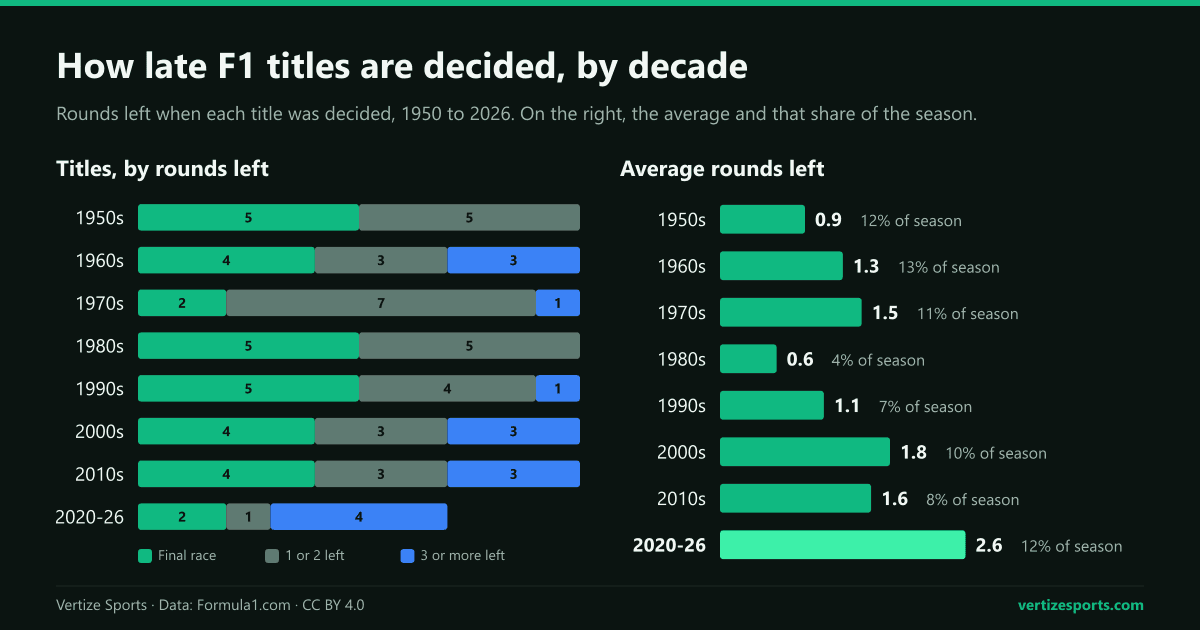
| Decade | Last race | Rounds left | Season left | Champion's wins |
|---|---|---|---|---|
| 1950s | 5/10 | 0.9 | 12% | 50% |
| 1960s | 4/10 | 1.3 | 13% | 41% |
| 1970s | 2/10 | 1.5 | 11% | 33% |
| 1980s | 5/10 | 0.6 | 4% | 26% |
| 1990s | 5/10 | 1.1 | 7% | 46% |
| 2000s | 4/10 | 1.8 | 10% | 45% |
| 2010s | 4/10 | 1.6 | 8% | 48% |
| 2020-26 | 2/7 | 2.6 | 12% | 54% |
In rounds, titles now end earlier: 2.6 left on average since 2020, against 0.6 in the 1980s, when none came with more than two left. As a share of the longer seasons the change is smaller: 12 percent left in 2020-26, the same as in the 1950s. The earliest was Schumacher's in 2002, at the French Grand Prix, six of 17 rounds left, ahead of Nigel Mansell in 1992 (five of 16) and Verstappen in 2023 (five of 22, the only title decided in a sprint).
Of the 31 decided at the last race, the driver leading going in lost 10, most recently Fernando Alonso to Vettel in 2010. The champion won the deciding race only 31 times in 77, and Jochen Rindt, killed at Monza in 1970, is the only posthumous champion. The Japanese Grand Prix has decided the most, 13, one more than the Italian, which last did so in 1979.
How many races F1 champions win in a title season
Champions won 43 percent of the Grands Prix in their title seasons from 1950 to 2025, and the most of anyone, alone or tied, in 63 of the 77 seasons through 2026. In the other 14, listed in our count of winners per season, a rival won more, most recently Verstappen's eight to Norris's seven in 2025. In the 1980s champions won the most in four of 10 seasons.
- Highest share: Verstappen in 2023, 19 of 22, 86.4 percent.
- Lowest: Keke Rosberg in 1982, one of 16; Mike Hawthorn in 1958 is the only other one-win champion.
- Antonelli through Mexico City: nine of 19, and no rival can still reach nine.
F1 title margins in race wins and today's scale
A win paid 8 points in the 1950s and pays 25 now, so we divided each margin by that season's win. Verstappen's 290 points in 2023 are 11.6 wins, ahead of Schumacher's 6.7 in 2002; 30 of the 76 titles through 2025 were won by less than one win, the closest Lauda's half point in 1984, 0.06 of a win. The measure does not adjust for longer seasons, for dropped scores, or for the 2003-09 scale, when second paid 8 of a win's 10.
Dropped scores decided two titles: Graham Hill outscored John Surtees 41-40 in 1964 and Prost outscored Ayrton Senna 105-94 in 1988, but each lost on the points that counted. Re-score every season on today's 25-18-15 scale, every Grand Prix counting, and seven of 76 change hands: 1964 (Graham Hill), 1976 (Lauda), 1983 (Prost, on countback), 1984 and 1988 (Prost), 1994 (Damon Hill) and 1999 (Eddie Irvine). Prost would have seven titles, level with Hamilton, and Schumacher six. That is arithmetic, not history: drivers raced to the rules of their day.
Back-to-back F1 champions and first-time winners
Eleven drivers have won back-to-back titles; Schumacher's five from 2000 to 2004 is the longest. Defending champions retained the title in nine of 49 seasons from 1951 to 1999, 18 percent, and 15 of 27 since, 56 percent. The longest spell without a first-time champion is six seasons, 1999 to 2004. Norris and Antonelli are the first consecutive first-time champions since Jenson Button and Vettel in 2009 and 2010.
F1 constructors champions list and the double
Fifteen teams have won the 68 constructors' titles from 1958 to 2025: Ferrari 16, McLaren 10, Williams nine, Mercedes eight, Lotus seven, Red Bull six and nine others two or one, all in our study of the most dominant teams. The drivers' champion's team also won it in 56 of the 68, 82 percent. The 12 splits, by constructors' champion: Ferrari 1976, 1982, 1983, 1999, 2008; Williams 1981, 1986, 1994; Vanwall 1958, Lotus 1973, Mercedes 2021, McLaren 2024. Ferrari also leads in drivers' titles, 15, ahead of McLaren 13, Mercedes 10 and Red Bull eight.
Who won the F1 championship in 2026
Kimi Antonelli of Mercedes, the youngest champion in F1 history, clinched it in Mexico City on November 1 by finishing third. As of November 4, formula1.com's standings have Antonelli on 380 points to Verstappen's 261, 119 clear with 100 left in the four Grands Prix on the schedule, the next in São Paulo on November 8.
The constructors' title is still open: Mercedes leads Ferrari 630 points to 504, 126 clear with 172 left, first and second in each race, and no other team can catch it. Follow it on our standings.
F1 world champions: frequently asked questions
How many F1 world champions are there? Thirty-six through 2026, all in formula1.com's Hall of Fame, from Nino Farina to Antonelli.
Who has the most F1 titles? Lewis Hamilton and Michael Schumacher, seven each.
Who won the F1 championship in 2026? Kimi Antonelli, on November 1 in Mexico City, with four Grands Prix left.
Who has won back-to-back F1 titles? Ascari, Fangio, Brabham, Prost, Senna, Schumacher, Häkkinen, Alonso, Vettel, Hamilton and Verstappen.
Which team has the most constructors' titles? Ferrari, with 16, the last in 2008; McLaren has 10.
How this was built: final standings and every Grand Prix and sprint result, 1950 to the 2026 Mexico City Grand Prix, from formula1.com; 2026 standings and calendar read November 4, 2026. A title is decided after the first race or sprint from which no rival could beat the champion's counted points by winning everything left, with dropped scores, countback on ties and results as they now stand; Wolfgang von Trips in 1961 and Ronnie Peterson in 1978, fatally injured at the Italian Grand Prix, stop counting there. Rebuilt totals match the final tables after six fixes to race pages, apart from drivers who scored only in the 11 Indianapolis 500s, which are not counted as Grands Prix. Rounds left match Wikipedia's list except 1953 (two, not one: Ascari's 33.5 points beat Nino Farina's possible 32) and 1960 (one, not two). Re-scoring counts half-points races in full and sprints on today's scale.