Nearly all of that came from one half of the First Four. Each year it held two games between the four lowest-seeded at-large teams and two between the four lowest-seeded automatic qualifiers, all No. 16 seeds. Once in the 64-team bracket, the 30 at-large winners went 23-30 and the 30 No. 16 seeds went 1-30.
How far First Four teams go in March Madness
We followed all 60 winners, over 15 tournaments with none in 2020, through the bracket they entered, and checked every at-large team's results against NCAA.com's list. The First Four was played at the University of Dayton each year except 2021, when the whole tournament was held in Indiana.
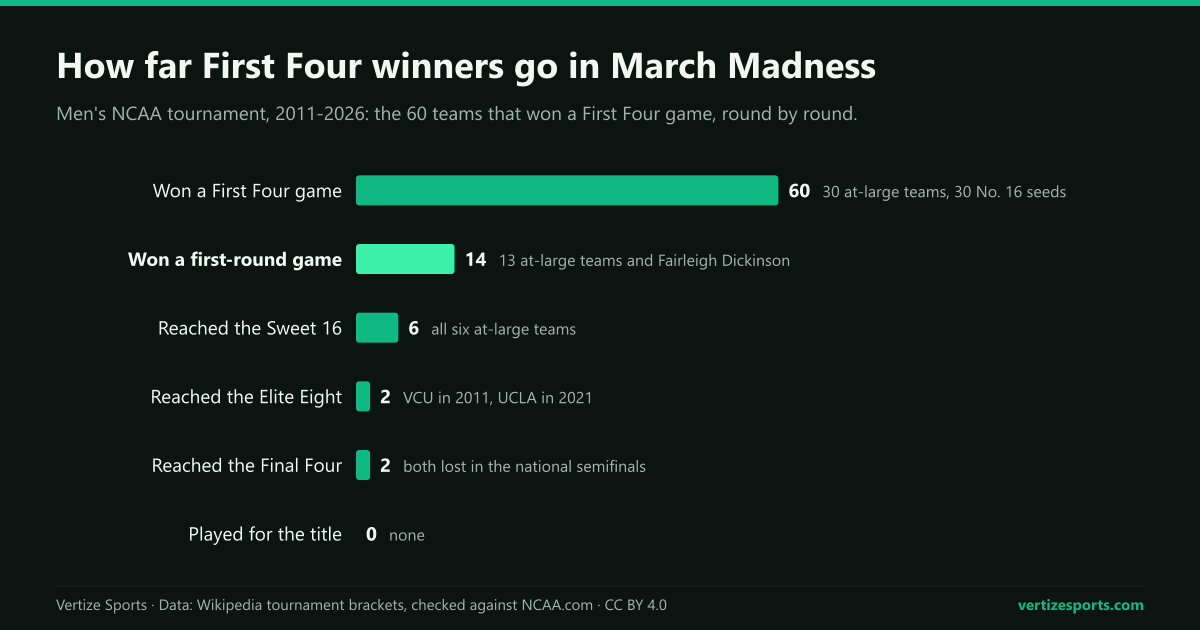
The first round is where most of them stop. The at-large winners, 22 of them No. 11 seeds, won 13 of their 30 first-round games, 43 percent. The No. 16 seeds, who go straight on to face a No. 1 seed, won once: the Fairleigh Dickinson Knights beat the Purdue Boilermakers 63-58 in 2023. In 2019 and 2025 no First Four team won in the first round; in each of the other 13 years, exactly one of the two at-large winners did.
First Four winners record, round by round
| Round | At-large winners | No. 16 seed winners | All 60 |
|---|---|---|---|
| Round of 64 | 13-17 | 1-29 | 14-46 |
| Round of 32 | 6-7 | 0-1 | 6-8 |
| Sweet 16 | 2-4 | – | 2-4 |
| Elite Eight | 2-0 | – | 2-0 |
| Final Four | 0-2 | – | 0-2 |
| Total | 23-30 | 1-30 | 24-60 |
Past the first round, the at-large winners went 6-7 in the round of 32, 2-4 in the Sweet 16 and 2-0 in the Elite Eight, where VCU beat the Kansas Jayhawks and UCLA beat the Michigan Wolverines, both No. 1 seeds. Counting Fairleigh Dickinson's upset, First Four teams have beaten a No. 1 seed three times in 33 tries.
First Four teams that made the Final Four
VCU, an 11 seed, beat USC in Dayton in the first year of the format, then Georgetown 74-56, Purdue 94-76, Florida State 72-71 in overtime and Kansas 71-61. The Rams lost 70-62 to Butler, an 8 seed, in the national semifinals in Houston.
UCLA, also an 11 seed, came back from 11 points down at halftime to beat Michigan State in overtime in the First Four, NCAA.com recalls. The Bruins then beat BYU 73-62, Abilene Christian 67-47, Alabama 88-78 in overtime and Michigan 51-49, before losing 93-90 in overtime to Gonzaga, the unbeaten No. 1 overall seed.
Four more First Four winners reached the Sweet 16 and lost there:
- 2013, La Salle (13 seed): beat Kansas State 63-61 and Ole Miss 76-74, then lost 72-58 to Wichita State. The Explorers are the only 13 seed to come out of the First Four.
- 2014, Tennessee (11): beat UMass 86-67 and Mercer 83-63, then lost 73-71 to Michigan.
- 2018, Syracuse (11): beat TCU 57-52 and Michigan State 55-53, then lost 69-65 to Duke.
- 2026, Texas (11): beat BYU 79-71 and Gonzaga 74-68, then lost 79-77 to Purdue.
Every First Four winner since 2011
| Year | At-large winners (seed) and where they went out | No. 16 seed winners |
|---|---|---|
| 2011 | VCU (11): Final Four; Clemson (12) | UTSA, UNC Asheville |
| 2012 | South Florida (12): round of 32; BYU (14) | Western Kentucky, Vermont |
| 2013 | La Salle (13): Sweet 16; Saint Mary's (11) | North Carolina A&T, James Madison |
| 2014 | Tennessee (11): Sweet 16; NC State (12) | Albany, Cal Poly |
| 2015 | Dayton (11): round of 32; Ole Miss (11) | Hampton, Robert Morris |
| 2016 | Wichita State (11): round of 32; Michigan (11) | Florida Gulf Coast, Holy Cross |
| 2017 | USC (11): round of 32; Kansas State (11) | Mount St. Mary's, UC Davis |
| 2018 | Syracuse (11): Sweet 16; St. Bonaventure (11) | Radford, Texas Southern |
| 2019 | Belmont (11), Arizona State (11) | Fairleigh Dickinson, North Dakota State |
| 2021 | UCLA (11): Final Four; Drake (11) | Norfolk State, Texas Southern |
| 2022 | Notre Dame (11): round of 32; Indiana (12) | Texas Southern, Wright State |
| 2023 | Pittsburgh (11): round of 32; Arizona State (11) | Texas A&M–Corpus Christi; Fairleigh Dickinson: round of 32 |
| 2024 | Colorado (10): round of 32; Colorado State (10) | Wagner, Grambling State |
| 2025 | North Carolina (11), Xavier (11) | Alabama State, Mount St. Mary's |
| 2026 | Texas (11): Sweet 16; Miami (OH) (11) | Howard, Prairie View A&M |
11-seed games vs 16-seed games: First Four winners against their seed line
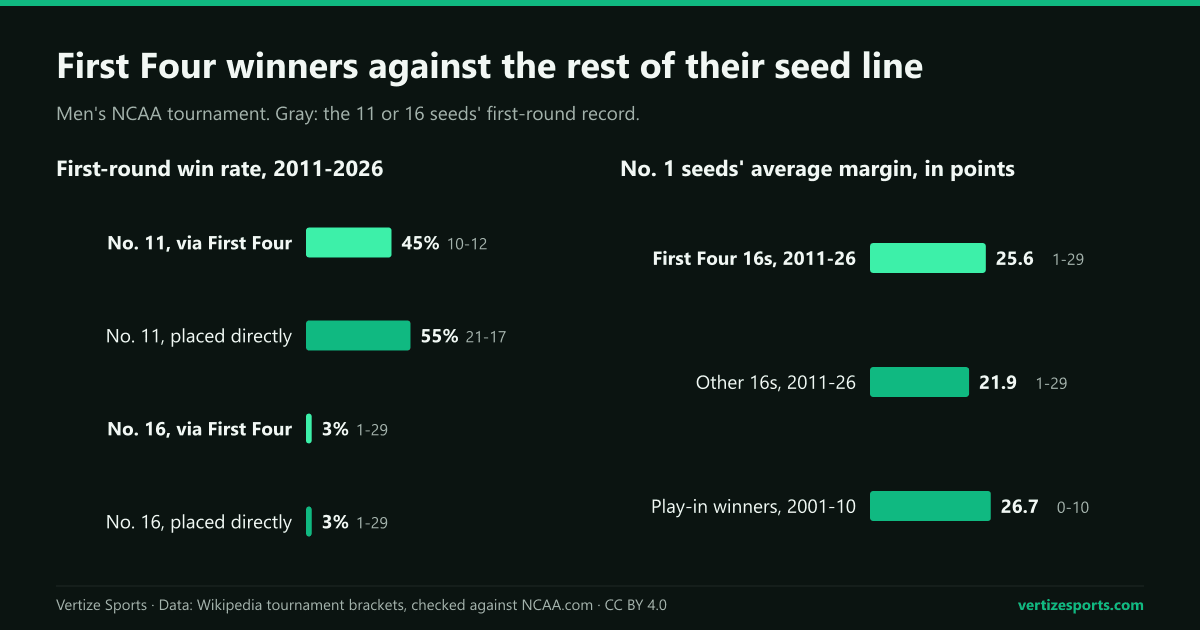
Twenty-two of the 30 at-large games were played on the 11 line, so their winners met No. 6 seeds next. They went 10-12, 45 percent, while the other 11 seeds in the same 15 tournaments, placed straight into the bracket, went 21-17, 55 percent. The direct 11 seeds also reached the Sweet 16 more often, 11 of 38 against 5 of 22, and matched the two Final Fours, with Loyola Chicago in 2018 and NC State in 2024.
With groups this small, chance alone would produce a gap that size more than half the time: the record shows no clear effect of the extra game either way. It does show a strong 11 line, which has won 31 of 60 first-round games since 2011, 52 percent, against 32 percent from 1985 to 2010. At the rates of the other teams on their seed lines, the 30 at-large winners would have won about 15 first-round games; they won 13.
On the 16 line the extra game has not changed the result. The 30 No. 16 seeds from the First Four went 1-29 against No. 1 seeds, as did the 30 placed directly, whose one win was UMBC's over Virginia in 2018, but the First Four teams lost by more: 25.6 points on average, against 21.9. The ten winners of the single opening-round game of 2001-2010 all lost, by 26.7 points on average, and the widest margin in the 164 games between No. 1 and No. 16 seeds since 1985 came last March against a First Four winner, Florida 114, Prairie View A&M 55.
March Madness Opening Round 2027: 12 games instead of four
The 2027 tournament is the first with 76 teams, 32 automatic qualifiers and 44 at-large teams under the NCAA's selection rules. The First Four becomes the March Madness Opening Round, 12 games on March 16 and 17, three a day at UD Arena in Dayton and three a day in Wichita, Kansas. The 12 lowest-seeded automatic qualifiers play each other, and so do the 12 lowest-seeded at-large teams:
- No. 16 seeds: overall seeds 69 to 76 play in pairs, 69 against 70 and so on, so every No. 1 seed will face an Opening Round winner.
- No. 15 seeds: 65 plays 66 and 67 plays 68, so two of the four No. 2 seeds will too.
- At-large teams: the last team in plays the second-to-last, the third-to-last plays the fourth-to-last, and so on for six games.
- Travel: Opening Round winners get priority for first-round sites, and a 16 seed that wins on Wednesday plays on Friday.
All of it applies provided the committee's bracketing principles are met. The 64-team bracket that follows is unchanged, with the first round on March 18 and 19.
What the First Four record suggests for the 2027 Opening Round
For the No. 1 seeds, little changes. Four of their opponents a year will now come from the Opening Round instead of two, and First Four teams won once in 30 tries against them while losing by more than the other 16 seeds. At that rate a No. 1 seed would lose to an Opening Round winner about once every seven or eight tournaments.
The 15 line is new ground, since no First Four game was ever played there; No. 15 seeds have won 11 of 164 first-round games since 1985, 7 percent. The NCAA's own case for the change is access: six automatic qualifiers a year will now play at least two games, up from two.
The at-large side grows the most, from two games to six. The 30 at-large First Four winners won 43 percent of their first-round games, a little below what the rest of their seed lines managed. If six Opening Round winners a year matched that rate, they would win two or three first-round games each March, against 13 in the last 15 tournaments combined.
The 2026-27 season and the first 76-team bracket
Michigan starts the season as the defending champion. The season tips off on Nov. 1 with Notre Dame against Villanova in Rome, Selection Sunday is March 14, 2027, and the Final Four is April 3 and 5 at Ford Field in Detroit. Until then, the college basketball schedule lists every game with an AP Top 25 team and the rankings page follows the AP and coaches polls, both in the college basketball section; our March Madness records by seed cover every seed line since 1985.
First Four teams in March Madness: frequently asked questions
Has a First Four team ever won the national championship? No. Two reached the Final Four, VCU in 2011 and UCLA in 2021, and both lost in the national semifinals, VCU 70-62 to Butler and UCLA 93-90 in overtime to Gonzaga.
What is the First Four winners' record in March Madness? They have gone 24-60 in the 64-team bracket since 2011: 23-30 for the at-large winners and 1-30 for the No. 16 seeds. In the first round alone they are 14-46.
Has a First Four team ever beaten a No. 1 seed? Three times: Fairleigh Dickinson beat Purdue 63-58 in the 2023 first round, VCU beat Kansas in the 2011 Elite Eight and UCLA beat Michigan in the 2021 Elite Eight.
How many games are in the 2027 March Madness Opening Round? Twelve, with 24 teams, on March 16 and 17 in Dayton, Ohio, and Wichita, Kansas. The 12 winners fill the last places in the 64-team bracket.
Where is the First Four played? At UD Arena in Dayton, Ohio, every year since 2011 except 2021, when the whole tournament was played in Indiana. In 2027 Wichita joins Dayton as an Opening Round site.
How this was built: every First Four game from 2011 to 2026 and every later game of its winner, from the results our script read from the brackets on Wikipedia's page for each tournament (2026 here), the data behind our seed records. Results and scores of all 30 at-large winners and Fairleigh Dickinson match NCAA.com's list of Opening Round teams, and every First Four game involving a historically Black college or university matches NCAA.com's history of those games. Seed lines are compared over the same 15 tournaments; the chance figure is a two-sided Fisher's exact test. Results count as played on the court.