Seeds are the selection committee's forecast, and 41 tournaments are enough to grade it. We rebuilt every bracket from 1985 to 2026, 2,582 games from the round of 64 to the final, and counted how each seed line fared. Our totals through 2025 match NCAA.com's records by seed for every seed line and every first-round pairing.
How often do 1 seeds win March Madness
No. 1 seeds have won 27 of the 41 titles, No. 2 seeds 5, No. 3 seeds 4 and No. 4 seeds 2. Only three champions came from further down: the Villanova Wildcats as an 8 seed in 1985, still the lowest seed to win it, the Kansas Jayhawks as a 6 seed in 1988 and the UConn Huskies as a 7 seed in 2014. No 5 seed has won the title in 164 tries, although four have reached the final.
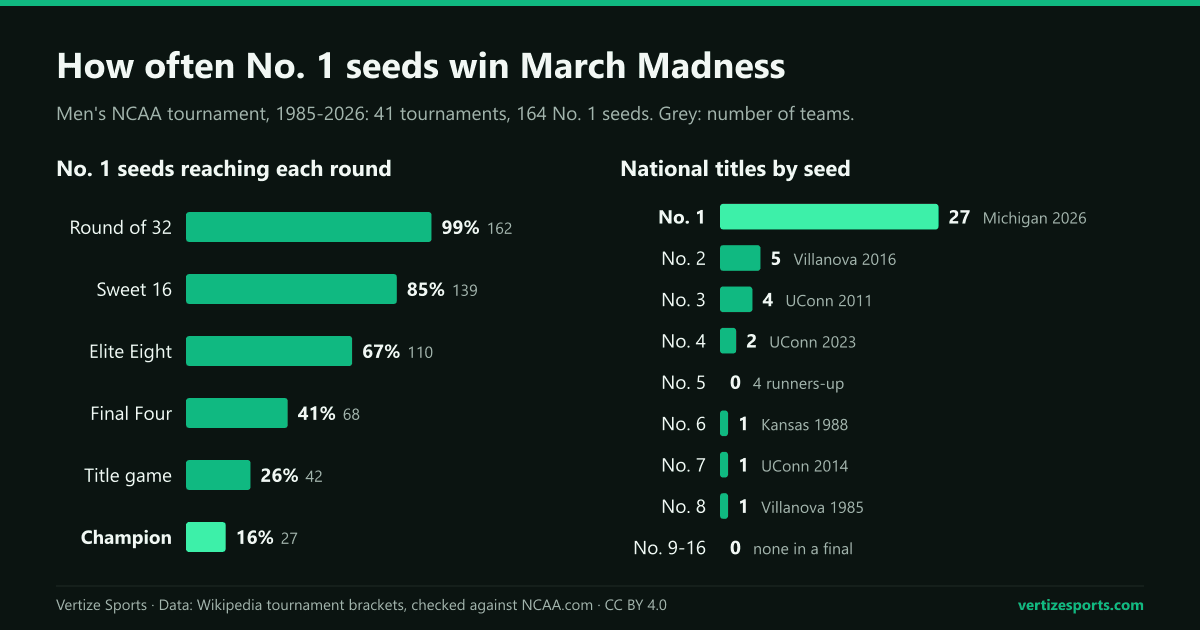
Round by round, the top seeds are near certain early and far less so late. They are 162-2 in the round of 64 and 139-23 in the round of 32, so 85 percent reach the Sweet 16. The Elite Eight is where they lose most often, 68-42 in regional finals, and 41 percent make the Final Four. There, No. 1 seeds have won 26 of 36 semifinals against lower seeds and 17 of 22 finals against them.
All four No. 1 seeds have reached the same Final Four twice, in 2008 and 2025, and none of them made it in 2006, 2011 and 2023. In 32 of the 41 tournaments the Final Four had one or two.
March Madness first-round records, from 1 vs 16 to 8 vs 9
In the round of 64 the better seed has won 970 of 1,311 games since 1985, 74 percent. The steepest drop between neighboring pairings comes from 4 vs 13 to 5 vs 12, from 80 percent to 65 percent.
| Matchup | Better seed's record | Better seed wins | Lower seed's last win |
|---|---|---|---|
| 1 vs 16 | 162-2 | 98.8% | 2023, Fairleigh Dickinson |
| 2 vs 15 | 153-11 | 93.3% | 2023, Princeton |
| 3 vs 14 | 141-23 | 86.0% | 2024, Oakland |
| 4 vs 13 | 131-33 | 79.9% | 2024, Yale |
| 5 vs 12 | 106-58 | 64.6% | 2026, High Point |
| 6 vs 11 | 100-64 | 61.0% | 2026, VCU and Texas |
| 7 vs 10 | 100-63 | 61.3% | 2026, Texas A&M |
| 8 vs 9 | 77-87 | 47.0% | 2026, four times |
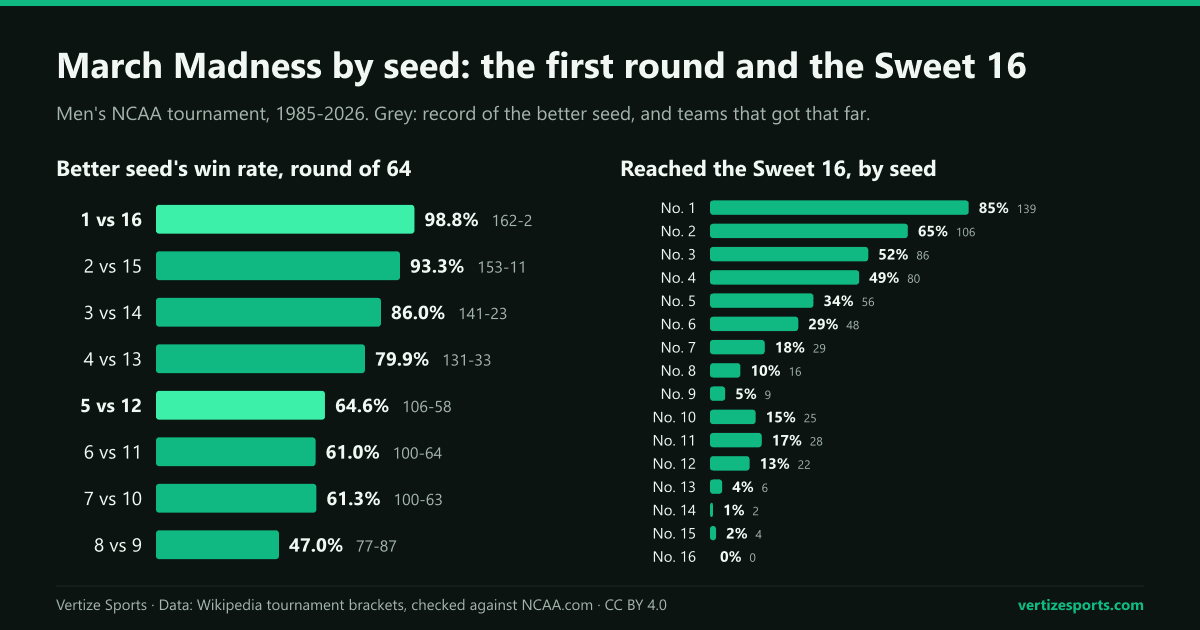
The 8 vs 9 game is the only pairing the lower seed leads, 87-77, and the 6 vs 11 and 7 vs 10 games are nearly identical, with the better seed at 61 percent in both. In the bigger mismatches, upsets get rare quickly: 13 seeds have won 33 times, 14 seeds 23, 15 seeds 11 and 16 seeds twice.
The 12 vs 5 upset record
Twelve seeds are 58-106 against 5 seeds, a 35 percent win rate, the same count as NCAA.com's. It happens almost every year: at least one 12 seed has won in 35 of the 41 tournaments, two or more in 18. The last year without one was 2023; the latest upset was the High Point Panthers' 83-82 win over the Wisconsin Badgers in 2026.
What 12 seeds rarely do is keep going: 22 trips to the Sweet 16, two to the Elite Eight, by Missouri in 2002 and Oregon State in 2021, and none to the Final Four. Still, that is more Sweet 16s than 8 seeds (16) or 9 seeds (9) have reached, because the winner of the 8 vs 9 game meets a No. 1 seed in the second round.
The 11 line has been the most dangerous of the double-digit seeds, with six Final Fours: LSU in 1986, George Mason in 2006, VCU in 2011, Loyola Chicago in 2018, UCLA in 2021 and NC State in 2024. One 10 seed has made it, Syracuse in 2016, and no team seeded 12th or lower.
Has a 16 seed ever beaten a 1 seed?
Twice in 164 games, and neither winner got past the next round:
- 2018: UMBC 74, Virginia 54. The UMBC Retrievers were the first 16 seed to beat a No. 1, and they did it by 20 points against the Virginia Cavaliers. They lost to Kansas State 50-43 in the second round.
- 2023: Fairleigh Dickinson 63, Purdue 58. The Fairleigh Dickinson Knights had to win a First Four game first, 84-61 over Texas Southern, before knocking out the Purdue Boilermakers. They lost to Florida Atlantic 78-70 in the second round.
Before 2018, the closest calls came in the same tournament: in 1989 Georgetown beat Princeton 50-49 and Oklahoma beat East Tennessee State 72-71. The widest margin in the pairing came in 2026, Florida's 114-55 win over Prairie View A&M.
One line up, 15 seeds have beaten 2 seeds 11 times, most recently Princeton over Arizona in 2023. Saint Peter's went furthest, beating Kentucky, Murray State and Purdue in 2022 to become the only 15 seed to reach an Elite Eight.
How far each seed goes: Sweet 16, Final Four and titles
| Seed | Record | Sweet 16 | Final Four | Titles |
|---|---|---|---|---|
| No. 1 | 548-137 | 139 (85%) | 68 (41%) | 27 (16%) |
| No. 2 | 385-159 | 106 (65%) | 33 (20%) | 5 (3%) |
| No. 3 | 302-160 | 86 (52%) | 18 (11%) | 4 (2%) |
| No. 4 | 257-162 | 80 (49%) | 15 (9%) | 2 (1%) |
| No. 5 | 187-164 | 56 (34%) | 9 (5%) | 0 (0%) |
| No. 6 | 172-163 | 48 (29%) | 3 (2%) | 1 (1%) |
| No. 7 | 144-163 | 29 (18%) | 3 (2%) | 1 (1%) |
| No. 8 | 113-163 | 16 (10%) | 6 (4%) | 1 (1%) |
| No. 9 | 104-164 | 9 (5%) | 2 (1%) | 0 (0%) |
| No. 10 | 98-163 | 25 (15%) | 1 (1%) | 0 (0%) |
| No. 11 | 108-164 | 28 (17%) | 6 (4%) | 0 (0%) |
| No. 12 | 82-164 | 22 (13%) | 0 (0%) | 0 (0%) |
| No. 13 | 39-164 | 6 (4%) | 0 (0%) | 0 (0%) |
| No. 14 | 25-164 | 2 (1%) | 0 (0%) | 0 (0%) |
| No. 15 | 16-164 | 4 (2%) | 0 (0%) | 0 (0%) |
| No. 16 | 2-164 | 0 (0%) | 0 (0%) | 0 (0%) |
Seeds 1 through 4 have produced 38 of the 41 champions. No team seeded lower than 11th has reached a Final Four, and none lower than 8th has played for the title: the 8 seeds that got there were Villanova in 1985, Butler in 2011, Kentucky in 2014 and North Carolina in 2022, and only Villanova won.
The 2027 NCAA tournament: what 76 teams change for the bottom seeds
The next tournament is the first with 76 teams, up from 68. The NCAA announced the expansion on May 7, 2026: the four First Four games become a 12-game Opening Round on March 16 and 17 in Dayton and Wichita, between the 12 lowest-seeded automatic qualifiers and the 12 lowest-seeded at-large teams, and automatic qualifiers only play automatic qualifiers. The 12 winners join the other 52 teams in the usual 64-team bracket, so every first-round pairing in this article stays the same.
The change lands on the bottom seeds. Barring conflicts with its bracketing rules, the committee will fill all four 16-seed places through Opening Round games among overall seeds 69 to 76, and two of the four 15-seed places through games among seeds 65 to 68. Every No. 1 seed will face a team that has already won a tournament game. On the record, that changes little: No. 1 seeds are 39-1 against 16 seeds that came through the First Four or the single opening-round game played each year from 2001 to 2010, and 123-1 against the rest.
The at-large games have a stronger record. Since 2011 the 30 at-large First Four winners have won 13 of their 30 first-round games, 43 percent, against 39 percent for all 11 seeds, the line where 22 of them played. Six reached the Sweet 16 and two the Final Four, VCU in 2011 and UCLA in 2021. Next March there will be six such games instead of two.
March Madness 2026 by seed, and the season ahead
Last March mostly went to form. Seeds 1 through 4 won all 16 first-round games for a second straight year, a first in the 64-team era, and three of the four No. 1 seeds reached the Elite Eight. The exception was the Florida Gators, beaten 73-72 in the second round by the Iowa Hawkeyes, a 9 seed that went on to the Elite Eight. Michigan beat Tennessee, Arizona and UConn, 69-63 in the final, for the program's first title since 1989.
The 2026-27 season tips off on November 1 with Notre Dame against Villanova in Rome, Selection Sunday is March 14, 2027, and the Final Four is April 3 and 5 at Ford Field in Detroit. Until then, the college basketball schedule lists every game with an AP Top 25 team, and the college basketball rankings follow the AP and coaches polls week by week. Everything else is on the college basketball hub, explained in our guide to the college basketball pages.
March Madness seed records: frequently asked questions
How often does a No. 1 seed win March Madness? A No. 1 seed has won 27 of the 41 tournaments since 1985, most recently Michigan in 2026. Counted team by team, the 164 No. 1 seeds won the title 16 percent of the time and reached the Final Four 41 percent of the time.
What is the 12 vs 5 upset record? Twelve seeds are 58-106 against 5 seeds since 1985, a 35 percent win rate, and at least one 12 seed has won in 35 of the 41 tournaments.
Has a 16 seed ever beaten a 1 seed? Twice in 164 games: UMBC beat Virginia 74-54 in 2018, and Fairleigh Dickinson beat Purdue 63-58 in 2023.
What is the lowest seed to win March Madness? An 8 seed, Villanova, in 1985. No team seeded ninth or lower has reached the championship game.
How many teams are in the 2027 NCAA tournament? Seventy-six, up from 68. Twenty-four of them play a 12-game Opening Round on March 16 and 17 for the last 12 places in the 64-team bracket.
How this was built: every game of the men's NCAA tournament from 1985 to 2026 (none was held in 2020), read by our own script from the brackets on Wikipedia's page for each year (2026 here). The 64-team bracket held 2,583 games; 2,582 were played, because the 2021 Oregon-VCU game was ruled a no contest, though Oregon advanced. Results count as played on the court, including games the NCAA later vacated. First Four and opening-round games are excluded from the seed records. Our records for every seed line and first-round pairing match NCAA.com's through 2025, and our 2026 totals match its 1 vs 16 and 5 vs 12 updates.