We rebuilt all 32 brackets, 2,016 games from the round of 64 to the final, and counted how each seed line fared; the 2020 tournament was canceled. Our totals through 2025 match NCAA.com's records by seed for every seed line.
Women's March Madness seed records by round
Each seed line has sent 128 teams to the bracket since 1994, and only seeds 1 through 6 have winning records. No. 2 and No. 3 seeds have never lost a first-round game, a combined 256-0, while No. 14 and No. 15 seeds are 0-128 each.
| Seed | Round of 64 | Round of 32 | Sweet 16 | Elite Eight | Final Four | Final | Total |
|---|---|---|---|---|---|---|---|
| No. 1 | 127-1 | 122-5 | 104-18 | 76-28 | 41-35 | 24-17 | 494-104 |
| No. 2 | 128-0 | 106-22 | 66-40 | 24-42 | 11-13 | 5-6 | 340-123 |
| No. 3 | 128-0 | 85-43 | 43-42 | 14-29 | 8-6 | 3-5 | 281-125 |
| No. 4 | 121-7 | 77-44 | 17-60 | 7-10 | 3-4 | 0-3 | 225-128 |
| No. 5 | 101-27 | 44-57 | 5-39 | 2-3 | 1-1 | 0-1 | 153-128 |
| No. 6 | 91-37 | 30-61 | 10-20 | 2-8 | 0-2 | – | 133-128 |
| No. 7 | 84-44 | 16-68 | 6-10 | 2-4 | 0-2 | – | 108-128 |
| No. 8 | 65-63 | 2-63 | 0-2 | – | – | – | 67-128 |
| No. 9 | 63-65 | 4-59 | 2-2 | 1-1 | 0-1 | – | 70-128 |
| No. 10 | 44-84 | 6-38 | 2-4 | 0-2 | – | – | 52-128 |
| No. 11 | 37-91 | 13-24 | 1-12 | 0-1 | – | – | 51-128 |
| No. 12 | 27-101 | 4-23 | 0-4 | – | – | – | 31-128 |
| No. 13 | 7-121 | 3-4 | 0-3 | – | – | – | 10-128 |
| No. 14 | 0-128 | – | – | – | – | – | 0-128 |
| No. 15 | 0-128 | – | – | – | – | – | 0-128 |
| No. 16 | 1-127 | 0-1 | – | – | – | – | 1-128 |
The path gets harder late. No. 1 seeds lose almost nothing on the opening weekend but are 76-28 in regional finals, and No. 2 seeds, who usually meet a No. 1 there, have lost more Elite Eight games than they have won, 24-42.
Women's March Madness upsets by first-round matchup
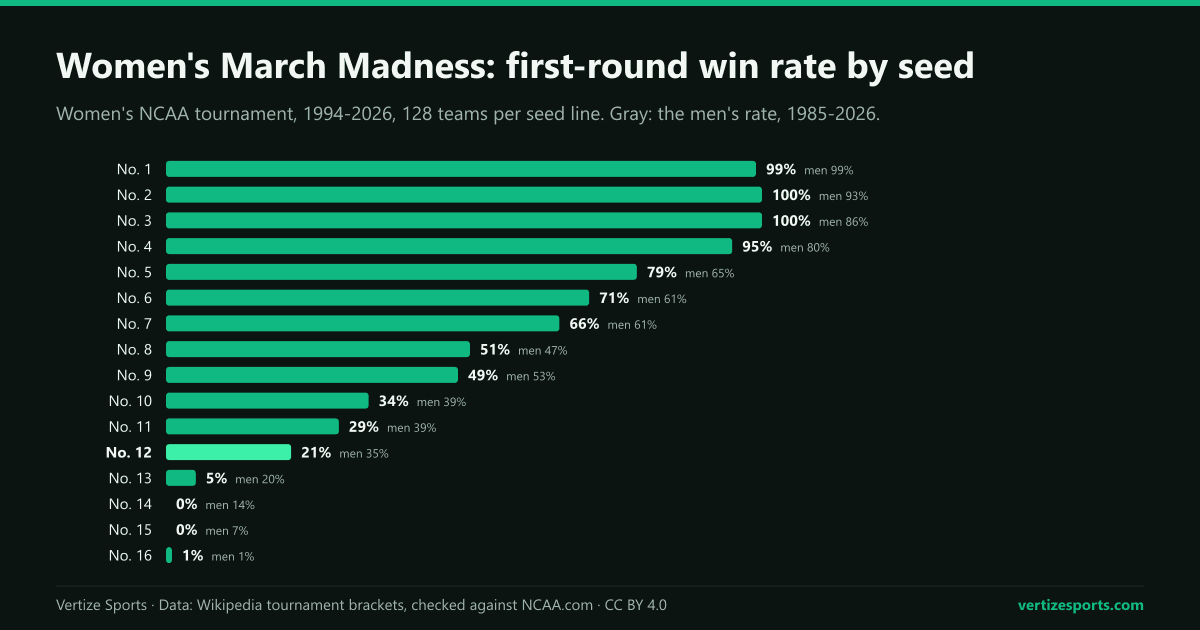
In the round of 64 the better seed has won 845 of 1,024 games, 83 percent, against 74 percent in the men's tournament since 1985, according to our men's seed records. The women's favorites win more often in every pairing, by 14 to 15 percentage points in the 3 vs 14, 4 vs 13 and 5 vs 12 games.
| Matchup | Better seed's record | Better seed wins | Men's tournament | Lower seed's last win |
|---|---|---|---|---|
| 1 vs 16 | 127-1 | 99.2% | 98.8% | 1998, Harvard |
| 2 vs 15 | 128-0 | 100.0% | 93.3% | Never |
| 3 vs 14 | 128-0 | 100.0% | 86.0% | Never |
| 4 vs 13 | 121-7 | 94.5% | 79.9% | 2021, Wright State |
| 5 vs 12 | 101-27 | 78.9% | 64.6% | 2023, Florida Gulf Coast and Toledo |
| 6 vs 11 | 91-37 | 71.1% | 61.0% | 2024, Middle Tennessee |
| 7 vs 10 | 84-44 | 65.6% | 61.3% | 2026, Virginia |
| 8 vs 9 | 65-63 | 50.8% | 47.0% | 2026, Syracuse and USC |
Outside the 8 vs 9 games, which the 8 seeds lead 65-63, lower seeds have won 116 first-round games in 32 tournaments, about 3.6 a year; men's lower seeds have won 254 in 41, about 6.2 a year. No. 13 seeds have beaten No. 4 seeds seven times, most recently the Wright State Raiders over the Arkansas Razorbacks in 2021, and a 16 seed has won once.
That was in 1998, when the Harvard Crimson beat the Stanford Cardinal 71-67 on Stanford's home floor, 20 years before the UMBC Retrievers did it in the men's tournament. Allison Feaster scored 35 points for Harvard, which then lost 82-64 to Arkansas.
12 seed vs 5 seed in the women's NCAA tournament
Twelve seeds are 27-101 against 5 seeds, a 21 percent win rate, against 35 percent in the men's tournament. At least one 12 seed has won in 20 of the 32 tournaments, against 35 of 41 in the men's, and two or more in seven. The latest were the Florida Gulf Coast Eagles and the Toledo Rockets in 2023; the three tournaments since have produced none, the longest such run since 1994.
Four 12 seeds reached the Sweet 16, San Francisco in 1996, Kansas in 2013, BYU in 2014 and Quinnipiac in 2017, and none went further. The 5 vs 12 winner usually meets a 4 seed next: 4 seeds are 54-40 against 5 seeds, the closest second-round pairing, and 23-4 against 12 seeds.
Second-round upsets and home court
The top seeds' edge carries into the second round. No. 1 seeds are 122-5 in the round of 32, against 139-23 for men's No. 1 seeds; No. 2 seeds are 106-22, No. 3 seeds 85-43 and No. 4 seeds 77-44. The top four seed lines have filled 390 of 512 Sweet 16 places, 76 percent, against 63 percent in the men's tournament, and double-digit seeds have reached it 26 times in 32 tournaments, against 87 in 41.
The women's opening weekend is also played on campus: under the NCAA's current procedures, the top 16 seeds host the first two rounds when they submit acceptable bids, while the men's 2027 first and second rounds are in eight host cities. Some upsets came with home court on the other side: NCAA.com notes that the 13th-seeded Texas A&M Aggies played at home in 1994 because Florida, the 4 seed, could not host, and that the Gonzaga Bulldogs beat Iowa and UCLA on their own court in 2011.
How often does a 1 seed win the women's tournament
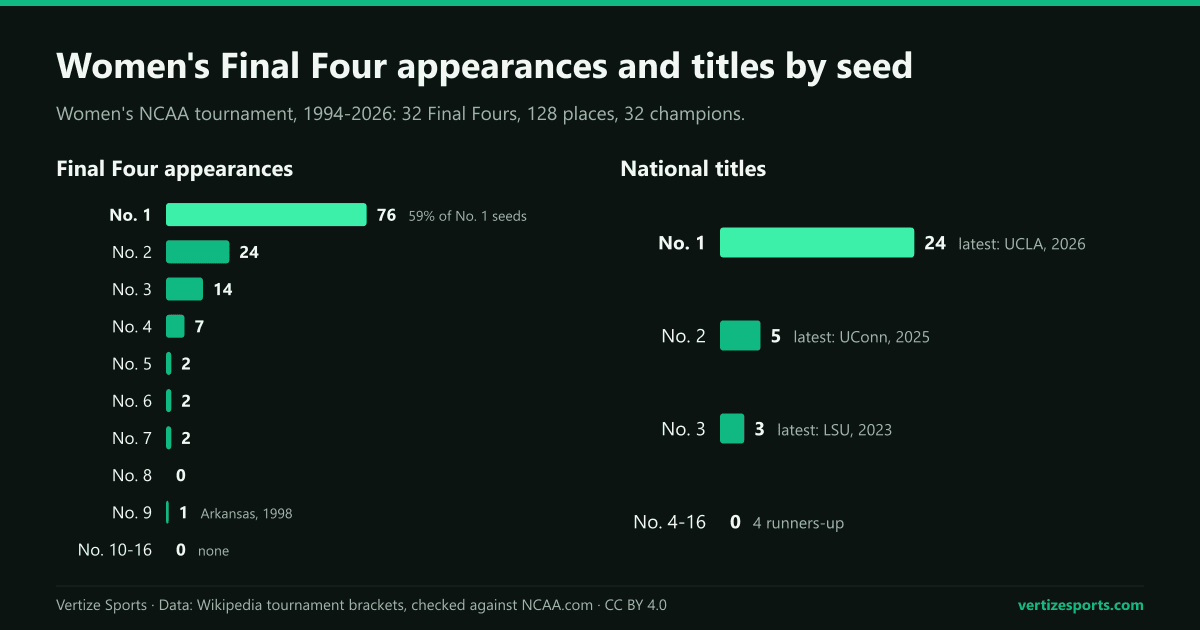
No. 1 seeds have won 24 of the 32 titles since 1994, No. 2 seeds 5 and No. 3 seeds 3. Counted team by team, the 128 No. 1 seeds won the title 19 percent of the time, about one in five, reached the Final Four 59 percent of the time and the Sweet 16 95 percent. The men's figures are 16, 41 and 85 percent. Twenty-nine of the 32 women's title games have included a No. 1 seed.
Women's Final Four seeds
Every women's Final Four since 1994 has had a No. 1 seed, and all four made it in 2012, 2015, 2018 and 2026; in the men's tournament all four made it twice and none three times. No. 1 and No. 2 seeds have taken 100 of the 128 places. Only seven teams seeded fifth or lower have reached a women's Final Four, against 30 in the men's tournament since 1985, six of them No. 11 seeds.
The lowest seed to win the women's NCAA tournament
Three No. 3 seeds have won the title, the lowest to do it: the North Carolina Tar Heels in 1994, the Tennessee Lady Volunteers in 1997 and the LSU Tigers in 2023. NCAA.com's list of the lowest seeds in each round, which covers every tournament, has no lower champion. The lowest seeds to reach each round since 1994:
- Second round, No. 16: Harvard in 1998.
- Sweet 16, No. 13: Texas A&M in 1994, Liberty in 2005 and Marist in 2007; all three then lost to a No. 1 seed.
- Elite Eight, No. 11: Gonzaga in 2011, beaten 83-60 by Stanford.
- Final Four, No. 9: Arkansas in 1998, which beat Hawaiʻi, Harvard, Kansas and Duke before losing 86-58 to Tennessee.
- Title game, No. 5: the Louisville Cardinals in 2013, who beat No. 1 Baylor 82-81 in the Sweet 16 and lost the final 93-60 to UConn.
The men's tournament has gone deeper. An 8 seed, Villanova in 1985, has won the men's title, while no women's team seeded lower than fifth has played for one.
The 2026 women's tournament and the 76-team field in 2027
Last March all four No. 1 seeds reached the Final Four in Phoenix, the fourth time since 1994. The South Carolina Gamecocks beat the UConn Huskies 62-48 and UCLA beat the Texas Longhorns 51-44 before beating South Carolina 79-51 in the final for its first NCAA title. Only one lower seed won a first-round game outside the 8 vs 9 pairings, tying the fewest since 1994: the Virginia Cavaliers, a 10 seed, who then won at Iowa in double overtime, the first women's First Four team to reach the Sweet 16.
The 2027 tournament is the first with 76 teams, up from 68: 32 automatic qualifiers and 44 at-large teams under the NCAA's procedures. The First Four becomes a 12-game Opening Round on March 17 and 18 on the campuses of 12 of the top 16 seeds, where the 12 lowest-seeded automatic qualifiers play each other and so do the 12 lowest-seeded at-large teams. The 64-team bracket keeps its pairings, with the first round on March 19 and 20 and the Final Four on April 2 and 4 in Columbus, Ohio.
The new round matters most at the bottom of the bracket. From 2022 to 2026 the women's First Four sent 10 No. 16 seeds into the bracket, all beaten by No. 1 seeds, and 10 at-large winners that went 2-8 in the first round; the men's First Four has a longer record. Seeds 15 and 16 have won one first-round game in 256 since 1994, and the NCAA says nearly half of the 28 men's and women's teams on those lines will now win at least one game.
The 2026-27 season tipped off on Nov. 1 with Notre Dame beating Villanova 99-75 in Rome, and Selection Sunday is March 14, 2027. Our college basketball section follows the men's game, with the AP Top 25 and every game involving a ranked team.
Women's March Madness seed records: frequently asked questions
How often does a No. 1 seed win the women's NCAA tournament? A No. 1 seed has won 24 of the 32 tournaments since 1994, most recently UCLA in 2026. Each No. 1 seed has won it 19 percent of the time.
What is the lowest seed to win the women's NCAA tournament? A No. 3 seed, three times: North Carolina in 1994, Tennessee in 1997 and LSU in 2023. The lowest seed in a final was No. 5 Louisville in 2013.
Has a 16 seed ever beaten a 1 seed in the women's tournament? Once: Harvard beat Stanford 71-67 in 1998. No. 1 seeds are 127-1 against 16 seeds since 1994.
How often does a 12 seed beat a 5 seed in the women's tournament? Twelve seeds are 27-101 against 5 seeds since 1994, a 21 percent win rate, and none has won since 2023.
How many teams are in the 2027 women's NCAA tournament? Seventy-six, up from 68. Twenty-four play a 12-game Opening Round on March 17 and 18 for the last 12 places in the 64-team bracket.
How this was built: every game of the women's NCAA Division I tournament from 1994 to 2026 (none was held in 2020), read by our own script from Wikipedia's bracket for each year (2026 here). First Four games are left out of the seed records, as in NCAA.com's. Champions, runners-up and final scores match the NCAA's championship history, and every 2026 winner matches NCAA.com's official bracket. Men's figures, 1985-2026, come from our men's seed records. Results count as played on the court.