We took the official time of game of all 154,130 regular-season games since 1950 from MLB's Stats API, and of every postseason game, and averaged the 139,202 that went exactly nine innings, the measure MLB itself uses. Time of game is MLB's official figure; rain delays are recorded separately and are not included. Seven-inning doubleheader games of 2020 and 2021, rain-shortened games and extra-inning games are not in the nine-inning average.
Average MLB game time by year since 1950
Games got longer for most of seven decades. A nine-inning game took 2:19 in 1950, the 1950s averaged 2:26 and the 1980s 2:40. The 2010s averaged 2:59, and 2014, at 3:02, was the first season in our data to average more than three hours. After 2:56 in 2015, every season from 2016 to 2022 went past three hours.
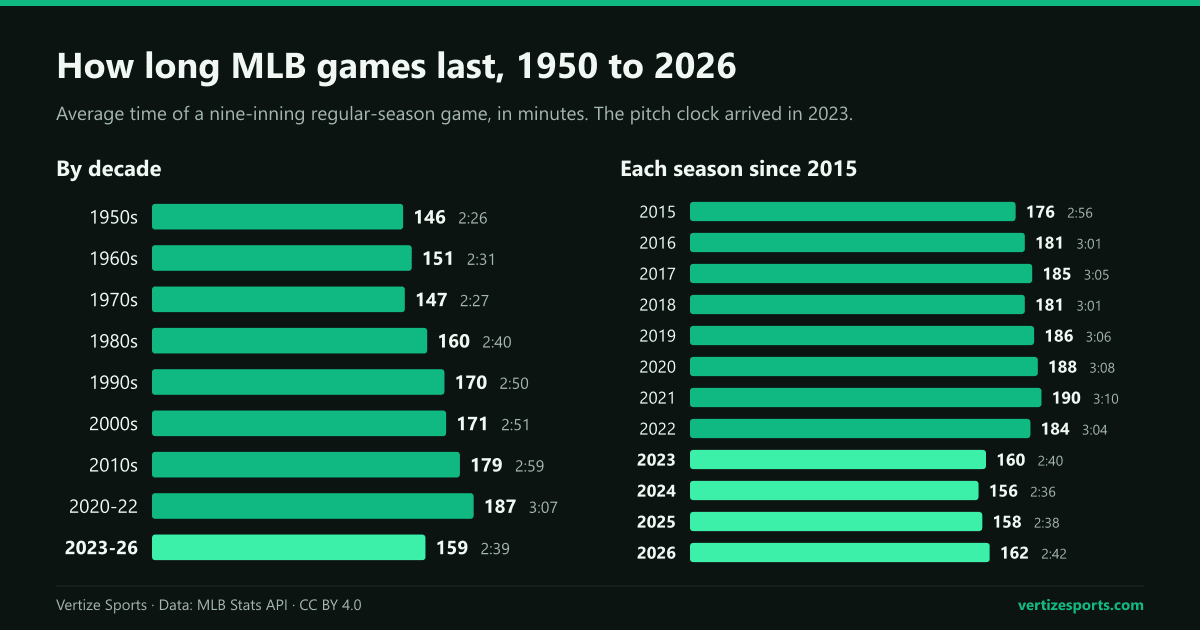
The peak was 2021: 3:10:04 per nine-inning game, the record MLB.com also cites. That year 1,402 of 2,086 nine-inning games, 67 percent, took three hours or more, and only 46 were over in less than two and a half. The longest nine-inning games of 2021 and 2022 both ran 4:26.
How the pitch clock cut MLB game times
MLB introduced three rule changes in 2023, and the pitch timer was the one aimed at game length:
- 15 seconds between pitches with the bases empty and 20 with runners on; a pitcher who is late is charged an automatic ball.
- 30 seconds between batters, and batters in the box and alert by the 8-second mark or charged an automatic strike.
- A limit of two pickoff attempts or step-offs per plate appearance, which reset when a runner advances.
The average fell from 3:03:45 in 2022 to 2:39:53 in 2023, a drop of 24 minutes. That is the largest one-season change in our data; the next largest was a fall of nine minutes in 1963. Compared with 2021, games were 30 minutes shorter. Nine-inning games under two and a half hours went from 46 in 2021 to 619 in 2023. Shorter games did not mean less offense: runs per team per game rose from 4.28 to 4.62 that year, as our MLB runs per game by season analysis shows.
Pitch clock changes since 2023: the 18-second timer and ABS challenges
For 2024, MLB cut the timer with runners on base from 20 seconds to 18, reduced mound visits from five to four per game, and reset the inning-break clock to 2:00, rather than 2:15, when a new pitcher reaches the warning track with less than two minutes left. The league said nine-inning games had grown seven minutes longer from April to September 2023. The 2024 average was 2:36, the shortest since 1984 (2:35) and the shortest of the pitch clock era. MLB's pitch timer glossary still lists 15 and 18 seconds today.
Games crept up to 2:38 in 2025 and 2:42 in 2026, the first season with the Automated Ball-Strike Challenge System. Each team starts with two challenges, which only the pitcher, catcher or batter can call, and keeps any that succeed; MLB said a challenge takes about 15 seconds. MLB attributed 61 seconds of the 2026 increase to the challenges, the Associated Press reported.
The longest and shortest MLB games of the pitch clock era
Marathon nine-inning games have nearly disappeared. MLB counted 391 regular-season nine-inning games of 3 hours, 30 minutes or more in 2021, 232 in 2022, nine in 2023 and seven in 2024. Our count matches from 2022 on, puts 2021 at 389, and finds three in 2025 and 10 in 2026.
| Season | Longest nine-inning game | Time | Shortest nine-inning game | Time |
|---|---|---|---|---|
| 2023 | Giants 11 at Padres 16, April 29 | 3:44 | Guardians 0 at Tigers 1, April 18 | 1:50 |
| 2024 | Athletics 7 at Mets 6, Aug. 15 | 3:45 | Reds 0 at Cubs 1, Sept. 27 | 1:48 |
| 2025 | Yankees 12 at Marlins 13, Aug. 1 | 3:43 | Cardinals 1 at Royals 0, May 17 | 1:49 |
| 2026 | Marlins 7 at Yankees 9, April 4 | 3:49 | Braves 0 at Phillies 1, Sept. 7 | 1:51 |
The New York Yankees' 9-7 win over the Miami Marlins on April 4, 2026, at 3:49, is the longest nine-inning game since the clock arrived. The shortest is the Chicago Cubs' 1-0 win over the Cincinnati Reds on Sept. 27, 2024, in 1:48. Every one of the shortest games in the table was a shutout.
MLB extra innings rules: the automatic runner and game length
Since 2020, each regular-season extra inning has started with a runner on second base, a pandemic measure MLB made permanent in 2023. In the regular season the share of games going to extra innings barely moved, from 8 percent to 9 percent, but the games got much shorter:
- 2015-2019, without the runner: 1,003 extra-inning games averaged 3:53 and 11.2 innings, and 30 percent reached the 12th inning; 49 went 15 innings or more, the longest 19.
- 2023-2026, with the runner: 835 extra-inning games averaged 3:08 and 10.4 innings, 45 minutes shorter, and 9 percent reached the 12th. None went past 14 innings.
- 2026: 209 extra-inning games averaging 3:13. The longest was the Boston Red Sox's 12-11 win over the Chicago White Sox on Aug. 6, 13 innings in 4:23.
How long are MLB playoff games?
Postseason games run longer than regular-season games, and they have in every postseason since 1971. From 2015 to 2019, a nine-inning playoff game averaged 3:28, 26 minutes more than the regular season's 3:02. The pitch clock applies in the postseason too, and from 2023 to 2025 playoff games averaged 3:00, still 22 minutes more than the regular season's 2:38. The longest postseason average since 1950 was 3:37, in 2021.
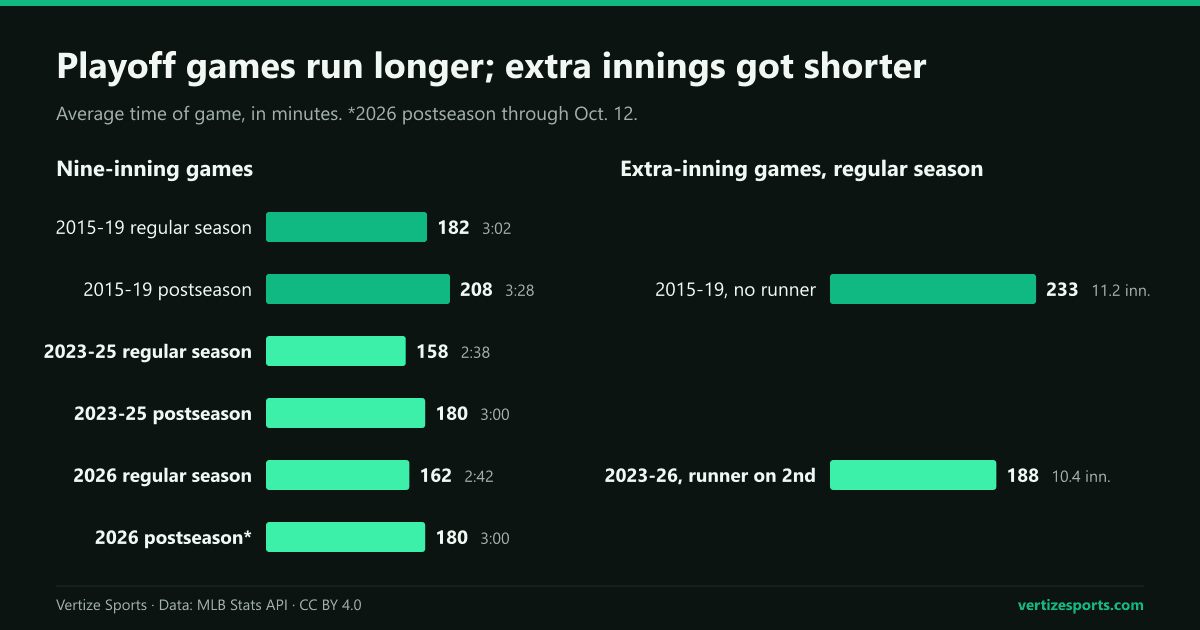
There is no automatic runner in the postseason, so playoff extra innings can still run long. The two longest games since 2020 were both 18-inning playoff games: the Houston Astros' 1-0 win at the Seattle Mariners in Game 3 of the 2022 American League Division Series, in 6:22, and the Los Angeles Dodgers' 6-5 win over the Toronto Blue Jays in Game 3 of the 2025 World Series, in 6:39.
MLB game length in 2026
The 2026 regular season ran from March 25 to Sept. 27. Its nine-inning games averaged 2:42:08, and the monthly average stayed between 2:39 and 2:43 all season. Of those games, 326, or 15 percent, lasted three hours or more, against 67 percent in 2021, and 531 were over in less than two and a half hours.
Through Oct. 12, 28 postseason games had been completed, 27 of them in nine innings, averaging 3:00, 18 minutes more than the regular season. Nine-inning Wild Card Series games averaged 2:53 and Division Series games 3:04; the longest nine-inning game so far was the Cleveland Guardians at the Chicago White Sox on Oct. 8, in 3:39. Every result is on the MLB schedule and the bracket on the 2026 MLB playoffs page.
Average MLB game time by season: the full table
| Season | Regular season | Postseason |
|---|---|---|
| 2026 | 2:42:08 | 3:00 |
| 2025 | 2:38:23 | 2:57 |
| 2024 | 2:36:20 | 3:02 |
| 2023 | 2:39:53 | 3:02 |
| 2022 | 3:03:45 | 3:23 |
| 2021 | 3:10:04 | 3:37 |
| 2020 | 3:07:41 | 3:32 |
| 2019 | 3:05:35 | 3:34 |
| 2018 | 3:00:44 | 3:35 |
| 2017 | 3:05:11 | 3:29 |
| 2016 | 3:00:42 | 3:28 |
| 2015 | 2:56:15 | 3:14 |
| 2014 | 3:02:21 | 3:26 |
| 2013 | 2:58:52 | 3:21 |
| 2012 | 2:55:58 | 3:17 |
| 2011 | 2:51:57 | 3:17 |
| 2010 | 2:50:46 | 3:15 |
| 2009 | 2:51:47 | 3:30 |
| 2008 | 2:50:38 | 3:16 |
| 2007 | 2:51:13 | 3:26 |
| 2006 | 2:48:11 | 3:08 |
| 2005 | 2:46:27 | 3:02 |
| 2004 | 2:47:08 | 3:15 |
| 2003 | 2:46:12 | 3:06 |
| 2002 | 2:52:24 | 3:25 |
| 2001 | 2:54:21 | 3:11 |
| 2000 | 2:57:47 | 3:24 |
| 1999 | 2:53:44 | 3:09 |
| 1998 | 2:47:41 | 3:04 |
| 1997 | 2:52:15 | 3:09 |
| 1996 | 2:51:10 | 3:05 |
| 1995 | 2:50:21 | 3:09 |
| 1994 | 2:53:46 | No postseason |
| 1993 | 2:48:17 | 3:19 |
| 1992 | 2:49:32 | 3:01 |
| 1991 | 2:49:03 | 3:03 |
| 1990 | 2:47:57 | 2:58 |
| 1989 | 2:45:36 | 3:00 |
| 1988 | 2:45:03 | 3:04 |
| 1987 | 2:47:59 | 2:58 |
| 1986 | 2:44:09 | 2:59 |
| 1985 | 2:39:49 | 2:51 |
| 1984 | 2:35:26 | 2:46 |
| 1983 | 2:36:17 | 2:39 |
| 1982 | 2:35:19 | 2:44 |
| 1981 | 2:33:27 | 2:48 |
| 1980 | 2:33:50 | 2:53 |
| 1979 | 2:31:33 | 3:00 |
| 1978 | 2:26:52 | 2:33 |
| 1977 | 2:28:38 | 2:36 |
| 1976 | 2:24:22 | 2:39 |
| 1975 | 2:25:24 | 2:40 |
| 1974 | 2:25:21 | 2:31 |
| 1973 | 2:26:53 | 2:30 |
| 1972 | 2:23:14 | 2:24 |
| 1971 | 2:25:17 | 2:34 |
| 1970 | 2:30:15 | 2:28 |
| 1969 | 2:28:20 | 2:31 |
| 1968 | 2:29:03 | 2:37 |
| 1967 | 2:32:09 | 2:22 |
| 1966 | 2:31:36 | 2:16 |
| 1965 | 2:31:57 | 2:20 |
| 1964 | 2:30:36 | 2:30 |
| 1963 | 2:25:28 | 2:04 |
| 1962 | 2:34:51 | 2:27 |
| 1961 | 2:34:23 | 2:32 |
| 1960 | 2:33:32 | 2:40 |
| 1959 | 2:31:18 | 2:30 |
| 1958 | 2:28:00 | 2:30 |
| 1957 | 2:28:28 | 2:26 |
| 1956 | 2:28:46 | 2:34 |
| 1955 | 2:28:14 | 2:36 |
| 1954 | 2:26:27 | 2:43 |
| 1953 | 2:23:42 | 2:56 |
| 1952 | 2:21:33 | 2:45 |
| 1951 | 2:19:23 | 2:42 |
| 1950 | 2:19:25 | 2:19 |
MLB game length: frequently asked questions
How long is an MLB game on average? A nine-inning regular-season game averaged 2:42 in 2026. Regular-season extra-inning games averaged 3:13, and nine-inning postseason games 3:00 through Oct. 12.
What was the longest average MLB game time? 2021, at 3:10 per nine-inning game, the record. 2022 averaged 3:04 before the pitch clock arrived in 2023.
How much time did the pitch clock save? The nine-inning average fell 24 minutes in its first season, from 3:04 to 2:40, and reached a low of 2:36 in 2024.
Why were MLB games longer in 2026? The average rose four minutes, to 2:42, in the first season of ABS challenges; MLB put 61 seconds of the increase down to the challenge system. The pitch timer was unchanged.
How this was built: the official time of game (gameDurationMinutes) and the number of innings of every completed MLB game come from MLB's Stats API schedule, one request per season, for every regular season and postseason from 1950 to 2026. Nine-inning averages use games that went exactly nine innings; time of game leaves out delays. A suspended game is counted once. Our averages match MLB's published figures to within five seconds wherever MLB gives them to the second. The 2026 regular season is complete; the 2026 postseason covers games finished by Oct. 12, with the League Championship Series under way.