MLB.com keeps the official list of all 327. To see how often no-hitters happen, we went through the line score of every regular-season and postseason game since 2000 in MLB's Stats API, 65,030 games, and flagged each one in which a team finished without a hit or went nine innings without one. That found 87 games. The 79 that meet MLB's definition match the official list date for date; the other eight show where the line is drawn.
How many no-hitters in MLB history
- 327 official no-hitters from 1876 through the 2026 season, 43 of them before the American League began in 1901.
- 24 perfect games, the most recent by Domingo Germán of the New York Yankees on June 28, 2023. Three came in 2012, the most in one season.
- 22 combined no-hitters, thrown by two or more pitchers. MLB.com's list of them starts with Babe Ruth and Ernie Shore in 1917, when Ruth was ejected after walking the first batter.
- Three in the postseason: Don Larsen's perfect game for the Yankees in the 1956 World Series, Roy Halladay's for the Philadelphia Phillies in the 2010 National League Division Series, and the Astros' combined no-hitter in Game 4 of the 2022 World Series.
MLB no-hitters by year since 2000
Our count gives 77 official no-hitters in the regular season from 2000 to 2026, an average of 2.9 a season, plus the two in the postseason. Three seasons had none, 2000, 2005 and 2025, and two had seven, 2012 and 2015, before 2021 set the record.
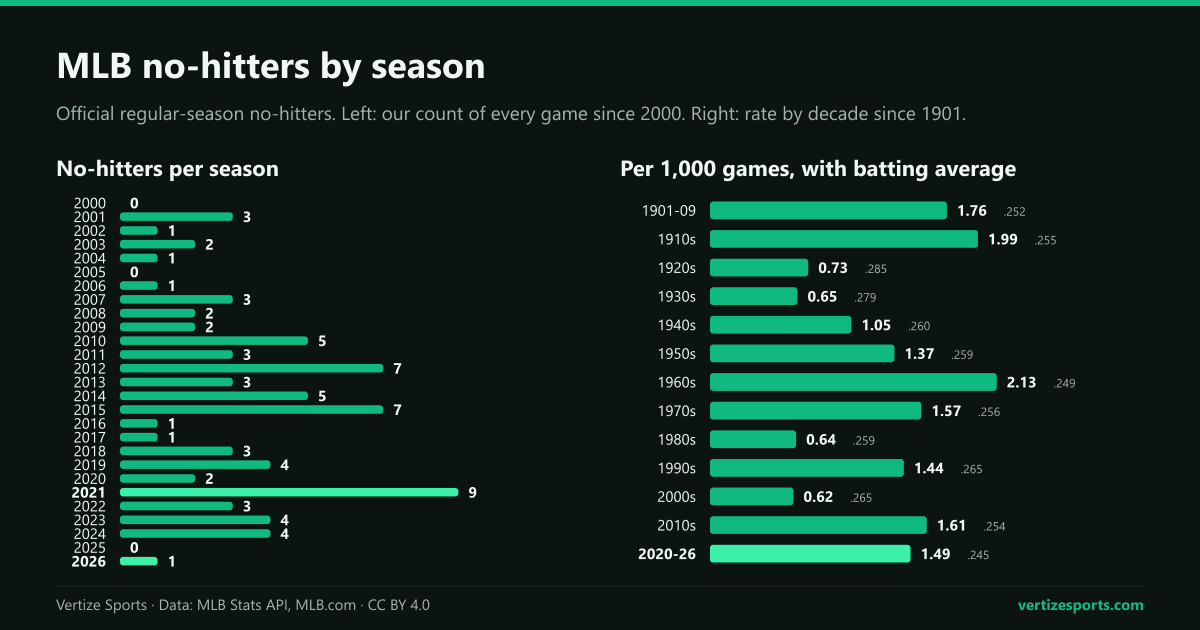
Over the whole history, the seasons with the most no-hitters are:
- 2021: 9, the record.
- 1884: 8, spread over three major leagues, four in the American Association, two in the National League and two in the Union Association.
- 1990, 1991, 2012 and 2015: 7 each.
Since 1901, 20 seasons have gone without one. The 2025 season was the first since 2005.
Why the number of no-hitters swings: batting average and strikeouts
Counts by season mislead, because the number of games has grown from about 1,200 a year in the early 1900s to 2,430. Per 1,000 regular-season games, no-hitters were most common in the 1960s, at 2.13, when the league hit .249, and in the 1910s, at 1.99. They were rarest in the 2000s, at 0.62, and in the 1980s and 1930s. The 1920s, the best decade for hitters at .285, produced 0.73 per 1,000 games.
| Seasons | No-hitters | Per 1,000 games | Batting average | Strikeout rate | Complete games |
|---|---|---|---|---|---|
| 1901-09 | 19 | 1.76 | .252 | n/a | 78.8% |
| 1910s | 24 | 1.99 | .255 | n/a | 56.6% |
| 1920s | 9 | 0.73 | .285 | 7.2% | 49.6% |
| 1930s | 8 | 0.65 | .279 | 8.5% | 44.6% |
| 1940s | 13 | 1.05 | .260 | 9.2% | 42.6% |
| 1950s | 17 | 1.37 | .259 | 11.4% | 33.5% |
| 1960s | 34 | 2.13 | .249 | 15.1% | 25.2% |
| 1970s | 31 | 1.57 | .256 | 13.5% | 25.3% |
| 1980s | 13 | 0.64 | .259 | 14.1% | 15.6% |
| 1990s | 31 | 1.44 | .265 | 15.9% | 7.4% |
| 2000s | 15 | 0.62 | .265 | 17.0% | 3.6% |
| 2010s | 39 | 1.61 | .254 | 20.5% | 2.1% |
| 2020-26 | 23 | 1.49 | .245 | 22.6% | 0.7% |
Across the 126 seasons since 1901, the correlation between the league batting average and the no-hitter rate is -0.42: fewer hits, more no-hitters, but far from one for one. The strikeout rate on its own tells less, with a correlation of 0.16. The 2020s have the highest strikeout rate of any decade, 22.6 percent, as our study of MLB strikeouts by season shows, and the lowest batting average, .245, yet their no-hitter rate, 1.49 per 1,000 games, is below the 2010s' 1.61.
The rest is chance. A no-hitter needs every ball in play to find a glove for nine innings, and at the 2020-26 rate a full season should produce about 3.6. If no-hitters arrived purely at random at that rate, a season with none would come up about 2.7 percent of the time and one with nine or more about 1.2 percent. Both happened within five seasons. In 1968, the season with the lowest league batting average since 1901, .237, there were five.
2021: the record season for no-hitters
The ninth no-hitter of 2021, by Corbin Burnes and Josh Hader of the Milwaukee Brewers on September 11, broke the record of eight set in 1884. It was the third time that season that Cleveland was no-hit, the first team to suffer three in a season, after Carlos Rodón of the Chicago White Sox on April 14 and Wade Miley of the Cincinnati Reds on May 7. The Seattle Mariners and the Rangers were each no-hit twice.
Two seven-inning doubleheader games were also hitless: Madison Bumgarner's for the Arizona Diamondbacks against the Atlanta Braves on April 25, and five Tampa Bay Rays pitchers' against Cleveland on July 7. That makes 11 hitless games. The league batted .244 and struck out in 23.2 percent of plate appearances, the highest of any 162-game season.
Combined no-hitters and the bullpen era
Half of the 22 combined no-hitters have come since 2018, and eight in the 2020s alone, including the only one of 2026. Only four came before 1990. The Astros have thrown five, the most of any team; the first, against the Yankees in 2003, and the Mariners' against the Los Angeles Dodgers in 2012 used six pitchers each, the most in a no-hitter.
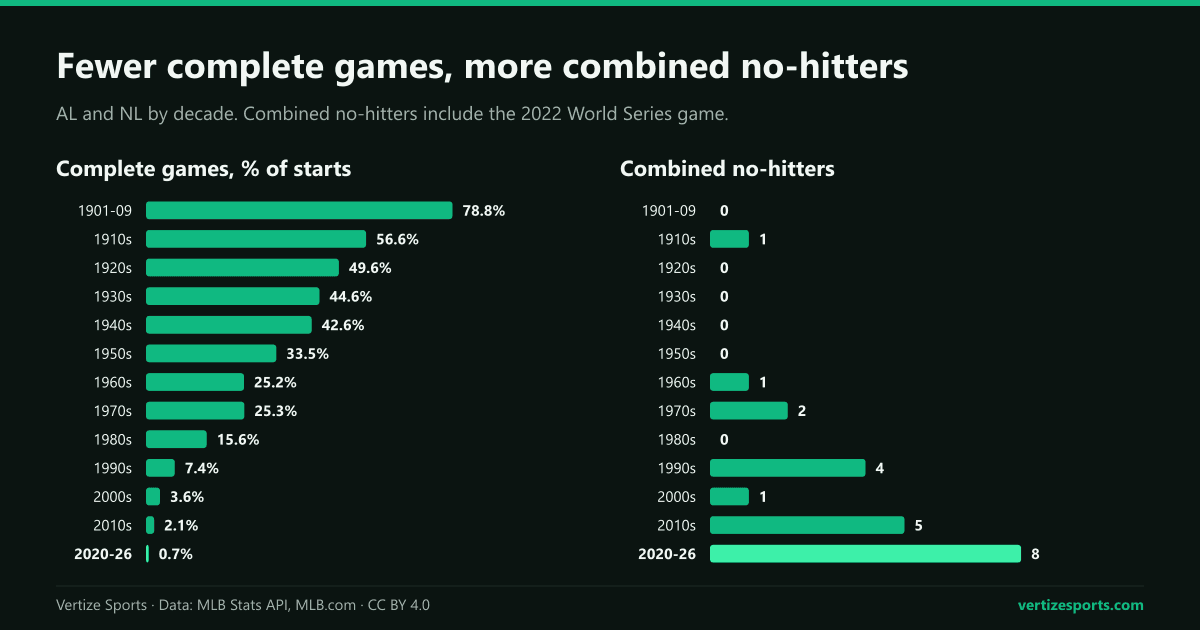
The reason is the complete game. Starters finished 78.8 percent of their games from 1901 to 1909, 33.5 percent in the 1950s and 15.6 percent in the 1980s. In 2026 there were 21 complete games in 4,858 starts, 0.4 percent. A starter with a no-hitter going can now be taken out for his pitch count, as Burnes was after 115 pitches, and the bullpen finishes it.
Postseason no-hitters
Of the three postseason no-hitters, Larsen's came in Game 5 of the 1956 World Series against the Brooklyn Dodgers, Halladay's against the Cincinnati Reds in the same season as his regular-season perfect game, and the Astros' 2022 effort, by Cristian Javier, Bryan Abreu, Rafael Montero and Ryan Pressly, was the first combined one.
None has come in the 2026 postseason so far: 28 games were completed through October 12, nine in the Wild Card Series, 16 in the Division Series and three in the League Championship Series, and every team got at least one hit. The bracket is on the 2026 MLB playoffs page.
What counts as an official no-hitter
Since a 1991 ruling by MLB's committee on statistical accuracy, a no-hitter is a game in which a pitcher or pitchers allow no hits while pitching at least nine innings. Since 2000, our count found eight hitless games or nine-inning no-hit bids that do not count:
- Too short: Devern Hansack of the Boston Red Sox in a game called after five innings on October 1, 2006, and the two seven-inning games of 2021.
- Lost in eight innings: the Los Angeles Angels' Jered Weaver and Jose Arredondo on June 28, 2008, and the Reds' Hunter Greene and Art Warren on May 15, 2022, both beaten 1-0 by home teams that did not need to bat in the ninth.
- Broken up in extra innings: Rich Hill of the Dodgers, who lost 1-0 in the 10th at Pittsburgh on August 23, 2017; the Rays against the Red Sox on April 23, 2022; and the Brewers against the Yankees on September 10, 2023, no-hit for 10 innings before losing in 13.
A no-hitter does not have to be a shutout. Ervin Santana's for the Angels against Cleveland on July 27, 2011, which finished 3-1, is the only official one since 2000 in which the no-hit team scored.
MLB no-hitters in 2026
The 2026 regular season, which ended on September 27, had one no-hitter: Tatsuya Imai pitched the first six innings, Steven Okert the seventh and Alimber Santa, in his major league debut, the last two, as the Astros beat the Rangers 9-0 at Globe Life Field. It was the first no-hitter in the majors since Shota Imanaga, Nate Pearson and Porter Hodge of the Chicago Cubs no-hit the Pittsburgh Pirates on September 4, 2024. The league batted .244, struck out in 22.1 percent of plate appearances and scored 4.48 runs a game; every result is on the MLB schedule.
MLB no-hitters by year, 2000 to 2026
| Season | No-hitters | Combined | Perfect games | Batting average | Strikeout rate |
|---|---|---|---|---|---|
| 2026 | 1 | 1 | 0 | .244 | 22.1% |
| 2025 | 0 | 0 | 0 | .245 | 22.2% |
| 2024 | 4 | 1 | 0 | .243 | 22.6% |
| 2023 | 4 | 1 | 1 | .248 | 22.7% |
| 2022 | 3 (+1 postseason) | 3 | 0 | .243 | 22.4% |
| 2021 | 9 | 2 | 0 | .244 | 23.2% |
| 2020 | 2 | 0 | 0 | .245 | 23.4% |
| 2019 | 4 | 2 | 0 | .252 | 23.0% |
| 2018 | 3 | 1 | 0 | .248 | 22.3% |
| 2017 | 1 | 0 | 0 | .255 | 21.6% |
| 2016 | 1 | 0 | 0 | .255 | 21.1% |
| 2015 | 7 | 0 | 0 | .254 | 20.4% |
| 2014 | 5 | 1 | 0 | .251 | 20.4% |
| 2013 | 3 | 0 | 0 | .253 | 19.9% |
| 2012 | 7 | 1 | 3 | .255 | 19.8% |
| 2011 | 3 | 0 | 0 | .255 | 18.6% |
| 2010 | 5 (+1 postseason) | 0 | 2 | .257 | 18.5% |
| 2009 | 2 | 0 | 1 | .262 | 18.0% |
| 2008 | 2 | 0 | 0 | .264 | 17.5% |
| 2007 | 3 | 0 | 0 | .268 | 17.1% |
| 2006 | 1 | 0 | 0 | .269 | 16.8% |
| 2005 | 0 | 0 | 0 | .264 | 16.4% |
| 2004 | 1 | 0 | 1 | .266 | 16.9% |
| 2003 | 2 | 1 | 0 | .264 | 16.4% |
| 2002 | 1 | 0 | 0 | .261 | 16.8% |
| 2001 | 3 | 0 | 0 | .264 | 17.3% |
| 2000 | 0 | 0 | 0 | .270 | 16.5% |
MLB no-hitters: frequently asked questions
How many no-hitters are there in MLB history? 327 official no-hitters through the 2026 season, including 24 perfect games, 22 combined no-hitters and three in the postseason.
What season had the most no-hitters? 2021, with nine. The previous record was eight, in 1884, and 1990, 1991, 2012 and 2015 had seven each.
When was the last MLB no-hitter? On May 25, 2026, by three Astros pitchers against the Rangers. There were none in 2025 and none in the 2026 postseason through October 12.
Does a seven-inning no-hitter count? No. Since 1991 MLB requires at least nine no-hit innings, so seven-inning games, shortened games and eight-inning road losses do not count.
How this was built: our own count covers every completed regular-season and postseason game from 2000 to 2026 in MLB's Stats API, 65,030 games; a team's hits in the line score add up to its official season total in every season. A game is an official no-hitter when a team had no hits after batting in at least nine innings; the number of pitchers comes from each game's box score. The full history, 1876 to 2026, is MLB.com's list of 327 no-hitters, checked date for date against Wikipedia's list. Rates per 1,000 games, batting averages, strikeout rates and complete games use the regular-season totals of every American and National League team in the Stats API (Federal League no-hitters of 1914-15 left out). 2026 covers the full regular season, March 25 to September 27, and postseason games completed through October 12, as recorded on October 13. The chance figures assume no-hitters occur at random at the 2020-26 rate.