We took every regular-season record and playoff series from the NHL's own results for the 23 franchises that entered through an expansion draft, from the six of 1967 to the Seattle Kraken in 2021-22, and followed each through its first five seasons, its first playoff berth and its first Stanley Cup. Teams that later moved are counted as one franchise, so the Kansas City Scouts' Cups are the ones the New Jersey Devils won. The four World Hockey Association clubs of 1979 and the Utah franchise of 2024 are treated separately below.
NHL expansion team first season records, all 23 ranked
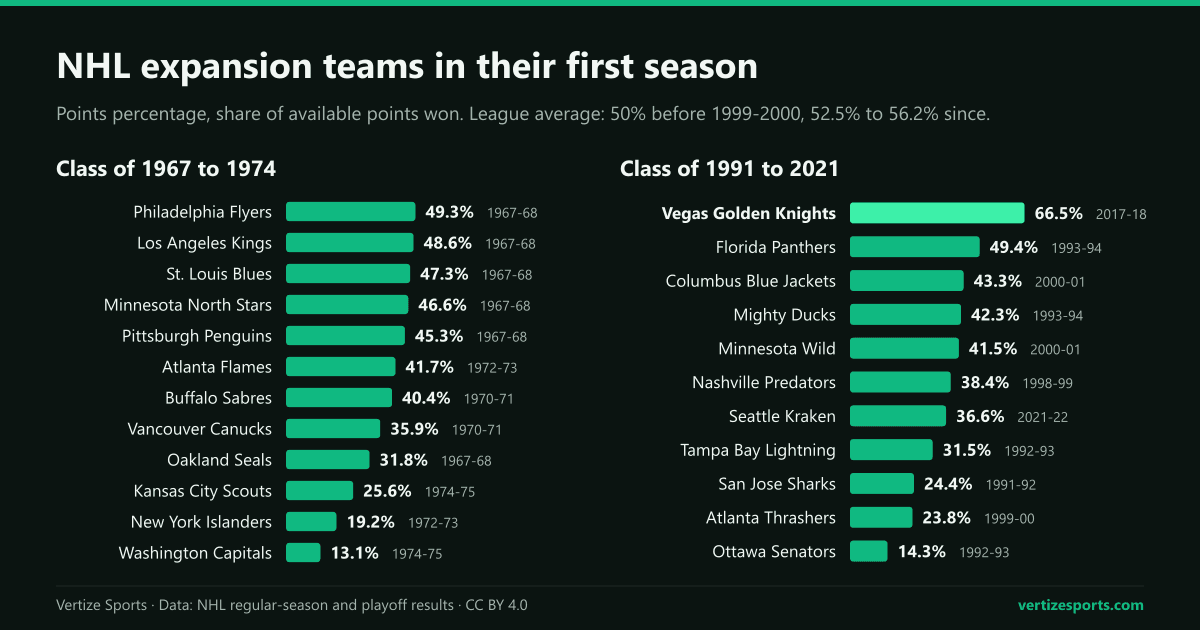
Points percentage is the share of available points a team won. It needs one adjustment across eras. Before 1999-2000 a tied game split two points, so the league average was exactly .500. Since then a team that loses in overtime or a shootout keeps a point, which lifts the average: .558 in 2017-18 and .562 last season, when the loser point handed out 326 points. The table compares each team with the average of its own season.
| Team | First season | Record | Pts % | vs. league | Playoffs, first 5 seasons | First Cup |
|---|---|---|---|---|---|---|
| Vegas Golden Knights | 2017-18 | 51-24-7 | .665 | +.106 | 4 of 5 | 2022-23 (year 6) |
| Florida Panthers | 1993-94 | 33-34-17 | .494 | -.006 | 2 of 5 | 2023-24 (year 30) |
| Philadelphia Flyers | 1967-68 | 31-32-11 | .493 | -.007 | 3 of 5 | 1973-74 (year 7) |
| Los Angeles Kings | 1967-68 | 31-33-10 | .486 | -.014 | 2 of 5 | 2011-12 (year 44) |
| St. Louis Blues | 1967-68 | 27-31-16 | .473 | -.027 | 5 of 5 | 2018-19 (year 51) |
| Minnesota North Stars | 1967-68 | 27-32-15 | .466 | -.034 | 4 of 5 | 1998-99 (year 32) |
| Pittsburgh Penguins | 1967-68 | 27-34-13 | .453 | -.047 | 2 of 5 | 1990-91 (year 24) |
| Mighty Ducks of Anaheim | 1993-94 | 33-46-5 | .423 | -.077 | 1 of 5 | 2006-07 (year 13) |
| Atlanta Flames | 1972-73 | 25-38-15 | .417 | -.083 | 3 of 5 | 1988-89 (year 17) |
| Columbus Blue Jackets | 2000-01 | 28-39-9-6 | .433 | -.092 | 0 of 5 | None |
| Buffalo Sabres | 1970-71 | 24-39-15 | .404 | -.096 | 2 of 5 | None |
| Minnesota Wild | 2000-01 | 25-39-13-5 | .415 | -.110 | 1 of 5 | None |
| Nashville Predators | 1998-99 | 28-47-7 | .384 | -.116 | 0 of 5 | None |
| Vancouver Canucks | 1970-71 | 24-46-8 | .359 | -.141 | 1 of 5 | None |
| Oakland Seals | 1967-68 | 15-42-17 | .318 | -.182 | 2 of 5 | None |
| Tampa Bay Lightning | 1992-93 | 23-54-7 | .315 | -.185 | 1 of 5 | 2003-04 (year 12) |
| Seattle Kraken | 2021-22 | 27-49-6 | .366 | -.189 | 1 of 5 | None |
| Kansas City Scouts | 1974-75 | 15-54-11 | .256 | -.244 | 1 of 5 | 1994-95 (year 21) |
| San Jose Sharks | 1991-92 | 17-58-5 | .244 | -.256 | 2 of 5 | None |
| Atlanta Thrashers | 1999-00 | 14-57-7-4 | .238 | -.287 | 0 of 5 | None |
| New York Islanders | 1972-73 | 12-60-6 | .192 | -.308 | 3 of 5 | 1979-80 (year 8) |
| Ottawa Senators | 1992-93 | 10-70-4 | .143 | -.357 | 1 of 5 | None |
| Washington Capitals | 1974-75 | 8-67-5 | .131 | -.369 | 0 of 5 | 2017-18 (year 43) |
| Utah Hockey Club* | 2024-25 | 38-31-13 | .543 | -.009 | 1 of 2 | None |
Vegas is the only team above the line. The next closest were the 1993-94 Florida Panthers, 33-34-17 with 83 points and still out of the playoffs, and the 1967-68 Philadelphia Flyers, both within .007 of the league average. At the bottom, the 1974-75 Washington Capitals went 8-67-5 for 21 points, a .131 points percentage, and the 1992-93 Ottawa Senators went 10-70-4 for .143.
Why the 1967 expansion teams made the playoffs
The 1967 records look better than they were. The six new teams played in their own West Division, and four of them qualified because 8 of the 12 teams made the playoffs that season. Against the Original Six they went 40-86-18, a .340 points percentage.
The bracket also guaranteed an expansion team a place in the Stanley Cup Final. The St. Louis Blues reached it in each of their first three seasons, each time after beating two other 1967 teams, and were swept all three times. The Blues are the only expansion team besides Vegas to play in the Final in year one; Vegas got there by winning three series against established teams before losing to the Washington Capitals in five games.
Why Vegas was different: the 2017 expansion draft rules
Under the rules the NHL published for 2017, each of the 30 existing teams could protect seven forwards, three defensemen and a goalie, or eight skaters and a goalie, and had to leave exposed at least two forwards and one defenseman under contract who had played 40 games the season before or 70 over the previous two. Vegas took one player from every team. First- and second-year professionals were exempt.
- 1967: each Original Six team protected a goalie and 11 skaters, but could add another player to its list every time it lost one, and six new teams drew 120 players from only six rosters.
- 1992: Ottawa and Tampa Bay drafted after each team protected two goalies and 14 other players.
- 2000: Columbus and the Minnesota Wild faced lists of nine forwards, five defensemen and a goalie, or seven, three and two.
- 2017: Vegas faced lists of 11 or 9 players, the shortest of the drafts above, drawn from 30 teams, against six in 1967, 21 in 1992 and 26 in 2000.
Rules do not explain everything. Seattle drafted under exactly the same rules in 2021 and went 27-49-6, 60 points and a .366 points percentage, 30th in a 32-team league. The Kraken reached the playoffs in their second season and won a round, and have not been back in the three seasons since.
How long it takes NHL expansion teams to make the playoffs
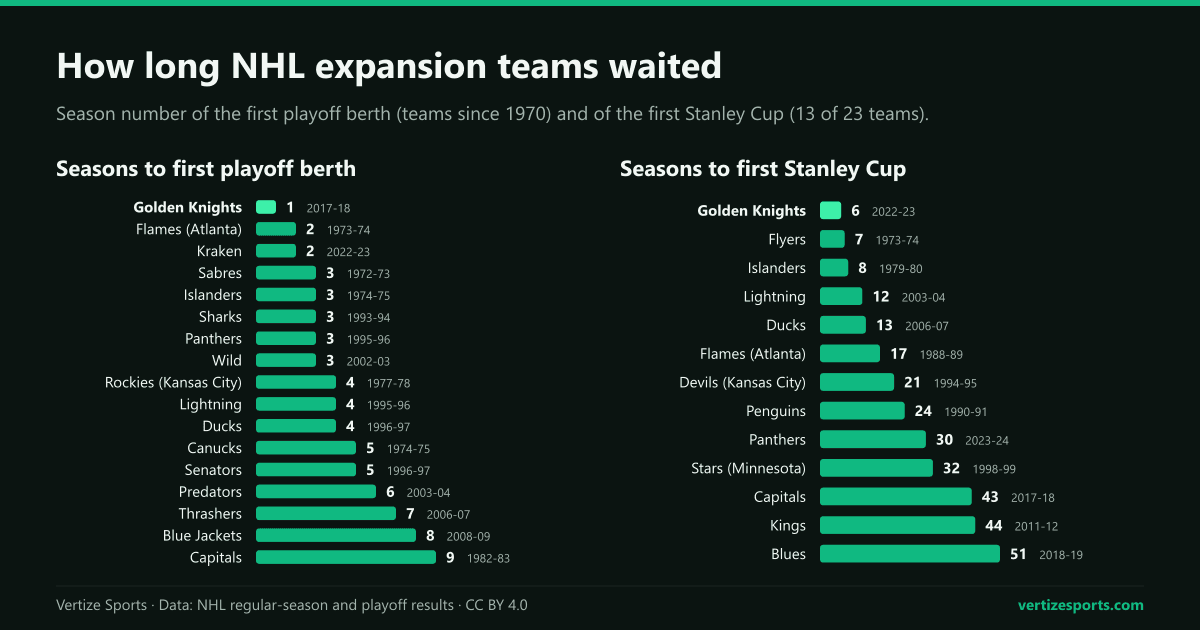
Across all 23 teams, the median first playoff berth came in season three; for the 17 that entered after 1967, in season four. Fourteen of the 23 got there within three seasons. The longest waits belong to the Capitals, nine seasons until 1982-83, the Columbus Blue Jackets, eight, the Atlanta Thrashers, seven, and the Nashville Predators, six.
- Over their first five seasons the 23 teams made the playoffs 41 times in 115 seasons.
- Vegas made it in four of five, with a .622 points percentage over that span, the best of the group. The Blues made it five of five, at .521.
- Four teams missed all five: Washington, Nashville, Atlanta and Columbus.
How long expansion teams took to win the Stanley Cup
Thirteen of the 23 franchises have won the Cup, at a median of 21 seasons. Vegas holds the record: it won in 2022-23, its sixth season, beating the Florida Panthers in five games. The Flyers won in their seventh season, 1973-74, and the New York Islanders in their eighth, 1979-80, the first of four in a row. At the other end, the Blues needed 51 seasons, until 2018-19.
Ten franchises are still waiting: the Buffalo Sabres, Vancouver Canucks, San Jose Sharks, Ottawa Senators, Predators, Thrashers (now the Winnipeg Jets), Blue Jackets, Wild and Kraken, plus the Seals franchise, which played its last season as the Cleveland Barons in 1977-78. Vegas, nine seasons old, has already reached three Finals, the latest in June 2026, when it lost to the Carolina Hurricanes in six games.
The WHA teams of 1979 and the Utah Mammoth
In 1979 the Edmonton Oilers, Hartford Whalers, Quebec Nordiques and Winnipeg Jets joined from the World Hockey Association. They held an expansion draft too, but before NHL teams reclaimed players they held rights to, each could protect up to two goalies and two skaters from its WHA roster, so they did not start from scratch. Edmonton went 28-39-13 and Hartford 27-34-19, and both made the playoffs, in a season when 16 of 21 teams did. The Oilers, with Wayne Gretzky, had a .599 points percentage over their first five seasons, .099 above the league average, the only team in this piece further above average than Vegas over its first five, and won the Cup in season five.
Utah is a new franchise on paper. The NHL created it in April 2024 and transferred the Arizona Coyotes' players, draft picks and hockey staff to it, with no expansion draft, so in practice it was a relocation. Playing as the Utah Hockey Club, it went 38-31-13 with 89 points in 2024-25, up from the Coyotes' 36-41-5 and 77 points the year before. Renamed the Utah Mammoth in May 2025, it made the playoffs in its second season and lost in the first round.
Vegas, Seattle and Utah in 2026-27
The 2026-27 season opened on Tuesday, September 29. Through the games of Monday, October 12, the Golden Knights were 5-2-0 and first in the Pacific Division, the Kraken 4-2-0 and fourth in the Pacific, and the Mammoth 4-2-0 and second in the Central, according to the NHL standings. It is too early for those records to mean much; our NHL standings update after every game, and the NHL simulator lets you play out the rest.
The pattern is not unique to hockey. In the WNBA, only one of 13 expansion teams since 1998 made the playoffs in its first season.
NHL expansion teams: frequently asked questions
What is the best first season by an NHL expansion team? The 2017-18 Vegas Golden Knights: 51-24-7, 109 points, a .665 points percentage, a division title and a trip to the Stanley Cup Final.
What is the worst first season by an NHL expansion team? The 1974-75 Washington Capitals, 8-67-5 with 21 points, a .131 points percentage. The 1992-93 Ottawa Senators were next at .143.
How long does it take an NHL expansion team to make the playoffs? The median is three seasons for all 23 teams built through an expansion draft and four for those since 1970. Since the 1967 class, only Vegas has made it in year one.
Is the Utah Mammoth an expansion team? Officially it is a new franchise, created in 2024, but it took over the Arizona Coyotes' roster instead of drafting one, so we count it as a relocation.
How this was built: regular-season records and playoff results for every NHL season from 1967-68 to 2025-26, from the NHL's stats API, grouped by franchise. Points percentage is points divided by twice the games played, compared with the league-wide figure for the same season. A playoff berth is any season with a playoff game, and a Cup is the winner of the season's last series. Draft rules come from the NHL for 2017 and 2021 and from Wikipedia for earlier drafts. The 2026-27 figures include only games finished by October 12, 2026.