We took every Super Bowl in the nflverse game file, which begins with the 1999 season, and followed both teams through the next season, with division titles from NFL.com's standings. To tell a hangover from ordinary regression, each team is then measured against what its record predicted, based on the other 777 team seasons from the same years.
How Super Bowl losers do the next season
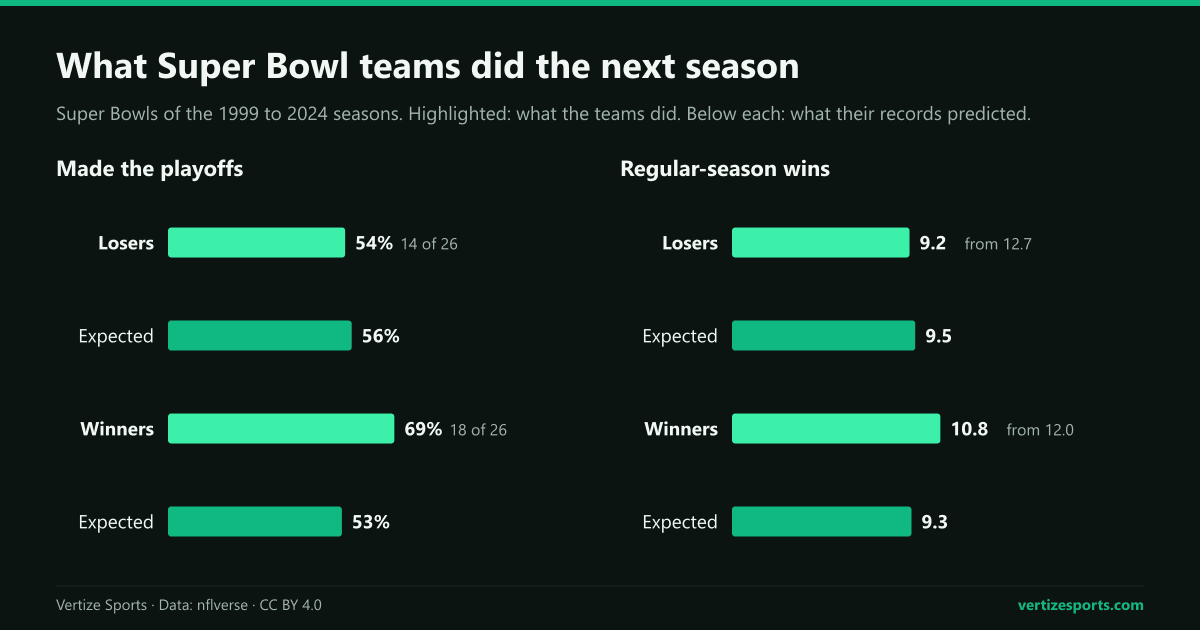
They usually go from great to good, and nearly half the time out of the playoffs. The 26 losers averaged 12.7 regular-season wins in their Super Bowl season and 9.2 the next, 3.6 fewer. In that next season, 14 made the playoffs, nine won their division, nine won at least one playoff game and 10 finished with a losing record.
- Back in the Super Bowl: one. The 2017 Patriots lost Super Bowl LII to the Philadelphia Eagles and won Super Bowl LIII a year later, 13-3 over the Los Angeles Rams.
- Missed the playoffs: 12, among them the last two before New England: the San Francisco 49ers, 6-11 in 2024, and the Kansas City Chiefs, 6-11 in 2025.
- The steepest falls, nine wins each: the Carolina Panthers from 15-1 to 6-10 after Super Bowl 50, and the Chiefs from 15-2 to 6-11 after Super Bowl LIX.
- The unbeaten loser: the 2007 Patriots went 16-0 and lost Super Bowl XLII to the New York Giants, then went 11-5 in 2008, the only team since 1999 to win 11 games and miss the playoffs.
- Three won more games the next season: the Arizona Cardinals, 9-7 then 10-6; the 49ers, 11-4-1 then 12-4; and the Cincinnati Bengals, 10-7 then 12-4.
The Super Bowl hangover, measured against their records
Some of that fall is built in. Across the other 777 team seasons from 1999 to 2024, a team's winning percentage the next season kept only about a third of its distance from .500, so a 13-4 team projects to about 10-7. The expected figures below apply that line, and a similar fit for each playoff outcome, to each Super Bowl team's record.
By that measure the losers did about what their records predicted: 9.2 wins the next season against 9.5 expected, and the playoffs 54 percent of the time against 56 percent. The gap in wins, less than half a game, is well within what chance produces in a group of 26.
| Next season | Super Bowl losers | Expected | Super Bowl winners | Expected |
|---|---|---|---|---|
| Made the playoffs | 14 (54%) | 56% | 18 (69%) | 53% |
| Won the division | 9 (35%) | 42% | 14 (54%) | 38% |
| Won a playoff game | 9 (35%) | 42% | 11 (42%) | 38% |
| Reached the Super Bowl | 1 (4%) | 16% | 6 (23%) | 14% |
| Won the Super Bowl | 1 (4%) | 10% | 2 (8%) | 8% |
| Losing record | 10 (38%) | 26% | 2 (8%) | 28% |
| Average wins | 9.2 | 9.5 | 10.8 | 9.3 |
Where the losers do trail is at the edges. At their records, about four of the 26 would have been expected to reach the next Super Bowl, and one did; about seven would have been expected to finish below .500, and 10 did. Neither gap proves a curse: if the losers had been like other teams with their records, one return or none would have happened about 6 percent of the time, and 10 or more losing seasons about 10 percent of the time.
The winners are the ones who do better than their records predict. They won 10.8 games the next season, about one and a half more than expected, a gap larger than chance usually produces, and 18 of 26 made the playoffs against about 14 expected. Two dynasties explain part of it: the Patriots and the Chiefs account for nine of the champions, and eight of those nine made the playoffs the next season. The other 17 made it 10 times, a little more than the nine their records predicted.
Super Bowl loser next-season records, and the 12 who missed the playoffs
Twelve of the 26 losers missed the playoffs, and they came in clusters. Seven of the eight from the 2000 to 2007 seasons missed the following postseason. Then nine of the next 10 made it, from the 2008 Cardinals to the 2017 Patriots, with the 2015 Panthers the exception. Since 2018, four of seven have missed.
| Season | Super Bowl | Loser | Record | Next season | Playoffs next season |
|---|---|---|---|---|---|
| 1999 | XXXIV | Tennessee Titans | 13-3 | 13-3 | Division title, lost divisional round |
| 2000 | XXXV | New York Giants | 12-4 | 7-9 | Missed |
| 2001 | XXXVI | St. Louis Rams | 14-2 | 7-9 | Missed |
| 2002 | XXXVII | Oakland Raiders | 11-5 | 4-12 | Missed |
| 2003 | XXXVIII | Carolina Panthers | 11-5 | 7-9 | Missed |
| 2004 | XXXIX | Philadelphia Eagles | 13-3 | 6-10 | Missed |
| 2005 | XL | Seattle Seahawks | 13-3 | 9-7 | Division title, lost divisional round |
| 2006 | XLI | Chicago Bears | 13-3 | 7-9 | Missed |
| 2007 | XLII | New England Patriots | 16-0 | 11-5 | Missed |
| 2008 | XLIII | Arizona Cardinals | 9-7 | 10-6 | Division title, lost divisional round |
| 2009 | XLIV | Indianapolis Colts | 14-2 | 10-6 | Division title, lost wild card round |
| 2010 | XLV | Pittsburgh Steelers | 12-4 | 12-4 | Wild card, lost wild card round |
| 2011 | XLVI | New England Patriots | 13-3 | 12-4 | Division title, lost AFC title game |
| 2012 | XLVII | San Francisco 49ers | 11-4-1 | 12-4 | Wild card, lost NFC title game |
| 2013 | XLVIII | Denver Broncos | 13-3 | 12-4 | Division title, lost divisional round |
| 2014 | XLIX | Seattle Seahawks | 12-4 | 10-6 | Wild card, lost divisional round |
| 2015 | 50 | Carolina Panthers | 15-1 | 6-10 | Missed |
| 2016 | LI | Atlanta Falcons | 11-5 | 10-6 | Wild card, lost divisional round |
| 2017 | LII | New England Patriots | 13-3 | 11-5 | Division title, won Super Bowl LIII |
| 2018 | LIII | Los Angeles Rams | 13-3 | 9-7 | Missed |
| 2019 | LIV | San Francisco 49ers | 13-3 | 6-10 | Missed |
| 2020 | LV | Kansas City Chiefs | 14-2 | 12-5 | Division title, lost AFC title game |
| 2021 | LVI | Cincinnati Bengals | 10-7 | 12-4 | Division title, lost AFC title game |
| 2022 | LVII | Philadelphia Eagles | 14-3 | 11-6 | Wild card, lost wild card round |
| 2023 | LVIII | San Francisco 49ers | 12-5 | 6-11 | Missed |
| 2024 | LIX | Kansas City Chiefs | 15-2 | 6-11 | Missed |
| 2025 | LX | New England Patriots | 14-3 | 1-2 so far | Season in progress |
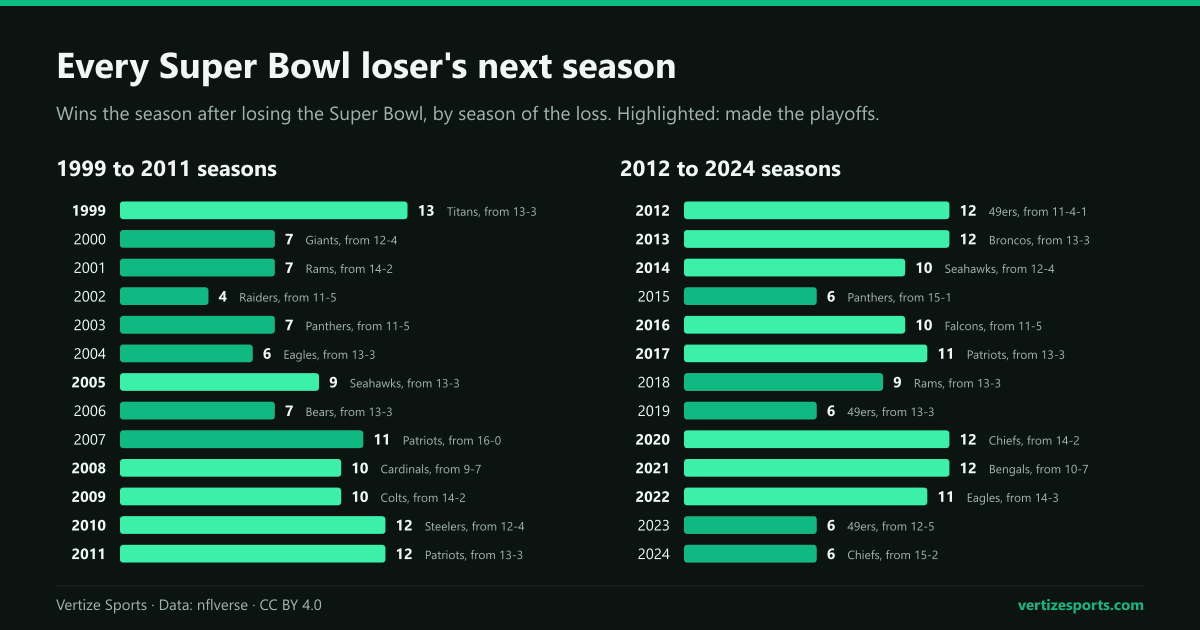
Only two of the 12 had a winning record, the 2008 Patriots at 11-5 and the 2019 Los Angeles Rams at 9-7; the other 10 finished below .500. How often NFL teams go from worst to first tracks the same kind of swing inside a division.
Super Bowl losers who won it the next year
The 2018 Patriots are the only loser since 1999 to reach the next Super Bowl, and they won it. According to the Patriots' game notes for Super Bowl LIII, that made them the third team to win a Super Bowl the year after losing one, after the Dallas Cowboys (Super Bowls V and VI) and the Miami Dolphins (VI and VII). No loser has done it since. The Buffalo Bills are the opposite case: they lost four Super Bowls in a row, the last of them to Dallas in Super Bowl XXVIII.
Winners go back far more often. Six of the 26 champions reached the next Super Bowl: the Patriots after the 2003 and 2016 seasons, the Seattle Seahawks after 2013, and the Chiefs after 2019, 2022 and 2023. Two of them won it again, the 2004 Patriots and the 2023 Chiefs, about what their records predicted.
The Patriots and the Seahawks after Week 3 of 2026
Super Bowl LX, played on February 8 at Levi's Stadium in Santa Clara, California, ended Seattle 29, New England 13. The two teams met again in the 2026 opener, in Seattle on Wednesday, September 9, and the Seahawks won 13-10.
After three weeks, NFL.com's standings have the Patriots, 14-3 last season, at 1-2: level with the New York Jets and two games behind the 3-0 Buffalo Bills in the AFC East, after a 20-3 home win over the Pittsburgh Steelers and a 35-6 loss at the Jacksonville Jaguars. The Seahawks, also 14-3 in 2025, are 2-1 and a game behind the 3-0 San Francisco 49ers in the NFC West; their loss came 33-31 at the Washington Commanders.
Three games settle little. Of the 13 Super Bowl losers that started the next season 1-2, seven still made the playoffs, among them the 2018 Patriots, who won the Super Bowl; our look at NFL starts has the playoff rate for every record after three games. In Week 4, New England plays at Buffalo and Seattle hosts the Los Angeles Chargers, both on Sunday.
The Vertize NFL simulator starts from the real standings with the 48 games played locked; you can score the 224 that remain, or let the model fill them in, and watch the playoff seeding settle. The NFL schedule lists every game.
Super Bowl losers the next season: frequently asked questions
How do Super Bowl losers do the next season? About half make the playoffs: 14 of the 26 losers from the 1999 to 2024 seasons did, nine won their division, and only the 2018 New England Patriots returned to the Super Bowl.
Is the Super Bowl hangover real? Mostly not. Super Bowl losers fall hard, from 12.7 wins to 9.2 on average, but teams with the same records fall almost as far: their records predicted 9.5 wins and a 56 percent chance of making the playoffs.
Which Super Bowl losers missed the playoffs the next season? Twelve since 1999: the New York Giants in 2001, the St. Louis Rams in 2002, the Oakland Raiders in 2003, the Carolina Panthers in 2004 and 2016, the Philadelphia Eagles in 2005, the Chicago Bears in 2007, the New England Patriots in 2008, the Los Angeles Rams in 2019, the San Francisco 49ers in 2020 and 2024, and the Kansas City Chiefs in 2025.
Has a Super Bowl loser ever won the next Super Bowl? Three times: the Dallas Cowboys in Super Bowl VI, the Miami Dolphins in Super Bowl VII and the New England Patriots in Super Bowl LIII, the only one since 1999.
How this was built: Super Bowls from the 1999 to 2025 seasons, and each team's next regular season and playoffs, come from the nflverse games file; division champions from NFL.com's standings for 2000 to 2025, whose records match nflverse's. A playoff team is one that played any postseason game; a tie counts as half a win. Expected results are fitted on the 777 team seasons from 1999 to 2024 that did not end in that season's Super Bowl: a straight line for next season's winning percentage, converted to wins, and a logistic curve for each playoff outcome. Matching each Super Bowl team with the teams within one win of its record gives the same picture. The 2026 standings and results are NFL.com's on September 30, after Week 3. Seasons had 16 games through 2020 and 17 since 2021.