Thirty clubs, thirty-four games, three points for a win and then a knockout tournament on top. MLS borrows from both sides of the Atlantic, and the result is a regular season where the table decides seeding rather than the title, and where the door into the postseason is unusually wide.
How the format works
Nine teams from each conference qualify, eighteen of thirty. The top seven go straight into a best-of-three series; eighth and ninth meet in a single Wild Card game to join them.
| Round | Who | Format |
|---|---|---|
| Wild Card | 8th v 9th | One game, hosted by the higher seed |
| Round One | Top 7 plus the Wild Card winner | Best of three; games 1 and 3 at the higher seed |
| Conference semi-finals | Four left per conference | One game, highest remaining seed hosts |
| Conference finals | Two left per conference | One game, better regular-season record hosts |
| MLS Cup | One from each conference | One game, better regular-season record hosts |
Two details matter more than they look. The Wild Card is a one-off, so a ninth-place finish is a coin toss rather than a series; and every round after it is settled in a single game hosted by the better-placed team, which turns the regular season into a fight for home advantage rather than for a trophy.
The line: about 43 points
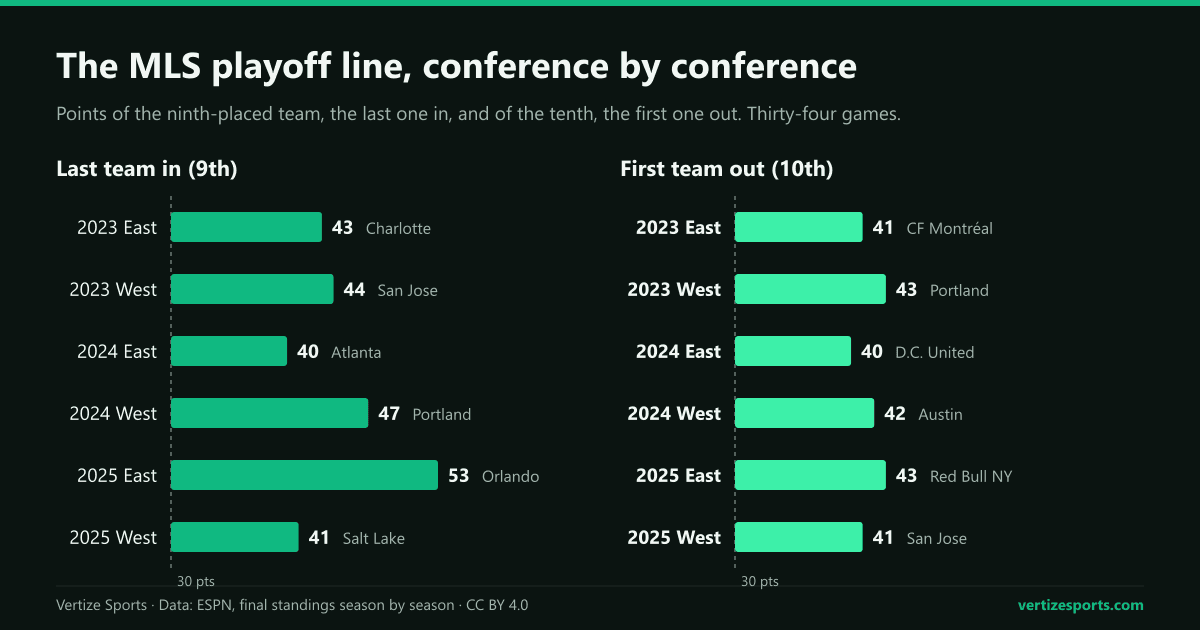
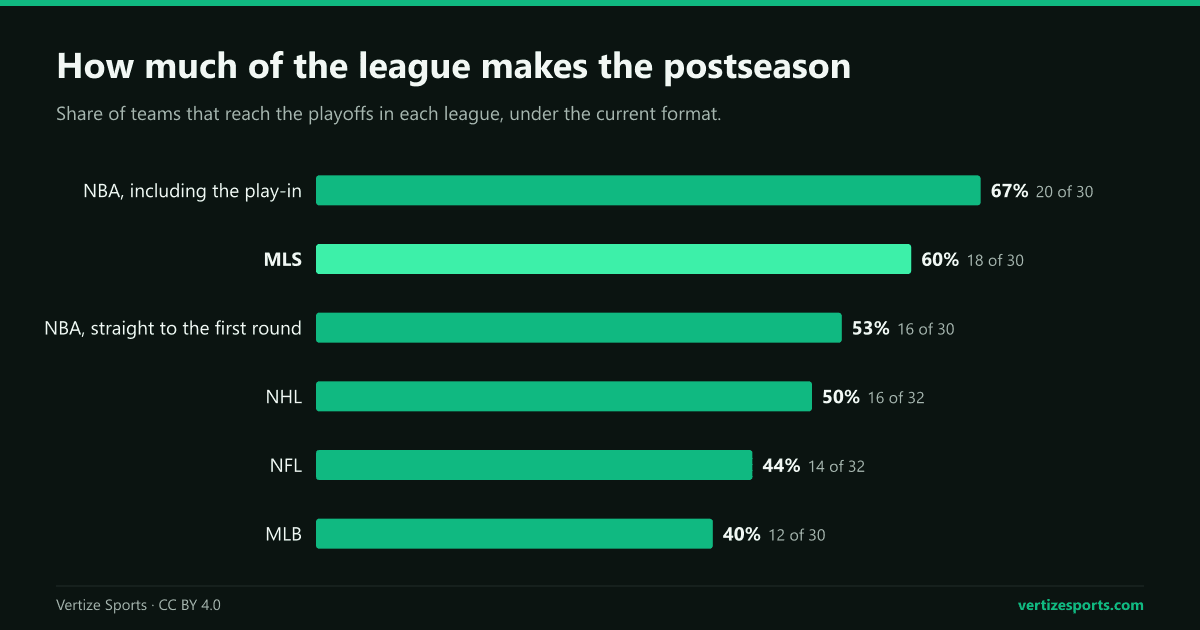
Across three completed seasons of this format, the ninth-placed team, the last one in, has finished on a median of 43.5 points out of a possible 102. That is 43 percent of the points on offer, a lower bar than any of the four big American leagues, the NBA's play-in included.
| Season | Conference | Last in (9th) | First out (10th) |
|---|---|---|---|
| 2023 | East | Charlotte, 43 pts | CF Montréal, 41 pts |
| 2023 | West | San Jose, 44 pts | Portland, 43 pts |
| 2024 | East | Atlanta, 40 pts | D.C. United, 40 pts |
| 2024 | West | Portland, 47 pts | Austin, 42 pts |
| 2025 | East | Orlando, 53 pts | Red Bull NY, 43 pts |
| 2025 | West | Salt Lake, 41 pts | San Jose, 41 pts |
The spread is wide. Atlanta United FC got in on 40 points in 2024; two years later Orlando City SC needed 53 to take the same ninth place in the Eastern Conference, 13 points more for the same reward. On the other side of the line, Portland Timbers finished 2023 on 43 points and stayed home, a total that would have been enough in three of the six conference seasons here.
That is what a short season with a wide door does: the cut moves by a dozen points depending on how the rest of the conference happens to be that year. It is the strongest argument for looking at the table you are in rather than at a number you remember from a previous season.
Seeding is what the season is really for
If the line is easy to clear, the thing worth chasing is the seed. Every round after the best-of-three is a single game hosted by the better-placed team, and in soccer that edge is real and measurable: across a full Premier League season home teams win 42.6 percent of matches against 30.0 percent for visitors, or 58.7 percent of the games that produce a winner.
So a club sitting eighth in October is not playing for qualification, which will probably arrive anyway. It is playing to avoid a one-off Wild Card game on someone else's field, and then to host as many knockout games as it can.
Why the bar is so low
Three things push it down at once. Sixty percent of the league qualifies, which is more than the NFL, the NHL or baseball let in. The season is short at thirty-four games, so a bad month does not have time to bury a team. And the three-point win means a side that draws often can bank a respectable total without winning much: forty-three points is thirteen wins and four draws, or eleven wins and ten draws.
That is the real difference between a table and a bracket. In a European league those forty-three points would be a mid-table season and nothing more; in MLS they are a ticket, and the tournament that follows starts everyone level.
Decision Day, and the calendar that is about to change
The regular season ends with Decision Day, all thirty clubs kicking off at once, on November 7 this year. The Wild Card games follow on November 18, Round One runs to December 2, and MLS Cup is on December 18.
Then the calendar turns over. MLS voted in November 2025 to align with the rest of world football: a short Sprint Season of fourteen games from February to May 2027, and from July 2027 a full summer-to-spring campaign with a winter break from mid-December to early February. The format that produced the numbers above, a thirty-four-game table feeding a nine-team field, ends with it, so treat this line as the record of a period rather than a rule for the future.
Follow the race
- The MLS table marks the playoff and Wild Card places where they fall, conference by conference.
- The MLS schedule has every game night by night, with the scores filled in as they land.
- There is no MLS simulator on the site yet: the simulators cover the leagues decided by one table, from the Premier League down to the Championship. A conference-and-bracket season needs a different model, and it is the next one on the list.
For the same question in the leagues that do have one, we counted the playoff line in the NFL, the NBA, the NHL and MLB, where the last team in has come through on as little as 8-9.
The points here are from the three completed seasons of the nine-per-conference format, 2023 to 2025, and the 2026 season is still running. A wide door and a short season make the line jumpy: treat forty-three as the middle of a range, not a target.