We counted every regular-season game since 1996-97 in NBA.com's official team game logs, plus every playoff game since 1983-84. The logs give each team's minutes: 240 for a game settled in regulation and 25 more for each five-minute overtime, which tells us how many overtimes every game had.
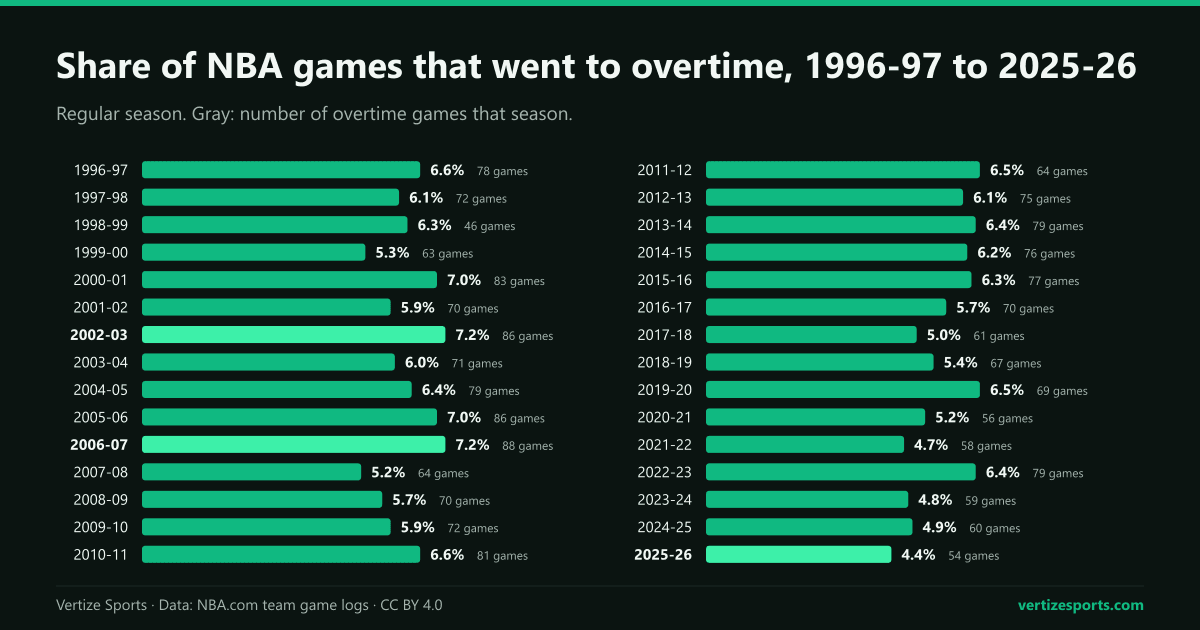
How often NBA games go to overtime, season by season
For two decades the share barely moved. Between 5.0 and 7.2 percent of games went to overtime in every season through 2020-21, 6.1 percent in all, with the peaks in 2002-03 (86 games) and 2006-07 (88). Over the last five seasons the share fell to 5.0 percent, and the four lowest of the 30 seasons have all come since 2021-22: 4.7 percent that season, 4.8 in 2023-24, 4.9 in 2024-25 and 4.4 in 2025-26. The exception was 2022-23, with 79 overtime games, 6.4 percent.
For a team, that is 4.9 overtime games in an average season against 3.6 at last season's rate. The NBA is in line with football: 6.0 percent of NFL regular-season games went to overtime from 2002 to 2025. Hockey is another matter, with a little under one game in four reaching overtime.
The likeliest reason is that results have spread out. A game can only reach overtime if it is level after 48 minutes, and that is less likely when margins vary more. The standard deviation of the margin in games decided in regulation averaged 13.3 points from 1996-97 to 2015-16 and reached 16.7 in 2025-26, the widest of the 30 seasons. Across all 30, the wider the spread, the fewer the overtimes: a correlation of −0.75. The spread grew alongside record scoring, 115.6 points per team per game in 2025-26.
NBA overtime rules: how long is overtime in the NBA
Overtime in the NBA is five minutes, with no limit on the number of periods. From the official rulebook:
- Five minutes a period. If the score is tied after the fourth quarter, play resumes after a 2:30 break, with the teams shooting at the same baskets, and further five-minute periods follow until one team leads at the end of one.
- A jump ball to start. Each overtime begins with a jump ball in the center circle, like the game itself.
- Two timeouts each per overtime period.
- Bonus after three fouls. A team's fourth team foul in an overtime period sends the opponent to the line, against the fifth in a 12-minute quarter, and a team that has not reached three fouls in the first three minutes can commit one more in the last two without penalty.
Double and triple overtime: the longest NBA games
Of the 2,113 overtime games since 1996-97:
- 292 went to at least a second overtime: 13.8 percent of overtime games, or one game in 122.
- 42 went to a third, one game in 846. There has not been one since 2021-22, which had two.
- Five went to a fourth, the most any game has needed in these 30 seasons. Three of them were played in Atlanta.
- 40.0 percent were decided by three points or fewer, and only 4.8 percent by 10 or more.
| Date | Winner | Score | Loser | Overtimes |
|---|---|---|---|---|
| November 14, 1997 | Phoenix Suns | 140-139 | Portland Trail Blazers | 4 |
| March 25, 2012 | Atlanta Hawks | 139-133 | Utah Jazz | 4 |
| December 18, 2015 | Detroit Pistons | 147-144 | Chicago Bulls | 4 |
| January 29, 2017 | Atlanta Hawks | 142-139 | New York Knicks | 4 |
| March 1, 2019 | Chicago Bulls | 168-161 | Atlanta Hawks | 4 |
| May 3, 2019 (playoffs) | Portland Trail Blazers | 140-137 | Denver Nuggets | 4 |
The longest game in NBA history is older than any of these: the Indianapolis Olympians beat the Rochester Royals 75-73 in six overtimes on January 6, 1951. Extra periods also inflate scores. The Sacramento Kings' 176-175 double-overtime win over the LA Clippers on February 24, 2023, is the second-highest-scoring game in NBA history, behind the Detroit Pistons' 186-184 triple-overtime win at Denver in 1983.
Who wins in overtime: the home team and the better team
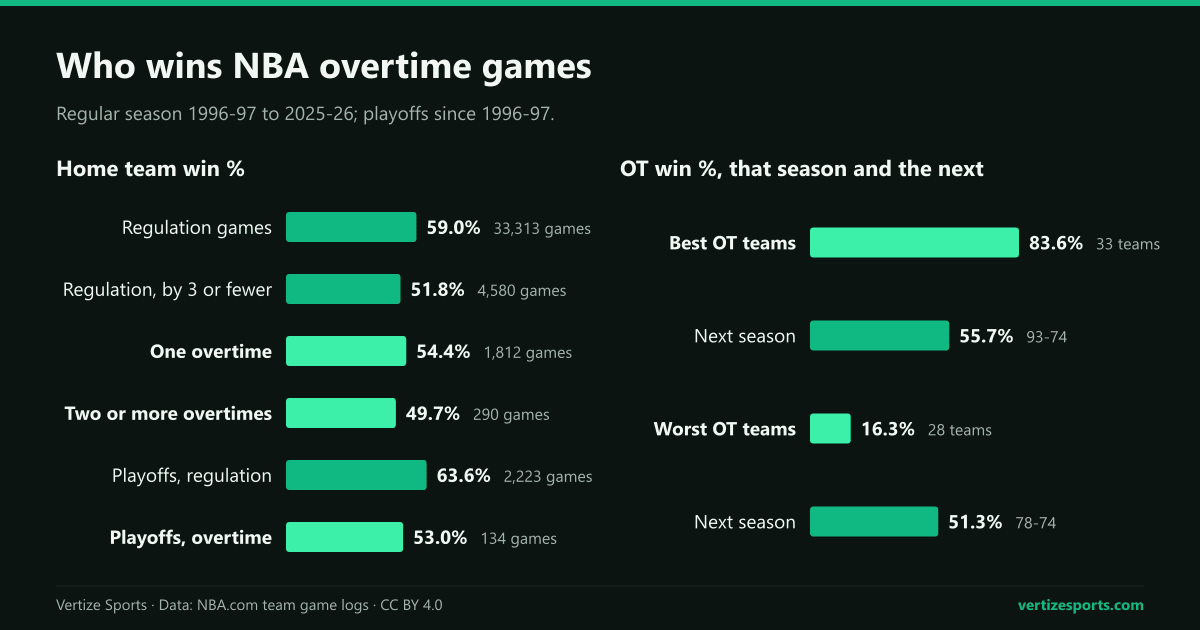
Home court counts for less in overtime. Home teams won 59.0 percent of the 33,313 regular-season games settled in regulation, but 53.7 percent of the 2,102 that went to overtime, outside neutral sites and the 2020 bubble. That brings them to the 58.7 percent overall that home teams have won since 1996-97. After one overtime, hosts won 54.4 percent; after two or more, 49.7 percent, 144 of 290 games.
Overtime sits between a close game and a full one. Home teams won 51.8 percent of regulation games decided by three points or fewer, and the team with the better point differential that season won 54.4 percent of such games,against 59.5 percent of overtime games and 68.0 percent of all games settled in regulation.
Do tired teams fade in overtime?
Not during it, but afterward. Over the 28 full seasons since 1996-97, without the shortened 2019-20 and 2020-21, we counted each team's days of rest and whether its previous game had gone to overtime. The strength-adjusted margin is the result minus the gap between the two teams' season point differentials and the home edge.
- On the second night of a back-to-back, against a rested opponent, teams won 40.3 percent of the games decided in regulation, but 48.6 percent of the 570 that went to overtime. A tired team that hangs on for 48 minutes holds up in the extra five.
- The night after an overtime game is where it shows. On a back-to-back after an overtime game, teams won 38.8 percent of 917 games, against 44.2 percent after a game settled in regulation, and their strength-adjusted margin was 1.8 points worse: −2.76 points a game against −0.99. Against a rested opponent the split was 35.9 percent and 41.1 percent.
- With at least a day off in between, the cost shrinks to about 0.5 points.
The 12 seasons in our study of NBA back-to-backs, where second-night teams won 44.2 percent, show the same split: 40.4 percent after an overtime game (319 games) and 44.4 after a regulation one.
NBA overtime record: luck or skill?
Mostly luck. Among teams that played at least five overtime games in two straight seasons, 219 pairs, the correlation between one season's overtime win percentage and the next was 0.06, close to none. For the same teams' records in regulation games it was 0.54.
The 33 team-seasons that won at least 75 percent of six or more overtime games went 199-39 in overtime, 83.6 percent, and 93-74 the next season, 55.7 percent, while their regulation record barely moved, 55.9 percent and then 54.4. The 28 worst, at 25 percent or less, went 34-175 and then 78-74.
| Team | Season | OT record | Overall record | OT record next season |
|---|---|---|---|---|
| Detroit Pistons | 2002-03 | 8-0 | 50-32 | 3-1 |
| New Orleans/Oklahoma City Hornets | 2006-07 | 7-0 | 39-43 | 4-0 |
| Cleveland Cavaliers | 2022-23 | 7-0 | 51-31 | 3-1 |
| Miami Heat | 2019-20 | 8-1 | 44-29 | 0-4 |
| Sacramento Kings | 2000-01 | 9-4 | 55-27 | 1-2 |
| Los Angeles Clippers | 2000-01 | 3-10 | 31-51 | 0-5 |
| Toronto Raptors | 2005-06 | 1-9 | 27-55 | 3-0 |
| Charlotte Hornets | 2021-22 | 0-7 | 43-39 | 1-4 |
The 2000-01 Sacramento Kings won the most overtime games in a season, nine, and they and the Los Angeles Clippers played the most, 13 each. Over all 30 seasons the Los Angeles Lakers have the best overtime record, 97-52, and the Golden State Warriors the worst, 47-80.
Overtime in the NBA playoffs
Playoff games go to overtime about as often as regular-season games: 208 of 3,375 since 1983-84, 6.2 percent. The recent drop shows there too: 18 overtime games in 422 over the last five postseasons, 4.3 percent.
- Home court fades in playoff overtime as well. Since 1997, outside the 2020 bubble, hosts won 63.6 percent of playoff games settled in regulation and 53.0 percent of the 134 that went to overtime. The team with the better regular-season point differential won 62.0 percent of regulation playoff games and 52.1 percent of overtime ones.
- The Finals have had 19 overtime games in 244 since 1984, including the Phoenix Suns' 129-121 triple-overtime win in Chicago in Game 3 in 1993. The last was Game 1 in 2018, a 124-114 Golden State Warriors win over the Cleveland Cavaliers on May 31; the eight Finals since have had none.
- The longest playoff game since 1983-84 was the Portland Trail Blazers' 140-137 win over the Denver Nuggets in four overtimes on May 3, 2019.
- The play-in tournament has had four overtime games in 36 since 2021, most recently the Charlotte Hornets' 127-126 win over the Miami Heat on April 14, 2026.
Overtime in the 2026-27 NBA season
The 2026-27 regular season starts on Tuesday, October 20, and ends on Sunday, April 11, 2027; no games have been played yet. The rule changes announced for the new season, such as NBA Cup semifinals moving to the higher seed's arena, leave overtime as it was: five-minute periods until someone wins. Every game, date and tip-off time is on the 2026-27 NBA schedule.
NBA overtime: frequently asked questions
How often do NBA games go to overtime? About one game in 17. From 1996-97 to 2025-26, 5.9 percent of regular-season games went to overtime; in 2025-26 it was 4.4 percent, 54 of 1,230 games, the lowest of the 30 seasons.
How long is overtime in the NBA? Five minutes, followed by more five-minute periods until one team leads.
What is the longest NBA game ever? Six overtimes, when the Indianapolis Olympians beat the Rochester Royals 75-73 on January 6, 1951. Since 1996-97 the longest games have gone to four overtimes, five times in the regular season, most recently the Chicago Bulls' 168-161 win in Atlanta on March 1, 2019.
Do home teams win more often in NBA overtime? A little. Home teams won 53.7 percent of regular-season overtime games since 1996-97, against 59.0 percent of games settled in regulation, and about half of the games that needed two or more overtimes.
How this was built: every NBA regular-season game from 1996-97 to 2025-26, every playoff game from 1983-84 to 2026 and every play-in game since 2021, from NBA.com's official team game logs; the number of overtimes is each team's minutes, less 240, divided by 25. Home-team figures exclude neutral-site games and the 2020 bubble, as in our home-court study. Point differentials use each team's full regular season. Rest skips each team's first game of a season. Rules from the official NBA rulebook as of October 13, 2026.