We took every playoff game from the 1990 to 2025 seasons and each team's seed in its conference. Games since 1999 come from the nflverse data, and seeds since 2002 from its standings file; both match Wikipedia's playoff pages game by game and seed by seed. Seeds for 1990 to 2001 and results for 1990 to 1998, before nflverse begins, come from those pages, such as the 1990-91 NFL playoffs.
How often the No. 1 seed wins the Super Bowl
A No. 1 seed won 16 of the 36 Super Bowls, 44 percent, and the top two seeds together won 25, or 69 percent. With two No. 1 seeds a season, each one won the title 22 percent of the time, 16 of 72, not far from the 26 percent of MLB teams with the best record since 1995.
The odds shrink round by round. A No. 1 seed's first game is a home game in the divisional round, after a bye: 74 percent won it, 51 percent then won the conference title game, and 22 percent won the Super Bowl. Nineteen of the 72, 26 percent, lost that first game.
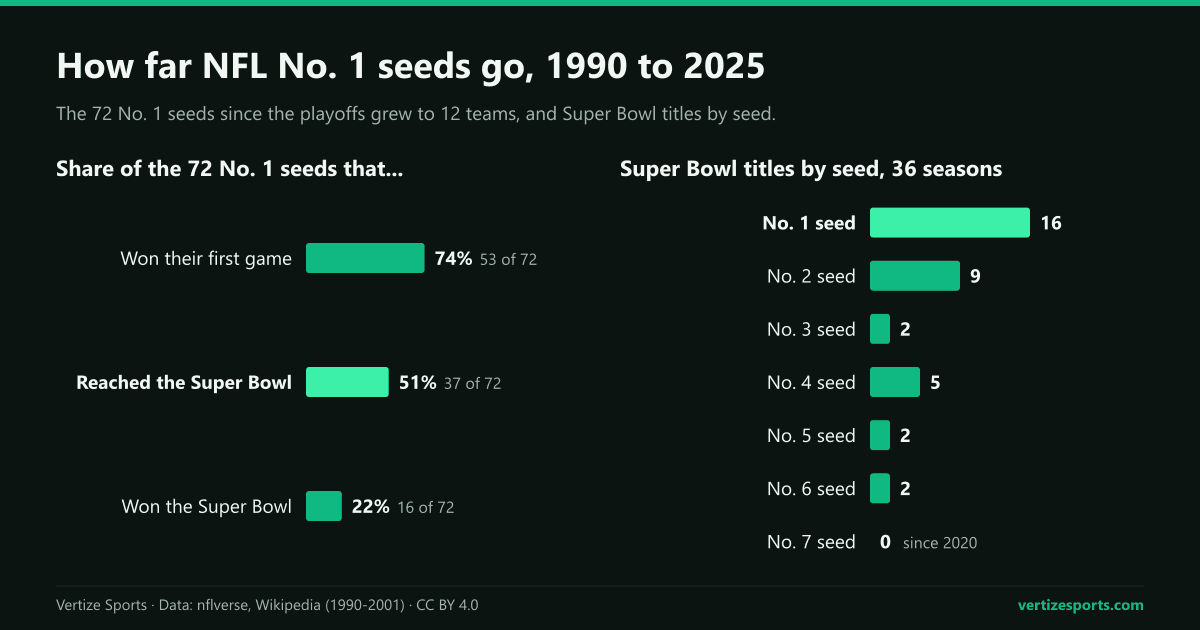
By decade of the season, No. 1 seeds won seven of the 10 Super Bowls of the 1990s, two of the 10 of the 2000s, five of the 10 of the 2010s and two of the six since 2020.
How often the No. 1 seed makes the Super Bowl
At least one No. 1 seed played in 29 of the 36 Super Bowls, and both did in eight, most recently when the Kansas City Chiefs beat the Philadelphia Eagles 38-35 after the 2022 season. In seven seasons neither got there: 1992, 1997, 2008, 2010, 2012, 2018 and 2021.
The Super Bowl itself has not favored the top seed. When a No. 1 seed met a lower seed there, the lower seed won 13 of 21 games, among them the New York Giants, a No. 5 seed, over the 18-0 New England Patriots in February 2008 and the Tampa Bay Buccaneers, also fifth, over the Chiefs in February 2021.
NFL playoff record and win percentage by seed
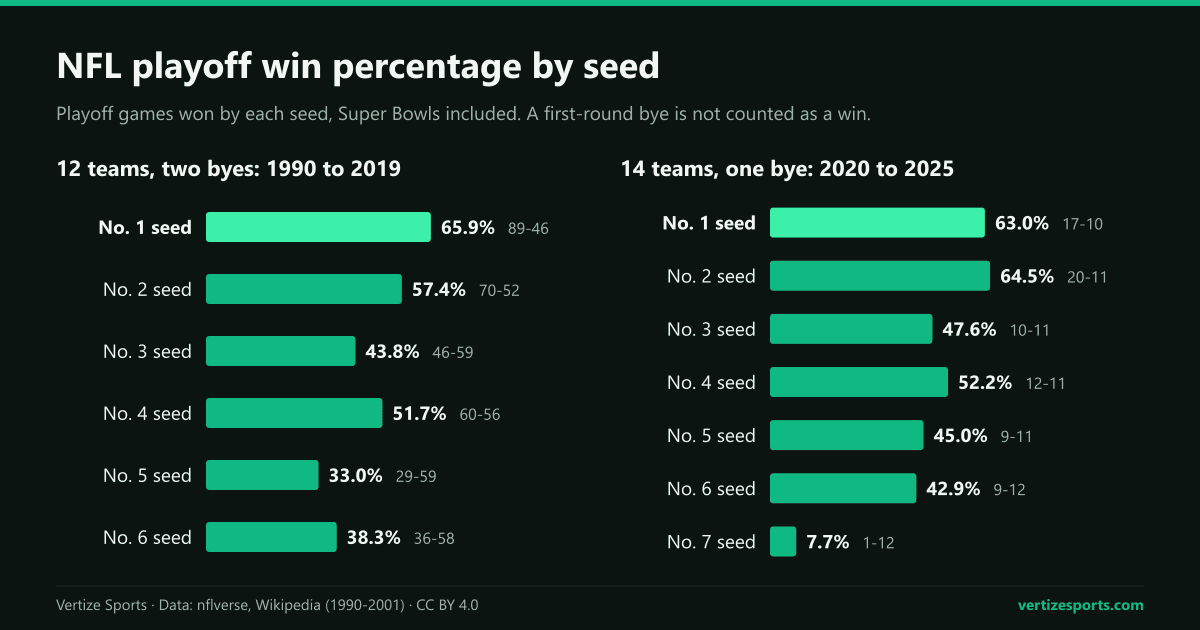
Over the 36 seasons, No. 1 seeds won 65.4 percent of their playoff games and No. 2 seeds 58.8 percent. Below them, every seed won less than it lost except the fourth, at 51.8 percent. In all games inside a conference, the better seed won 248 of 372, 67 percent: 62 percent in the wild-card round, 73 percent in the divisional round and 65 percent in conference title games.
| Seed | Teams | Playoff record | Win % | Conf. title games | Super Bowls | Titles |
|---|---|---|---|---|---|---|
| No. 1 | 72 | 106-56 | 65.4% | 53 | 37 | 16 |
| No. 2 | 72 | 90-63 | 58.8% | 51 | 19 | 9 |
| No. 3 | 72 | 56-70 | 44.4% | 12 | 3 | 2 |
| No. 4 | 72 | 72-67 | 51.8% | 12 | 9 | 5 |
| No. 5 | 72 | 38-70 | 35.2% | 8 | 2 | 2 |
| No. 6 | 72 | 45-70 | 39.1% | 8 | 2 | 2 |
| No. 7 | 12 | 1-12 | 7.7% | 0 | 0 | 0 |
Fourth seeds have done better than thirds, with nine Super Bowl trips and five titles against three and two. Some of the gap opens in the first round: from 1990 to 2019, third seeds beat sixth seeds 34 times in 60, while fourth seeds beat fifth seeds 39 times in 60. Part is history: until 2001, with three divisions per conference, the fourth seed was the best wild card, not a division winner; the 1997 Denver Broncos and the 2000 Baltimore Ravens both won the title from there.
Lowest seeds to win the Super Bowl
- No. 6 seeds, twice: the Pittsburgh Steelers after the 2005 season, over the top-seeded Seahawks, and the Green Bay Packers after 2010, over the Steelers.
- No. 5 seeds, twice: the Giants after 2007, over the top-seeded Patriots, and the Buccaneers after 2020, over the top-seeded Chiefs.
- No. 7 seeds, never past the second round: they are 1-12, and the only win came from the Packers, 48-32 at the Dallas Cowboys in January 2024, before a 24-21 loss at the San Francisco 49ers.
What one bye changed for the No. 1 and No. 2 seeds
Before 2020 the top two seeds in each conference had a bye. The 2020 expansion to 14 teams left it to the No. 1 seed alone and sent the No. 2 seed into the wild-card round against the seventh. Since then No. 2 seeds have won those games 11 times in 12.
The top seed has kept about the same record: No. 1 seeds won 65.9 percent of playoff games from 1990 to 2019 and 63.0 percent since, and reached the Super Bowl at almost the same rate, 52 percent then and six of 12 now. No. 2 seeds went from 17 Super Bowl trips in 60 chances, 28 percent, to two in 12, even though their win rate rose to 64.5 percent with those games against seventh seeds. Six seasons are not enough to separate the bye from chance.
| Seed | Teams | Playoff record | Win % | Conf. title games | Super Bowls | Titles |
|---|---|---|---|---|---|---|
| No. 1 | 12 | 17-10 | 63.0% | 9 | 6 | 2 |
| No. 2 | 12 | 20-11 | 64.5% | 6 | 2 | 1 |
| No. 3 | 12 | 10-11 | 47.6% | 3 | 1 | 1 |
| No. 4 | 12 | 12-11 | 52.2% | 2 | 2 | 1 |
| No. 5 | 12 | 9-11 | 45.0% | 2 | 1 | 1 |
| No. 6 | 12 | 9-12 | 42.9% | 2 | 0 | 0 |
| No. 7 | 12 | 1-12 | 7.7% | 0 | 0 | 0 |
Three of the 12 No. 1 seeds since 2020 lost their first game: both of them after the 2021 season, the Tennessee Titans and the Packers, and the Detroit Lions after 2024. The Chiefs were the AFC's top seed three times, and won the Super Bowl once from there.
| Season | Conf. | No. 1 seed | Record | How it ended |
|---|---|---|---|---|
| 2020 | AFC | Kansas City Chiefs | 14-2 | Lost the Super Bowl |
| 2020 | NFC | Green Bay Packers | 13-3 | Lost the conference title game |
| 2021 | AFC | Tennessee Titans | 12-5 | Lost its first game |
| 2021 | NFC | Green Bay Packers | 13-4 | Lost its first game |
| 2022 | AFC | Kansas City Chiefs | 14-3 | Won the Super Bowl |
| 2022 | NFC | Philadelphia Eagles | 14-3 | Lost the Super Bowl |
| 2023 | AFC | Baltimore Ravens | 13-4 | Lost the conference title game |
| 2023 | NFC | San Francisco 49ers | 12-5 | Lost the Super Bowl |
| 2024 | AFC | Kansas City Chiefs | 15-2 | Lost the Super Bowl |
| 2024 | NFC | Detroit Lions | 15-2 | Lost its first game |
| 2025 | AFC | Denver Broncos | 14-3 | Lost the conference title game |
| 2025 | NFC | Seattle Seahawks | 14-3 | Won the Super Bowl |
The 2025 No. 1 seeds and Super Bowl LX
Both top seeds of the 2025 season went 14-3, the Denver Broncos in the AFC and the Seahawks in the NFC. Denver beat the Buffalo Bills 33-30 and then lost the AFC Championship Game at home, 10-7, to the No. 2 seed, the Patriots, who had also gone 14-3.
Seattle beat the 49ers 41-6 and the Los Angeles Rams 31-27, then beat New England 29-13 in Super Bowl LX. The Seahawks were the first No. 1 seed to win the title since the Chiefs after the 2022 season. The Patriots' next season is followed in our look at Super Bowl losers.
The 2026 playoff picture
With Week 4 of the 2026 season under way, no seed is set: the seven places in each conference are decided only at the end of the regular season, and records alone may not settle them, as our guide to the NFL tiebreakers shows. The Vertize NFL simulator starts from the real standings and lets you play out the rest of the season to see how the seeds could fall.
Seeding also decides who hosts. Since 1999, home teams have won 64.4 percent of playoff games before the Super Bowl, as counted in our study of NFL home-field advantage, and a No. 1 seed hosts every game until the Super Bowl.
No. 1 seed and Super Bowl: frequently asked questions
How often does the No. 1 seed win the Super Bowl? A No. 1 seed won 16 of the 36 Super Bowls from the 1990 to 2025 seasons, 44 percent. Each individual No. 1 seed won it 22 percent of the time, 16 of 72.
How often does the No. 1 seed make the Super Bowl? 37 of 72 No. 1 seeds did, 51 percent, and at least one of the two reached it in 29 of the 36 seasons.
What is the lowest seed to win the Super Bowl? The sixth: the 2005 Steelers and the 2010 Packers. No seventh seed has reached the conference title game.
Has a No. 7 seed ever won a playoff game? Once in 12 tries: the 2023 Packers beat the second-seeded Cowboys 48-32.
How often does a No. 1 seed lose its first playoff game? 19 times in 72, 26 percent, always in the divisional round after a bye; three of them came since 2020.
How this was built: every playoff game of the 1990 to 2025 seasons, 408 in all, and every playoff team's seed. Games from 1999 on come from the nflverse games file, downloaded on September 30, 2026, and seeds from 2002 on from the nflverse standings file, downloaded on October 3, 2026; Wikipedia's playoff page for each season supplied seeds for 1990 to 2001 and results for 1990 to 1998, and matched nflverse in all 309 games and 24 seasons both cover. A bye is not counted as a win. Win percentages include the Super Bowl; better-seed comparisons use only games inside a conference.