We counted every try after a touchdown since 1999 in nflverse's play-by-play data: 34,400 in the regular season through 2025, extra-point kicks and two-point attempts alike, with game types and results from the nflverse games file. A two-point attempt succeeds when the offense reaches the end zone; the score we use for each decision includes the touchdown just scored, as the coach sees it.
NFL two-point conversion success rate by season
Single seasons are noisy, with only 50 to 155 attempts a year: from 36.9 percent in 1999 and 40.7 in 2024 to 55.3 in 2006 and 55.1 in 2023. Pooled, the eras look alike: 46.9 percent from 1999 to 2014, 47.7 percent from 2015 to 2025 and 47.5 percent from 2021 to 2025.
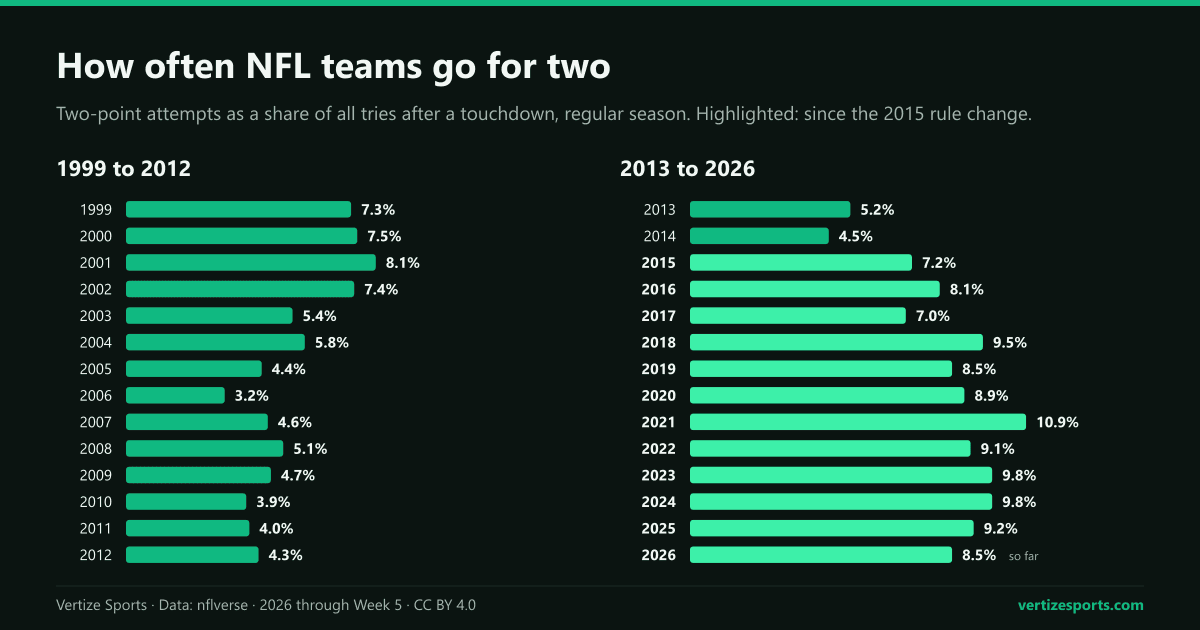
What moved is the share of tries that are two-point attempts. It fell from 7.3 percent in 1999 to 3.2 percent in 2006 and stayed under 6 percent every season from 2003 to 2014. Since 2015 it has been at least 7 percent every year, above every season of that stretch, and it peaked at 10.9 percent in 2021, with 154 attempts.
| Season | Tries | Two-point attempts | Share | Converted | Success rate | Extra points made | Points per try: kick | Points per try: go for two |
|---|---|---|---|---|---|---|---|---|
| 1999 | 1,143 | 84 | 7.3% | 31 | 36.9% | 98.9% | 0.989 | 0.738 |
| 2006 | 1,176 | 38 | 3.2% | 21 | 55.3% | 98.8% | 0.988 | 1.105 |
| 2014 | 1,289 | 58 | 4.5% | 28 | 48.3% | 99.3% | 0.993 | 0.966 |
| 2015 | 1,311 | 94 | 7.2% | 45 | 47.9% | 94.2% | 0.942 | 0.957 |
| 2018 | 1,365 | 130 | 9.5% | 66 | 50.8% | 94.3% | 0.943 | 1.015 |
| 2021 | 1,411 | 154 | 10.9% | 75 | 48.7% | 93.4% | 0.934 | 0.974 |
| 2023 | 1,296 | 127 | 9.8% | 70 | 55.1% | 95.9% | 0.959 | 1.102 |
| 2024 | 1,376 | 135 | 9.8% | 55 | 40.7% | 95.8% | 0.958 | 0.815 |
| 2025 | 1,390 | 128 | 9.2% | 59 | 46.1% | 95.9% | 0.959 | 0.922 |
| 2026 (through Week 5) | 410 | 35 | 8.5% | 20 | 57.1% | 94.4% | 0.944 | 1.143 |
The 2015 extra-point rule and the two-point break-even
The NFL adopted the two-point conversion at its annual meeting in Orlando on March 22, 1994, in a package of rule changes; the AFL had used the play since its first season in 1960. Through 2014 the extra point was close to automatic, and in 2015 owners voted 30-2 to snap it from the 15-yard line, with two-point tries left at the 2.
- The kick got longer: the typical extra point went from 20 yards to 33 in our data, every season since 2015.
- Kickers missed more: 99.3 percent of extra points were good in 2014 and 94.2 percent in 2015; every season since has been under 96 percent, and every season from 1999 to 2014 was above 98.
- Teams went for two more: 58 attempts in 2014, 94 in 2015, and never fewer than 86 since.
- The defense can score: the same rule gives the defense two points if it returns a blocked kick or a failed two-point try to the other end zone.
That rule made the choice a near coin flip. A kick is worth its success rate in points, a two-point try twice its rate. From 1999 to 2014 that was 0.988 points for the kick and 0.938 for going for two; from 2021 to 2025, 0.951 against 0.950. Going for two now breaks even at 47.6 percent, almost exactly what teams convert, and it returned more per try in seven of the 11 seasons since 2015, though not in 2025, 0.922 to 0.959. Our count of NFL scoring by season shows the same rule from the points side.
Two-point conversion: run vs pass
Runs work better, and teams mostly pass. From 1999 to 2025, runs converted 55.4 percent of 659 two-point attempts and passes 44.2 percent of 1,704, yet 72 percent of attempts were passes. From 2021 to 2025 the split was the same: 56.4 percent against 44.0, with passes still 72 percent of calls. The same pattern shows up on fourth-and-1, where runs beat passes too.
When to go for two: down 8, down 14 and late in close games
Per try the two choices are worth the same, so the scoreboard decides. A few spots in the fourth quarter have always called for two: down 2 after the touchdown, to tie; up 1, to lead by a field goal; down 5, to pull within a field goal. Teams went for two in those spots about nine times in ten from 1999 to 2014, and in every one of the 49 times they were down 2 and the 49 times they were up 1 from 2021 to 2025.
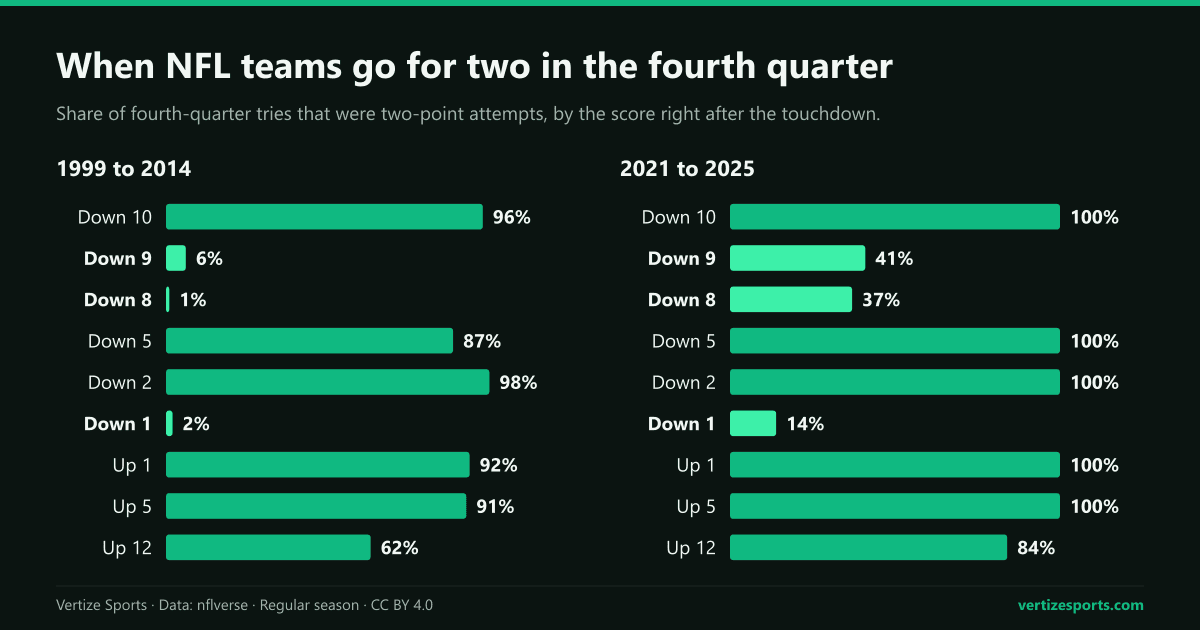
The big change is down 8, where a team trailing by 14 lands after its first touchdown. The old habit was to kick and trail by 7. The analytics case is to go for two first: make it, and the next touchdown plus a kick wins; miss it, and a second two-point try can still tie. With the 2021-2025 rates, if the trailing team scores both touchdowns, the opponent scores nothing else and overtime is a coin flip, going for two first wins about 59 percent of the time and kicking first about 46 percent.
Teams have come around. From 1999 to 2017 they went for two down 8 in the fourth quarter twice in 288 chances. From 2021 to 2025 they did it 28 times in 75, 37.3 percent, and converted 16, 57 percent. In 2025, 9 of 17 teams in that spot went for two, the first season since at least 1999 above half. Down 9 and down 1 moved the same way. Eight points is the most one possession can erase, and about half of all NFL games end within that margin.
Earlier in games, teams went for two on 1.9 percent of tries in the first three quarters from 1999 to 2014 and 4.6 percent from 2021 to 2025; 112 of those 220 recent attempts came from teams that were behind.
Which NFL teams go for two the most
From 2021 to 2025 the New York Jets went for two most often, on 30 of 156 tries, 19.2 percent, and converted 18. The Arizona Cardinals made the most attempts, 34. The San Francisco 49ers went for two least often, 10 times in 254 tries, 3.9 percent, and the Tennessee Titans made the fewest attempts, 8.
| Team | Tries | Two-point attempts | Share | Converted | Win percentage |
|---|---|---|---|---|---|
| New York Jets | 156 | 30 | 19.2% | 18 | 30.6% |
| Arizona Cardinals | 206 | 34 | 16.5% | 13 | 35.3% |
| New York Giants | 166 | 26 | 15.7% | 12 | 31.2% |
| Washington Commanders | 205 | 32 | 15.6% | 14 | 42.9% |
| Chicago Bears | 190 | 29 | 15.3% | 11 | 37.6% |
| Cleveland Browns | 184 | 28 | 15.2% | 16 | 40.0% |
| Seattle Seahawks | 223 | 13 | 5.8% | 6 | 57.6% |
| Los Angeles Rams | 232 | 13 | 5.6% | 6 | 57.6% |
| Tennessee Titans | 174 | 8 | 4.6% | 7 | 36.5% |
| San Francisco 49ers | 254 | 10 | 3.9% | 4 | 62.4% |
The list is mostly a list of teams that spent a lot of time behind. The eight teams that went for two most often won 39 percent of their games from 2021 to 2025, and all eight had losing records; the eight that did it least won 56 percent. The single season with the most attempts since 1999 belongs to the 2020 Philadelphia Eagles, 16, of which they converted 7.
When the defense scores two points
Since 2015, defenses have returned a try to the other end zone for two points 16 times, 15 in the regular season and one in the playoffs: 10 returns of blocked kicks and 6 of failed two-point tries. Only two decided a game, both in 2016. In New Orleans, the Denver Broncos' Will Parks returned a blocked extra point with the score tied at 23, and Denver won 25-23. A few weeks later the Atlanta Falcons went for two leading 28-27, and the Kansas City Chiefs' Eric Berry intercepted the pass and ran it back; Kansas City won 29-28.
Two-point conversions in the 2026 NFL season so far
Through Week 5, which ended with the Buffalo Bills' 37-34 win over the Los Angeles Rams on Monday night, teams went for two on 35 of 410 tries, 8.5 percent, and converted 20, 57.1 percent. That share is a little behind 2025, 9.6 percent after five weeks, and lower at this point than every season since 2015 except 2016, 2017 and 2019. Kickers made 94.4 percent of extra points.
The Denver Broncos are 3 for 3, the Buffalo Bills and the Las Vegas Raiders have also tried three times, and 10 teams have not tried at all. Down 8 in the fourth quarter, three of five teams went for two. The NFL schedule has every result so far, and the Vertize NFL simulator lets you pick the remaining games and see the standings that follow.
NFL two-point conversions: frequently asked questions
What is the NFL two-point conversion success rate? About 47 percent: 47.4 percent of attempts in the regular season from 1999 to 2025, 46.1 percent in 2025 and 57.1 percent in 2026 through Week 5. Runs convert more often than passes, 55.4 percent to 44.2 percent since 1999.
Is it better to go for two or kick the extra point? Per try it is a wash: from 2021 to 2025 a kick returned 0.951 points and a two-point attempt 0.950. The score decides. Down 2 or up 1 late, teams always go for two; down 8, going for two first gives a better chance of winning than kicking.
When did the NFL start the two-point conversion? In 1994. The extra point moved back to the 15-yard line in 2015, with two-point tries still snapped from the 2, and since then the defense scores two points on a return.
How this was built: every try after a touchdown in the NFL regular season and playoffs from 1999 to 2026, from the play-by-play in nflverse-data, with game types and finished games checked against the nflverse games file. A try is a play flagged as an extra-point kick or a two-point attempt, including the few with a penalty enforced on the next kickoff; a botched snap on a kick counts as a missed extra point. Run or pass is how nflverse records the play. A few early games have no play-by-play in nflverse. The 2026 figures cover all 79 games of Weeks 1 to 5, played by 12 October 2026, and every final score matches the games file. The figures above are regular season; in the playoffs from 2015 to 2025 teams went for two on 11.5 percent of tries and converted 47.6 percent.